Why Some Precision Milling Center Factories Miss Tolerance
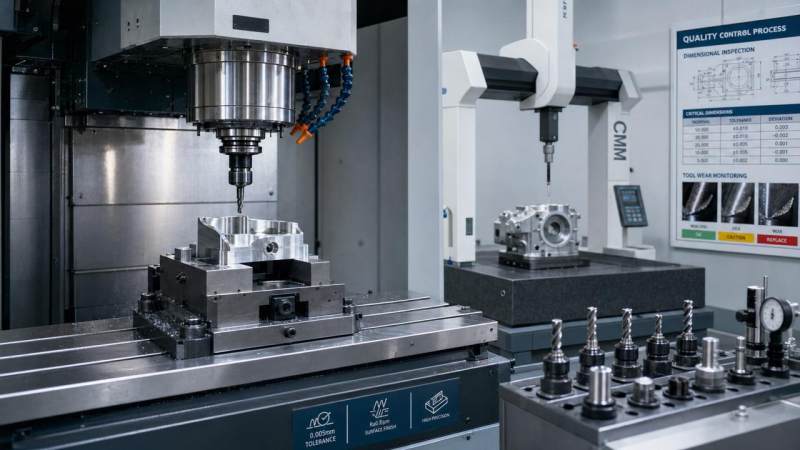
Why do some buyers still face out-of-spec parts from a precision milling center factory despite advanced machines and certifications? For quality and safety managers, missed tolerance is rarely a single error—it often signals deeper issues in process control, tooling, inspection discipline, and shop-floor execution. This article explains the root causes and what to verify before production risk turns into compliance, downtime, or costly rejection.
Why can a precision milling center factory miss tolerance even with modern CNC equipment?
A common assumption is that a newer 4-axis or 5-axis machine automatically guarantees dimensional accuracy. In reality, a precision milling center factory can own advanced equipment and still deliver unstable results if the entire manufacturing system is not controlled. Tolerance performance depends on machine condition, fixture stability, cutting strategy, thermal behavior, tool life management, material consistency, measurement method, and operator discipline.
For quality control personnel, the key point is this: tolerance failure is often systemic rather than accidental. A machine may be capable of holding microns in a short test cut, but production conditions are different. Long cycles, multiple setups, heat buildup, tool wear, coolant inconsistency, and part deformation can all shift dimensions over time. A factory may pass first article inspection yet fail later in the batch because process capability was never truly stable.
Safety managers should also pay attention. Out-of-tolerance parts do not only create scrap. In assemblies involving rotating systems, press fits, sealing faces, fluid pathways, or structural interfaces, dimensional drift can lead to leakage, vibration, early wear, overheating, or even field failure. That is why evaluating a precision milling center factory requires more than checking machine brands or certificates on a wall.
What are the most common root causes behind tolerance problems?
Most tolerance issues come from a small number of recurring weak points. The best suppliers control them proactively; weaker factories react only after rejection. Buyers should investigate the following causes early.
1) Machine accuracy is not the same as process capability
A machine can have acceptable positioning accuracy on paper but still produce variation in real cutting. Ball screw backlash, spindle runout, axis squareness error, and vibration may remain within serviceable limits while still pushing critical dimensions beyond specification under load. If the precision milling center factory does not perform periodic capability checks using actual production materials and cycle conditions, it may rely too heavily on nominal machine specifications.
2) Tooling and wear control are poorly managed
Tool wear is one of the fastest ways to lose tolerance. End mills, inserts, and drills gradually change cutting forces and dimensional output. If tool offsets are not updated at the right interval, dimensions drift. In shops with weak control, replacement decisions are based on operator judgment rather than tool life data, spindle load trend, or surface finish signals. This creates inconsistency from shift to shift.
3) Fixture design allows movement or distortion
A rigid machine cannot save a weak clamping method. Thin-wall parts, long components, aluminum structures, and complex profiles are especially vulnerable. Excessive clamping force can distort the part during machining; insufficient force can allow micro-movement. Once unclamped, the part may spring back and fail inspection. A capable precision milling center factory designs fixtures around datum integrity, repeatability, and controlled load paths rather than simple holding convenience.
4) Thermal control is underestimated
Temperature affects the machine, the cutting tool, and the workpiece. During long runs, spindle heat, ambient fluctuations, and coolant temperature shifts can change actual dimensions. This matters even more for tight tolerance parts, dissimilar materials, and large workpieces. Some factories inspect parts in a cooler room after machining them hot on the machine, creating measurement differences that are not properly compensated.
5) Inspection discipline is weaker than the machining capability
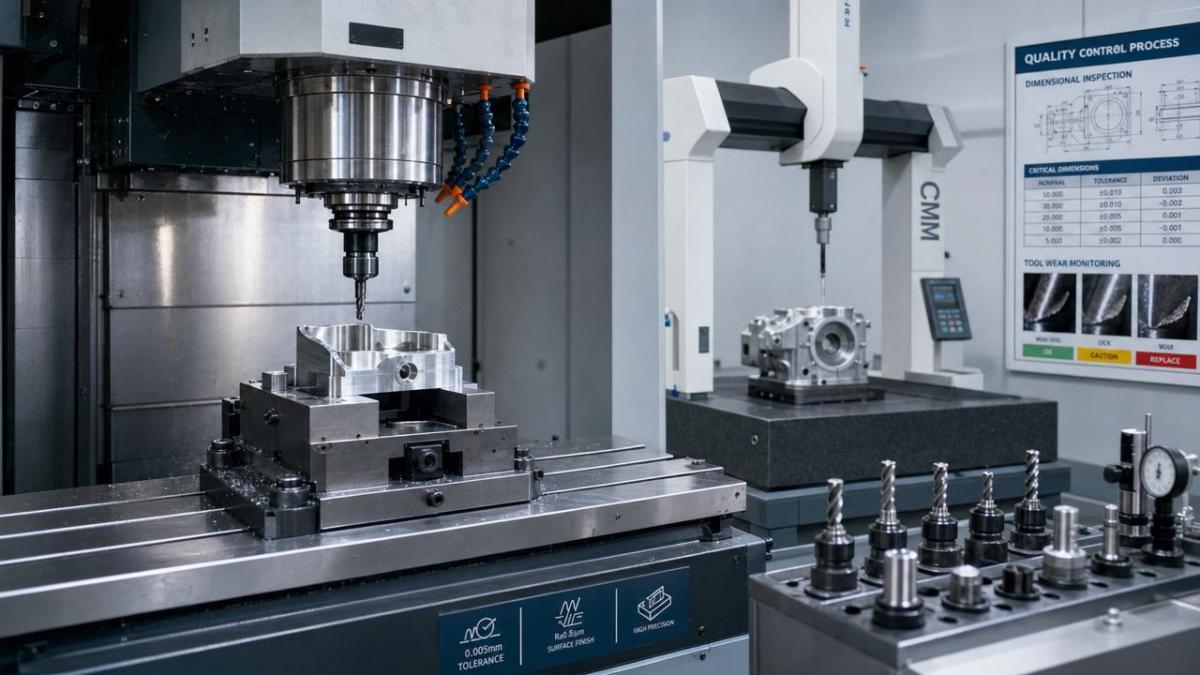
Many buyers focus on cutting capacity but forget metrology maturity. A precision milling center factory may own a CMM, but if calibration status, gauge R&R, measurement program validation, sampling frequency, and datum interpretation are weak, inspection will not prevent defects. Some factories measure only final dimensions and ignore in-process checkpoints, meaning deviations are discovered too late to protect the batch.
6) Process instructions are not followed consistently
Even strong process plans fail if setup sheets, offset protocols, inspection routes, and revision controls are not followed on the floor. Operator turnover, poor training, undocumented manual adjustments, and weak first-piece approval practices create hidden variation. This is a major warning sign for any quality or safety manager reviewing a supplier.
How can quality managers tell whether a tolerance issue is isolated or systemic?
The fastest way is to look beyond the rejected dimension and trace the process evidence. If one feature is bad but all related controls were active and recorded, the event may be isolated. If records are incomplete, inspection timing is irregular, and tool or setup changes were not documented, the issue is probably systemic.
Ask the precision milling center factory for objective proof instead of verbal assurance. Useful evidence includes first article reports, control plans, in-process inspection records, machine capability checks, tool life logs, nonconformance history, corrective action closure data, and traceability by lot and operator. The goal is not to collect paperwork for its own sake. The goal is to see whether the factory can explain why the part stayed in control—or why it went out of control.
Which questions should buyers ask a precision milling center factory before approving production?
For procurement teams working with quality and safety functions, the smartest approach is to ask questions that reveal process maturity. Good suppliers can answer clearly, with records. Weak ones stay general and shift the conversation back to equipment lists.
Ask about capability, not just capacity
How does the factory prove it can hold the required tolerance across the full batch, not just on a sample? What Cp or Cpk data exists for similar features? How are critical characteristics identified and monitored? If the answer is limited to “our machine is imported” or “we have experienced operators,” the risk remains high.
Ask about setup repeatability
Can the precision milling center factory reproduce the same result after tool change, operator change, or fixture reset? Repeatability across events is a stronger sign of control than one successful run. This is especially important for multi-operation parts and recurring orders.
Ask about inspection logic
Which dimensions are inspected on-machine, which are checked offline, and how often? How are datums established? What happens if a result trends toward the upper or lower limit? Strong factories intervene before nonconformance appears; weak ones inspect after the risk has already materialized.
Ask about change control
If a cutting parameter, insert grade, fixture element, coolant type, or subcontracted step changes, how is the risk reviewed? For regulated or safety-sensitive sectors, uncontrolled changes can invalidate qualification assumptions. A reliable precision milling center factory treats process changes as formal events, not informal shop decisions.
What mistakes do buyers make when evaluating a precision milling center factory?
One major mistake is overvaluing certifications without checking daily execution. ISO certification supports system discipline, but it does not prove every operator, setup, or inspection routine is effective at the point of manufacture. Another mistake is focusing only on quotation and lead time. A lower unit price can become expensive if parts require sorting, rework, line stoppage, or customer complaint handling.
Buyers also underestimate drawing clarity. If tolerance chains, datum schemes, burr limits, surface finish expectations, edge break requirements, or inspection method assumptions are ambiguous, even a competent factory may produce the wrong result. The precision milling center factory is responsible for review and clarification, but the customer should still ensure that technical requirements are complete and prioritized.
A further error is ignoring part application. Some dimensions are technically within print but functionally unsafe if related geometric tolerances, sealing surfaces, flatness, perpendicularity, or residual stress are not controlled. Quality and safety managers should evaluate tolerance not only as a drawing issue, but as a performance and risk issue.
How should quality and safety managers reduce risk before mass production starts?
The most effective step is a structured pre-production validation process. Start with technical review, then pilot build, then measured approval criteria. Do not move directly from supplier promise to full-volume release. For critical parts, require a process flow, PFMEA logic, control plan, fixture concept, and inspection plan before launch.
During pilot production, confirm whether the precision milling center factory can maintain tolerance across multiple pieces, not just one golden sample. Review actual measurement spread, not only pass/fail status. A narrow tolerance with a process centered near one limit is still unstable. Also review surface integrity, burr behavior, tool marks, and hidden risks such as distortion after anodizing, heat treatment, or assembly.
For safety-sensitive components, establish escalation rules in advance. Define what triggers containment, sorting, re-inspection, production hold, or customer notification. When a factory knows that deviation handling is formal and traceable, discipline usually improves. This protects both compliance and operational uptime.
What should be verified first if you are comparing suppliers right now?
If you are screening a precision milling center factory for a new project, verify four things first: the ability to hold your specific critical tolerances, the reliability of the measurement system, the repeatability of the setup process, and the discipline of nonconformance control. These four areas reveal far more than a generic capability brochure.
In practical terms, ask for a sample quality package from a similar part family, not just a company presentation. Review how the supplier defines critical features, how it reacts to trend data, how it documents offsets and tool changes, and how it prevents mixed lots or undocumented rework. A trustworthy precision milling center factory will be comfortable discussing process evidence in detail because control is part of its normal operating rhythm.
If further confirmation is needed on specific machining routes, tolerances, validation plans, inspection frequencies, production lead times, quotation assumptions, or cooperation models, the best next conversation should focus on these exact points before order release: which features are function-critical, what capability evidence already exists, what controls will be added for your project, how deviations will be escalated, and who owns final approval at each production stage.
Recommended News
 What to audit at a CNC machine tools factory before approving a supplierCNC machine tools factory audit guide: verify machining accuracy, metrology, traceability, workforce skills, and capacity resilience before approving a precision supplier.
 When does a horizontal boring machine with ATC justify its cost?Discover when a horizontal boring machine with ATC delivers ROI through faster setups, higher uptime, lower labor costs, and reliable capacity growth.
 How office acoustics affect speech privacy in open-plan workspacesOffice acoustics shape speech privacy in open-plan workspaces. Discover practical strategies for reducing distractions, protecting sensitive conversations, and improving focus.
 Can AI in precision engineering for aerospace applications improve defect detection?AI in precision engineering for aerospace applications improves defect detection through smarter inspection, traceable workflows, and early process-drift alerts. Explore proven deployment strategies.
 Using a supplier capability evaluation framework to screen CNC suppliersSupplier capability evaluation framework for screening CNC suppliers: verify quality, traceability, capacity, and resilience to select reliable partners.
 When supplier capability evaluation services reduce tooling project riskSupplier capability evaluation services help reduce tooling project risk by verifying technical fit, quality controls, capacity, and delivery readiness before costly delays occur.
 How can a trade network help distributors enter new regional markets?Trade network strategies help distributors enter regional markets with verified partners, local insights, technical fit, and reliable logistics for faster, lower-risk growth.
 Does private label manufacturing contract assembly reduce launch risk?Private label manufacturing contract assembly can reduce launch risk with proven quality systems, traceability, supplier validation, and scalable production control.
 When do e-readers make sense for a distraction-free work library?E-readers for focused work libraries: discover when they improve deep reading, technical document review, security, and distraction-free research workflows.
 How a precision milling center factory controls part-to-part consistencyDiscover how a precision milling center factory achieves reliable part-to-part consistency through controlled tooling, workholding, traceability, and in-process inspection.
 Which CNC manufacturing investment drivers matter before capacity expansionCNC manufacturing investment drivers: evaluate demand, automation, workforce readiness, and lifecycle ROI before expanding capacity. Build resilient, profitable growth.
 When CNC turning is the right fit for precision machining servicesPrecision machining services: discover when CNC turning delivers superior concentricity, surface finish, and cost control for critical rotational parts.
 When ozone generators are suitable for odor control in commercial spacesOzone generators for commercial odor control: learn when controlled treatment is appropriate, how to protect people and materials, and why source removal comes first.
 How to select mechanical seals for mixers handling abrasive slurriesMechanical seals for mixers: learn how to select durable seal arrangements, face materials, and support systems for abrasive slurry service.
 How supply chain analysis supports risk management before disruptions occurSupply chain analysis risk management helps businesses detect hidden dependencies, assess recovery time, and act early to protect operations before disruptions occur.
 How to evaluate a smart switchable glass OEM before project approvalSmart switchable glass OEM evaluation guide: verify panel buildability, visual performance, controls integration, quality evidence, and delivery support before project approval.
 When should an interior design distributor expand into commercial projects?Interior design distributor guide: discover the key readiness signals, risks, and practical steps for expanding confidently into profitable commercial projects.
 Where to find industrial application guidance resources for process upgradesIndustrial application guidance resources help technical evaluators validate process upgrades with standards, supplier data, trials, and lifecycle insights.
 How to verify a chip conveyor is CE certified before purchaseChip conveyor CE certified? Learn how to verify declarations, safety documentation, integration duties, and supplier evidence before purchase.
 When smart machine tool integration reduces unplanned downtimeSmart machine tool integration helps manufacturers cut unplanned downtime by turning machine data into actionable maintenance, scheduling, and quality decisions.
 How to size portable solar generators for reliable jobsite powerPortable solar generators sized right deliver reliable jobsite power. Learn to match inverter output, battery capacity, surge demand, and solar recharge for every shift.







Search News
Popular Tags