
FDA Sets New Validation Rule for Metal Cleaners

On August 10, 2026, the U.S. Food and Drug Administration (FDA) issued an updated compliance guide for industrial metal cleaners used in the manufacturing of food-contact equipment. The immediate point of attention for importers, exporters, manufacturers, and supply chain teams is the new requirement that, from October 1, 2026, importers must submit third-party residue toxicity validation reports for covered products or face refusal at the border. For suppliers shipping from China into the U.S., Canada, and Mexico markets, this is not just a documentation change; it directly affects compliance preparation and delivery timing.
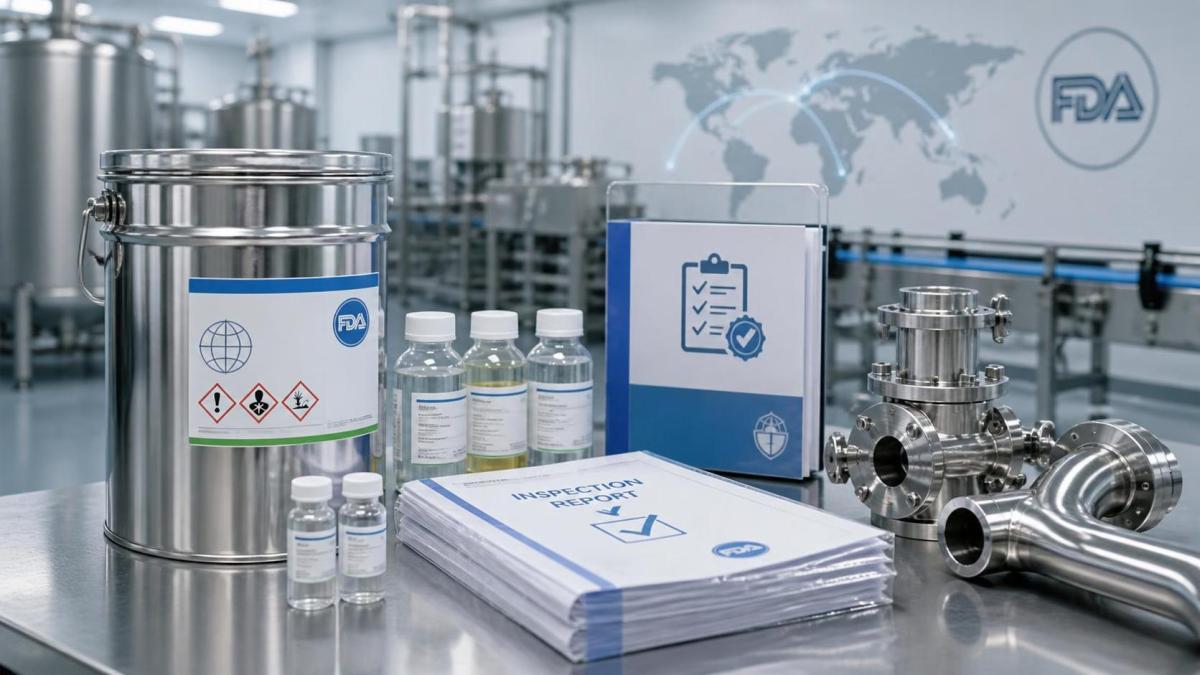
What the FDA has formally required
According to the information provided, the FDA released a guide titled Industrial Metal Cleaners in Food-Contact Manufacturing: Updated Validation Requirements on August 10, 2026. The guide applies to metal cleaners used in food-contact equipment manufacturing, including alkaline degreasers, pickling solutions, and chlorine-containing solvent products.
The stated requirement is that, starting on October 1, 2026, importers must provide a third-party laboratory residue toxicity validation report to the FDA. The report must include testing related to NDMA, nitrosamines, and heavy metal migration. If the required report is not submitted, the products will be refused entry.
The information provided also makes clear that this requirement directly affects the compliance route and delivery cycle of metal cleaner suppliers in China exporting to the U.S., Canada, and Mexico markets.
Where the pressure is likely to appear first
Border-facing import operations will carry the immediate compliance burden
From an industry perspective, importers are the first business role directly named in the requirement. Their exposure is concentrated in customs clearance, documentation readiness, and shipment release timing. What deserves closer attention is whether product files, lab reports, and shipment documents can be aligned before October 1, 2026, because the consequence described in the update is refusal of entry.
Export suppliers will be drawn into earlier technical and document coordination
For overseas suppliers, especially those shipping from China, the impact is likely to show up before goods move. Analysis shows that even though the submission obligation is placed on importers, exporters will likely need to support the testing file, product residue validation, and category-specific documentation tied to alkaline degreasers, pickling solutions, and chlorine-containing solvents. The practical issue is less about sales intent and more about whether compliance evidence can be prepared in time for customer shipments.
Manufacturing and procurement teams may face scheduling friction
Companies sourcing metal cleaners for food-contact equipment manufacturing may also need to watch purchasing and delivery schedules more closely. Observably, when a new report requirement becomes a condition for import, procurement, production planning, and replenishment timing can all become more sensitive to testing lead time and document completion. The key change to monitor is whether compliance review begins to influence order confirmation and shipment release.
Supply chain service providers may need tighter document checkpoints
Logistics coordinators, compliance service providers, and trade support teams may be affected through documentation workflows. Their likely exposure is operational rather than regulatory in name: shipment readiness, file completeness, and communication between importer, exporter, and laboratory. In this context, the most relevant shift is that missing validation materials could become a direct interruption point for cross-border movement.
What companies should watch now
Track the exact scope of covered products
One immediate task is to confirm whether a product falls within the scope described in the FDA update: industrial metal cleaners used in food-contact equipment manufacturing, including the categories specifically referenced in the provided information. Businesses should distinguish between broad product families and the specific products actually entering the covered application scenario.
Prepare testing and document timelines against the October 1 deadline
The rule change is tied to a clear implementation date. Analysis shows that the business risk is not only whether a report exists, but whether it is completed, available, and matched to shipment timing. Importers and suppliers should therefore focus on document lead times, laboratory coordination, and internal review steps that could affect dispatch and customs filing.
Separate regulatory language from operational execution
What deserves closer attention is the gap between the policy statement and day-to-day shipment execution. The confirmed fact is the FDA requirement for third-party residue toxicity validation reports and the refusal-of-entry consequence for non-submission. The operational question, which still requires careful follow-up, is how companies translate that requirement into product-level files, shipment-level paperwork, and customer-facing commitments without creating avoidable delay.
Review customer communication and delivery commitments
For suppliers serving North American buyers, this update may require more explicit communication around compliance status, supporting documents, and possible lead-time adjustments. The practical focus should be on purchase orders already in progress, scheduled shipments near the implementation date, and the readiness of supporting files that importers will need to present.
How this update is best understood at this stage
Analysis shows that this is more than a routine wording revision because the update sets a specific importer obligation, a defined effective date, and a clear border consequence. At the same time, it is more appropriate to understand this as a compliance enforcement signal rather than a complete picture of all downstream market effects. The confirmed facts establish a new threshold for entry, but the degree of disruption across supply chains will depend on how quickly importers and suppliers can organize validation, documentation, and shipment planning.
Observably, the short interval between the August 10, 2026 issuance date and the October 1, 2026 implementation date is a key reason this development deserves industry attention. The issue is not only regulatory interpretation; it is also execution speed across laboratories, document preparation, and trade coordination.
Why the industry should treat this as an active compliance signal
In practical terms, the FDA update indicates that residue toxicity validation is becoming a front-line import condition for covered metal cleaners used in food-contact equipment manufacturing. For affected businesses, the significance lies in how compliance evidence may now influence whether products can enter the market at all. It is more appropriate to understand this development as an immediate operational compliance change with longer-term signaling value, rather than as a settled indicator of broader market restructuring.
The most rational reading for now is that companies involved in exporting, importing, sourcing, and moving these products should treat the update as actionable, while continuing to watch how implementation details are clarified through subsequent official communication and market practice.
Basis of this article and points for continued verification
This article is based on the user-provided news title, event date, and event summary concerning the FDA's August 10, 2026 update on validation requirements for industrial metal cleaners used in food-contact manufacturing. In this type of industry development, commonly relevant source categories may include official regulatory notices, company disclosures, industry association updates, authoritative media reporting, and standards-related documents.
No specific official source link was provided in the input, so the exact official link remains to be further verified. Follow-up attention should remain on any subsequent FDA clarification, scope interpretation for covered products, and implementation details that may affect documentation practice and shipment execution.
Recommended News
 Can AI for multi axis machining reduce errors in complex toolpaths?AI for multi axis machining helps reduce complex toolpath errors through smarter collision detection, kinematic analysis, post validation, and machine-data insights. Learn how to improve precision.
 How seamless steel pipes are checked for wall-thickness consistencySeamlesssteelpipes wall-thickness checks explained: learn how ultrasonic scanning, calibration, and tolerance control ensure reliable, pressure-ready pipe quality.
 When a horizontal boring machine for metalworking improves large-part setupHorizontal boring machine for metalworking: learn how stable datums, rotary indexing, and rigid fixturing improve large-part accuracy and setup efficiency.
 What the MTTF standard for CNC means for machine reliabilityMTTF standard for CNC explained: learn how failure definitions, duty cycles, MTTR, and real-world data shape machine reliability and uptime.
 When does company formation offshore reduce cross-border tax risk?Companyformationoffshore can reduce cross-border tax risk when substance, governance, transfer pricing, and supply-chain roles align. Learn the key tests.
 How to read a measuring tape accurately for repeatable cutsMeasuringtape guide for accurate, repeatable cuts: master markings, hook movement, reference edges, kerf control, and stop-block setup.
 How to assess a CNC cutting tools manufacturer before orderingAssess a CNC cutting tools manufacturer with confidence: compare quality control, application support, trial results, supply reliability, and total machining cost before ordering.
 How often should scaffolding be inspected on active job sites?Scaffolding inspection guidance for active job sites: learn when to inspect, key safety triggers, compliance intervals, and practical controls to prevent incidents.
 What to verify when sourcing precision machining tools in EuropePrecision machining tools Europe sourcing guide: verify accuracy, ISO compliance, traceability, service coverage, and delivery resilience to reduce risk and lifecycle costs.
 When electronics require precision manufacturing at micron tolerancesPrecision manufacturing solutions for electronics deliver micron-level control, reliable inspection, and scalable quality for critical housings, thermal parts, and complex assemblies.
 When do cabletrays need corrosion protection in industrial facilities?Cabletrays need corrosion protection when exposed to moisture, chemicals, salt, washdown, or condensation. Learn how to select durable materials and protect critical industrial routes.
 What suppliers must prove for manufacturing standards compliance in Southeast AsiaManufacturing standards compliance Southeast Asia: learn what suppliers must prove, from traceable materials and calibrated tools to controlled processes, safety, and shipment records.
 What to verify in a fluid control manufacturer's quality systemFluid control manufacturer quality checks: verify traceability, testing, calibration, document control, and corrective actions to reduce risk.
 When do smart device manufacturing solutions reduce assembly errors?Smart device manufacturing solutions reduce assembly errors with closed-loop controls, vision inspection, torque verification, and traceable process data. Learn what drives reliable production.
 Import trends reshaping precision tooling supply in 2026Import trends in 2026 are reshaping precision tooling supply. Discover how to reduce landed risk, strengthen sourcing resilience, and protect production performance.
 Choosing carbide end mills for stainless steel without edge chippingCarbide end mills for stainless steel: learn how to prevent edge chipping with the right substrate, geometry, coating, coolant, and stable milling parameters.
 What contract manufacturing support should cover before sourcingIndustrial procurement support for contract manufacturing: learn what to verify before sourcing, from DFM and traceability to quality, capacity, cost control, and compliance.
 When integrated precision manufacturing solutions reduce launch delaysIntegrated precision manufacturing solutions help industrial teams prevent launch delays by aligning design, sourcing, machining, sealing, testing, and supply-chain readiness.
 How tooling cost calculation changes with EDM electrode complexityTooling cost calculation for EDM electrodes: learn how geometry, electrode count, tolerances, wear, and inspection drive accurate mold cost estimates.
 Tooling cost meaning in precision casting project quotationsTooling cost meaning explained for precision casting quotations: compare scope, quality risks, lifecycle costs, and supplier assumptions to make smarter sourcing decisions.
 What is tooling cost in manufacturing for a low-volume CNC part?What is tooling cost in manufacturing? Learn how setup, fixtures, programming, and inspection affect low-volume CNC pricing—and control costs without risking quality.





















Search News
Popular Tags