
How tooling cost calculation changes with EDM electrode complexity
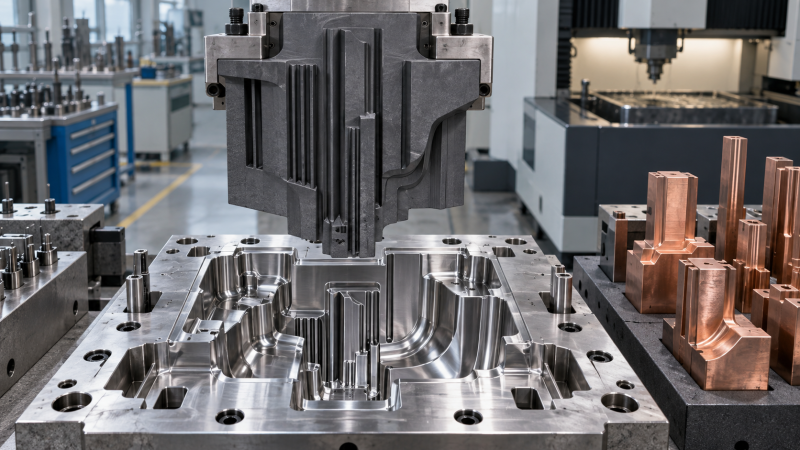
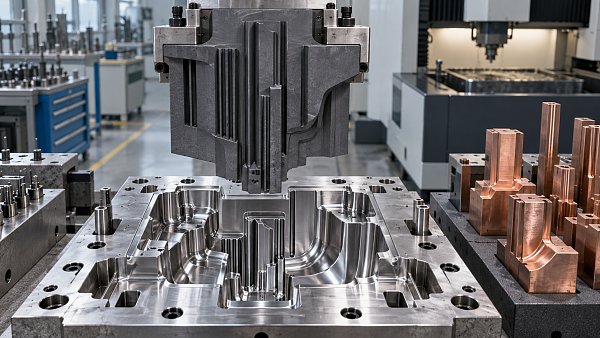
EDM electrode complexity changes tooling cost less through the price of copper or graphite than through the amount of controlled work required before, during, and after burning. A simple electrode may be modeled as a short machining operation plus a predictable EDM cycle. A complex electrode becomes a chain of interdependent operations: detailed CAD interpretation, stock planning, multi-axis milling, holder referencing, inspection, EDM parameter development, wear compensation, possible redressing, and cavity verification.
That distinction matters because a quotation based mainly on electrode volume, weight, or nominal machining hours can substantially understate the cost of deep ribs, narrow slots, compound curvature, fine texture regions, or features requiring multiple finishing electrodes. A sound tooling cost calculation must treat electrode complexity as a process-planning variable rather than a material variable.
Complexity changes the cost model, not just the cycle time
The total cost associated with EDM electrodes can be represented as a combination of engineering, electrode manufacture, EDM execution, verification, and risk allowance:
Total electrode-related cost = engineering and programming + electrode material and holder cost + electrode machining + setup and inspection + EDM burn time + wear and replacement allowance + quality verification + rework contingency.
For uncomplicated cavities, machining and EDM time may dominate. As geometry becomes more difficult, the engineering, setup, inspection, and contingency terms rise faster than material consumption. This is why two electrodes with similar external dimensions can have very different commercial values. A large, open copper electrode may be straightforward to machine and burn. A smaller graphite electrode containing thin standing ribs, blended surfaces, sharp internal transitions, and several Z-level finishing regions may require much more preparation and carry a greater risk of failure.
The relevant question is therefore not “How large is the electrode?” but “How many controlled manufacturing decisions are embedded in its geometry?”
Geometry is the primary multiplier
EDM is selected where cutting tools cannot reliably generate the intended steel geometry, particularly in deep, narrow, sharp-cornered, or difficult-to-access regions. The same characteristics that justify EDM also raise electrode cost.
Deep ribs illustrate the interaction. The electrode must maintain sufficient stiffness along its length while reaching into the cavity. A slender feature can deflect during milling, chip during handling, or wear unevenly in the EDM process. The electrode may need a stronger base, a larger support structure, a different material grade, or a staged roughing and finishing strategy. Each response adds cost, even if the final active surface is small.
Narrow slots and close-pitch details create a different problem. Cutter diameter becomes limited, tool reach increases, and machining time rises because smaller tools require lighter cutting conditions and more toolpaths. If the gap between electrode features approaches the practical stability limit for the selected material and milling process, the risk is not simply slower machining. Feature damage can make the electrode unusable, requiring remanufacture and delaying mold completion.
Compound surfaces add cost because they increase both toolpath complexity and inspection difficulty. A 3D electrode with continuously changing surface normals may require five-axis positioning or simultaneous machining to avoid holder interference and maintain cutter engagement. Even where three-axis machining is technically possible, it may require additional setups, longer tools, and less stable cutting conditions. The cost comparison must account for the chosen manufacturing route, not only for the CAD geometry.
Sharp internal corners require special attention. An EDM electrode can create a smaller inside radius than a conventional end mill, but it cannot produce a mathematically perfect zero-radius corner. The corner geometry depends on electrode shape, spark gap, orbit strategy, and wear. If the tool design specifies a corner radius that is unnecessarily tight, the cost impact can include smaller electrode tools, slower finishing conditions, more electrode wear, and additional polishing of the steel cavity.
The number of electrodes is often more important than electrode size
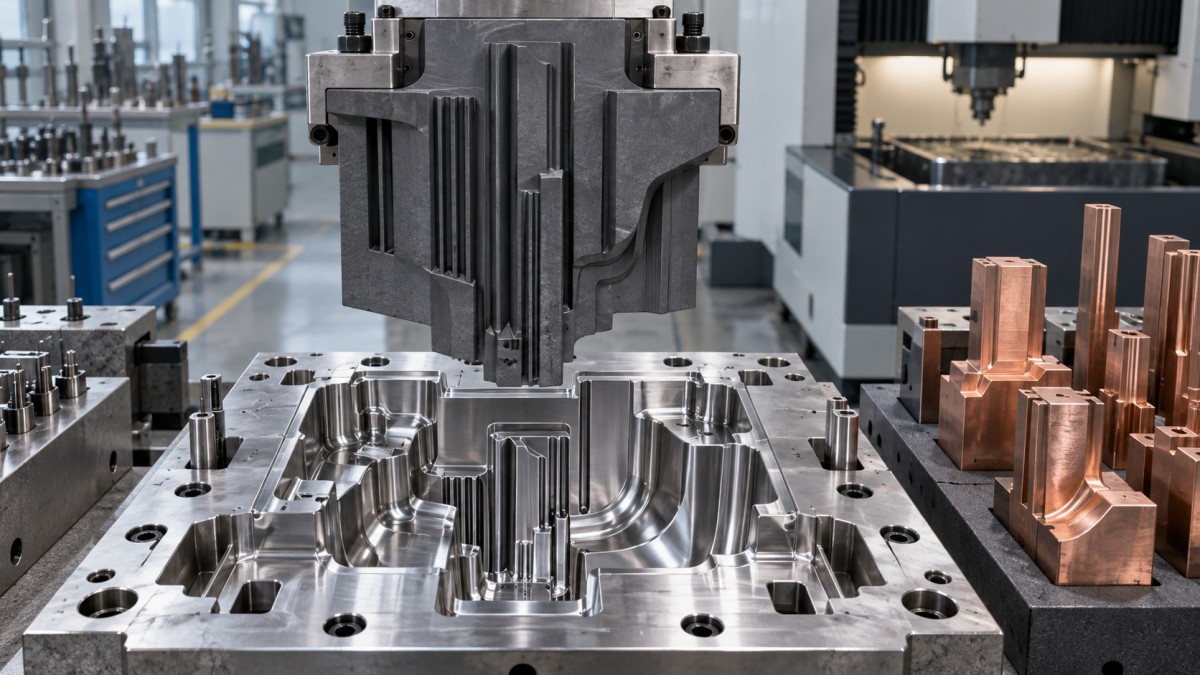
One of the most frequent quotation errors is to treat a cavity as requiring one electrode because one visible feature group appears to have one shape. In practice, a feature may require separate electrodes for roughing, semi-finishing, finishing, and localized detail correction. It may also require different electrodes because a single burn direction creates flushing problems, causes excessive wear at a fine feature, or cannot access all regions without collision.
Electrode count rises for several reasons:
- Roughing electrodes remove the bulk of stock efficiently but cannot hold final detail.
- Finishing electrodes are sized with lower wear and finer surface requirements in mind.
- Separate electrodes may be needed for deep areas and shallow areas to control flushing and burn stability.
- Small logos, textures, shutoff details, or local radii may need dedicated electrodes rather than being integrated into a larger unit.
- Duplicate electrodes may be justified where wear, schedule criticality, or multiple identical cavities create an unacceptable interruption risk.
Electrode count does not scale linearly with cavity complexity. A design modification that adds one small, highly detailed feature can introduce a new electrode family, its own holder, program, inspection routine, EDM setup, and verification requirement. Its material cost may be modest, but its organizational and machine-time burden is not.
Technical review should distinguish between the number of physical electrodes and the number of unique electrode designs. Repeated identical electrodes for multi-cavity tooling may benefit from repeated machining efficiency, but they still consume material, machine capacity, inspection capacity, and EDM time. A unique complex finishing electrode generally has a higher unit planning cost than a repeated geometry.
Material choice shifts the balance between machining and EDM performance
Copper and graphite remain common electrode materials, but their cost effects cannot be reduced to a price-per-kilogram comparison. Material selection should reflect feature scale, surface requirement, wear behavior, machining method, contamination control, and the electrical conditions required for the workpiece material.
Copper is often selected where fine detail, favorable surface finish, or high thermal and electrical conductivity are important. It can, however, be slower to machine than graphite and may generate burrs on delicate edges. Complex copper electrodes may require more finishing operations and careful handling to avoid damaging sharp features. Their density also increases material cost when the electrode blank is large or when extra stock is needed for rigidity.
Graphite can be machined efficiently, particularly for larger roughing electrodes, and it is often advantageous in high-temperature or high-wear EDM conditions. Yet graphite grades differ materially in grain size, strength, machinability, and achievable detail. Fine-grain grades capable of reproducing small features are not interchangeable with coarse grades intended for roughing. Their higher material cost may be justified, but only where the geometry and finish requirement demand it.
Graphite also introduces operational costs that should remain visible in the calculation: dust extraction, machine cleanliness, sealed or protected components, and process separation where graphite contamination could affect other machining work. These costs may be absorbed in shop overhead, but they do not disappear. A comparison between copper and graphite is meaningful only when the same scope of setup, machining, EDM performance, and finishing quality is included.
Tolerance and surface finish create different cost curves
Tighter tolerances do not merely require a more precise electrode. They require a more controlled system. The resulting cavity dimension depends on electrode dimension, spark gap, orbital motion, EDM generator settings, electrode wear, workpiece condition, machine calibration, and measurement method. The electrode is only one part of that chain.
For a roughing operation, a larger spark gap and more aggressive electrical conditions may be acceptable because finishing stock remains. In finishing, the gap is smaller, energy is lower, and burn time increases. If a specified cavity tolerance leaves little room for variation, the process may need a semi-finish stage, a dedicated finish electrode, more frequent probing, or test burns to validate offsets. The incremental cost comes from control activity as much as from slower EDM parameters.
Surface finish specifications have a similar effect. A fine finish may be achieved by reducing discharge energy and extending EDM time, but geometry determines whether that approach is sufficient. Deep blind cavities can have poor debris evacuation. Fine details can retain particles. Local arcing or unstable burning can degrade both finish and dimensional consistency. Achieving the intended surface condition may therefore require altered flushing arrangements, segmented electrode design, or hand finishing after EDM.
It is important to separate arithmetic surface roughness requirements from visual and functional requirements. A cavity may meet a specified roughness value while still showing localized EDM witness marks, edge artifacts, or nonuniform texture that are unacceptable for an optical, cosmetic, sealing, or release-sensitive molded part. Where the functional acceptance criterion is stricter than a numerical roughness target, the tooling calculation should explicitly include the necessary inspection and finishing scope.
Electrode wear must be planned as a geometric issue
Wear allowance is sometimes added as a generic percentage of electrode cost. That approach is weak for complex work because wear is not distributed uniformly. Corners, thin projections, deep burning regions, and poorly flushed zones may experience disproportionately high erosion. A finishing electrode can lose the geometric integrity needed for the final pass even when its overall volume loss appears low.
Wear compensation may be handled through electrode overburn, undersize rules, orbit offsets, machine control settings, or staged electrodes. The correct method depends on the electrode material, workpiece steel, cavity geometry, finish target, and EDM strategy. It should be documented at the process-planning stage because late compensation decisions can alter the final cavity dimensions.
For cost purposes, the key distinction is between predictable consumable wear and uncertainty-driven replacement risk. Predictable wear belongs in planned electrode quantity and EDM cycle parameters. Replacement risk belongs in a contingency that is traceable to specific geometric hazards, such as unsupported fins or extremely localized finish areas. Combining both into an unexplained percentage conceals the reason for the cost and makes design alternatives difficult to compare.
Setup, referencing, and inspection are not secondary activities
Complex electrodes require a stable datum strategy from CAD through milling, EDM, and measurement. The electrode holder, work coordinate system, reference surfaces, and cavity datum structure must agree. If the electrode is machined relative to one reference but burned relative to another without a controlled transformation, even an accurately machined electrode can produce a misplaced cavity feature.
Standardized holders can reduce repeated setup effort, but they do not remove the need to verify electrode position and orientation. Complex electrodes may need CMM inspection, probing on the milling machine, inspection of critical active features, or scanning where freeform surfaces are involved. The inspection method must be selected according to the tolerance being claimed. Checking only the holder datum does not confirm a thin rib tip, a deep feature, or a blended active surface.
Inspection time is especially easy to omit from a low-level tooling cost calculation because it is often performed outside the EDM machine. Yet it directly protects against high-cost outcomes: burning an incorrect geometry into hardened tool steel, discovering an offset issue after polishing, or repeating a finishing sequence because the electrode profile was not verified.
A practical way to compare design alternatives
When evaluating two part or mold designs, compare them through an electrode complexity register rather than through a single estimated EDM hour value. Each electrode region can be assessed against the process conditions that drive cost:
This approach reveals where a design change genuinely reduces cost. Enlarging a nonfunctional internal radius, widening a deep rib, separating a complex feature from an otherwise simple electrode, or relaxing a finish requirement outside the molded part’s functional zone can reduce process complexity. By contrast, changing the nominal electrode material while leaving difficult geometry, multiple finishing stages, and demanding inspection unchanged may have little effect on total tooling cost.
Quotation risk is usually a scope-definition problem
EDM quotations become unreliable when technical assumptions remain implicit. A defensible quotation identifies the intended electrode material and grade, quantity by operation stage, holder approach, expected machining route, burn condition, required finish, inspection scope, and allowance for replacement or correction. It should also state whether polishing, texture restoration, cavity matching, or post-EDM fitting are included.
The most useful cost review occurs before final mold design release, when geometry can still be adjusted without rework. Once hardened inserts have been machined and the EDM route is committed, a difficult detail can no longer be treated as a minor quotation variable. It becomes a schedule, quality, and recoverability issue.
Electrode complexity should therefore be evaluated as a controlled manufacturing burden. Material volume matters, but geometry, electrode count, tolerance chain, wear behavior, and verification requirements determine whether the tooling cost calculation reflects the work actually needed to produce a reliable cavity.
Recommended News
 Can AI for multi axis machining reduce errors in complex toolpaths?AI for multi axis machining helps reduce complex toolpath errors through smarter collision detection, kinematic analysis, post validation, and machine-data insights. Learn how to improve precision.
 How seamless steel pipes are checked for wall-thickness consistencySeamlesssteelpipes wall-thickness checks explained: learn how ultrasonic scanning, calibration, and tolerance control ensure reliable, pressure-ready pipe quality.
 When a horizontal boring machine for metalworking improves large-part setupHorizontal boring machine for metalworking: learn how stable datums, rotary indexing, and rigid fixturing improve large-part accuracy and setup efficiency.
 What the MTTF standard for CNC means for machine reliabilityMTTF standard for CNC explained: learn how failure definitions, duty cycles, MTTR, and real-world data shape machine reliability and uptime.
 When does company formation offshore reduce cross-border tax risk?Companyformationoffshore can reduce cross-border tax risk when substance, governance, transfer pricing, and supply-chain roles align. Learn the key tests.
 How to read a measuring tape accurately for repeatable cutsMeasuringtape guide for accurate, repeatable cuts: master markings, hook movement, reference edges, kerf control, and stop-block setup.
 How to assess a CNC cutting tools manufacturer before orderingAssess a CNC cutting tools manufacturer with confidence: compare quality control, application support, trial results, supply reliability, and total machining cost before ordering.
 How often should scaffolding be inspected on active job sites?Scaffolding inspection guidance for active job sites: learn when to inspect, key safety triggers, compliance intervals, and practical controls to prevent incidents.
 What to verify when sourcing precision machining tools in EuropePrecision machining tools Europe sourcing guide: verify accuracy, ISO compliance, traceability, service coverage, and delivery resilience to reduce risk and lifecycle costs.
 When electronics require precision manufacturing at micron tolerancesPrecision manufacturing solutions for electronics deliver micron-level control, reliable inspection, and scalable quality for critical housings, thermal parts, and complex assemblies.
 When do cabletrays need corrosion protection in industrial facilities?Cabletrays need corrosion protection when exposed to moisture, chemicals, salt, washdown, or condensation. Learn how to select durable materials and protect critical industrial routes.
 What suppliers must prove for manufacturing standards compliance in Southeast AsiaManufacturing standards compliance Southeast Asia: learn what suppliers must prove, from traceable materials and calibrated tools to controlled processes, safety, and shipment records.
 What to verify in a fluid control manufacturer's quality systemFluid control manufacturer quality checks: verify traceability, testing, calibration, document control, and corrective actions to reduce risk.
 When do smart device manufacturing solutions reduce assembly errors?Smart device manufacturing solutions reduce assembly errors with closed-loop controls, vision inspection, torque verification, and traceable process data. Learn what drives reliable production.
 Import trends reshaping precision tooling supply in 2026Import trends in 2026 are reshaping precision tooling supply. Discover how to reduce landed risk, strengthen sourcing resilience, and protect production performance.
 Choosing carbide end mills for stainless steel without edge chippingCarbide end mills for stainless steel: learn how to prevent edge chipping with the right substrate, geometry, coating, coolant, and stable milling parameters.
 What contract manufacturing support should cover before sourcingIndustrial procurement support for contract manufacturing: learn what to verify before sourcing, from DFM and traceability to quality, capacity, cost control, and compliance.
 When integrated precision manufacturing solutions reduce launch delaysIntegrated precision manufacturing solutions help industrial teams prevent launch delays by aligning design, sourcing, machining, sealing, testing, and supply-chain readiness.
 How tooling cost calculation changes with EDM electrode complexityTooling cost calculation for EDM electrodes: learn how geometry, electrode count, tolerances, wear, and inspection drive accurate mold cost estimates.
 Tooling cost meaning in precision casting project quotationsTooling cost meaning explained for precision casting quotations: compare scope, quality risks, lifecycle costs, and supplier assumptions to make smarter sourcing decisions.
 What is tooling cost in manufacturing for a low-volume CNC part?What is tooling cost in manufacturing? Learn how setup, fixtures, programming, and inspection affect low-volume CNC pricing—and control costs without risking quality.












Search News
Popular Tags