
ECHA Adds 12 SVHCs Used in Metalworking Fluids
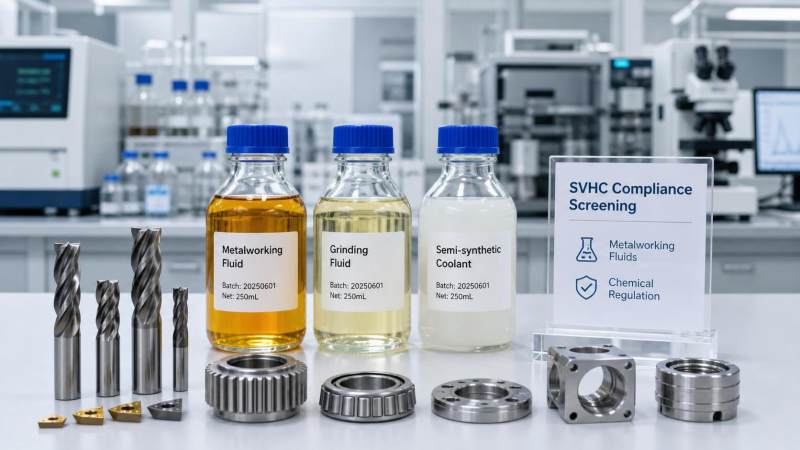
On August 9, 2026, ECHA updated the SVHC Candidate List by adding 12 substances commonly used in industrial cutting fluids, metal cleaners, and lubricant formulations. The immediate point of attention for EU importers, formulators, traders, and supply chain partners is that from November 1, 2026, imported products containing any of these newly listed SVHCs at or above 0.1% w/w will require SCIP notification by the EU importer. For the metalworking fluids segment, this is not just a list update; it directly affects compliance access, product screening, and responsibility allocation across cross-border supply chains.
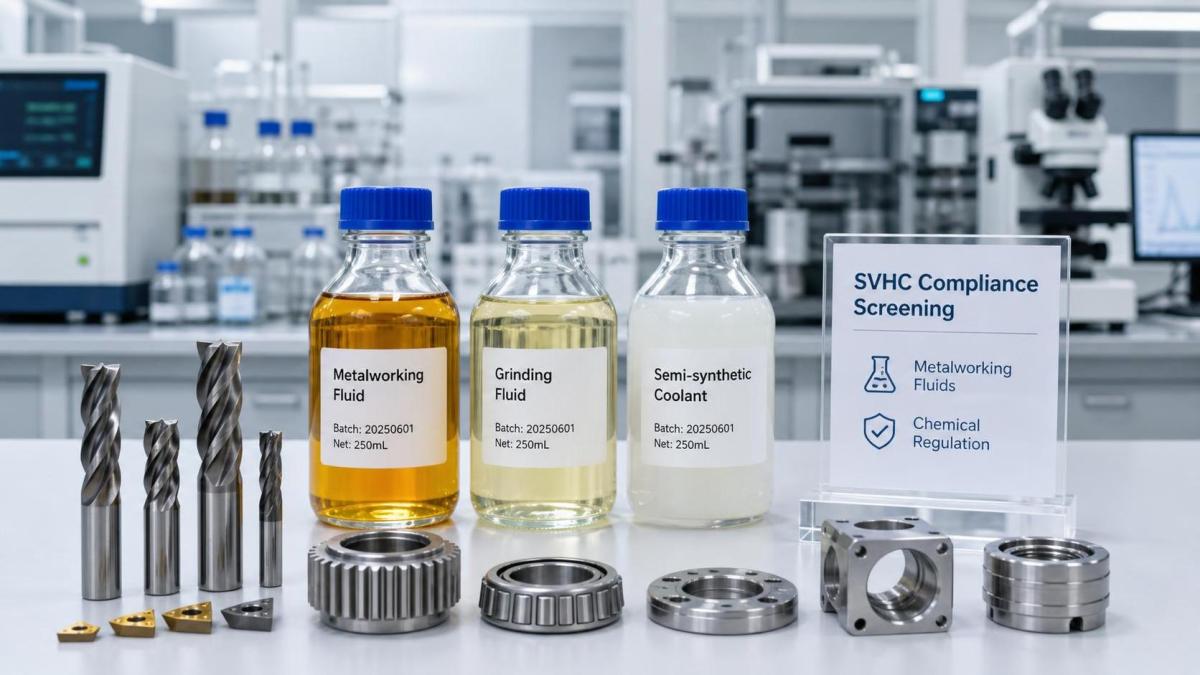
What the Update Confirms
The confirmed change is that ECHA added 12 new substances to the SVHC Candidate List on August 9, 2026. According to the provided event summary, these include four phosphorus-containing extreme pressure additives, five benzotriazole corrosion inhibitors, and three alkylphenol ethoxylate surfactants. The summary also states that these substances are widely used in formulations for industrial cutting fluids, metal cleaning agents, and lubricants.
The confirmed compliance requirement is that, starting November 1, 2026, EU importers must complete SCIP database notification for imported products that contain any of the newly added SVHCs at concentrations of 0.1% w/w or above. The stated direct impact falls on Metal Cleaners, Cutting Fluids, and Synthetic Oils in terms of compliance entry routes and the division of supply chain responsibility.
Where the Operational Pressure Will Appear First
Imported product portfolios face an immediate screening task
From an industry perspective, companies importing finished products or chemical preparations into the EU may be affected first because the new requirement is tied to importer notification obligations. The main pressure point is product-level composition review: businesses will need to identify whether any imported Metal Cleaners, Cutting Fluids, or Synthetic Oils contain one of the newly added SVHCs at or above the stated threshold. What deserves closer attention is whether current product data is detailed enough to support that determination within the compliance timeline.
Formulators and manufacturers may see new information requests
For formulators and manufacturing partners, the likely impact is indirect but practical. If downstream EU importers carry the SCIP obligation, they may request clearer composition disclosures, confirmation of substance presence, or threshold-related statements from suppliers. The business effect is less about the publication of the list itself and more about whether formulation data, raw material declarations, and customer-facing technical documentation can support importer compliance without delay.
Distributors and supply chain coordinators will need clearer role boundaries
Observably, the update also matters for distributors, traders, and supply chain service providers because the event summary specifically points to changes in responsibility allocation. Where products move through multiple entities before entering the EU market, commercial teams will need to determine who is acting as importer, who holds the relevant substance information, and who is responsible for delivering the data needed for SCIP notification. The practical risk is not only chemical content, but also unclear ownership of compliance actions.
Industrial buyers may need to recheck procurement assumptions
For procurement teams and end users sourcing metal cleaners, cutting fluids, or synthetic oils, the issue is continuity of compliant supply. Analysis shows that buyers may need to confirm whether current suppliers can support the new reporting requirement and whether documentation will be available in time for shipments after the effective date. The concern is operational rather than speculative: products may remain commercially relevant, but their compliance pathway into the EU market now requires closer verification.
What Companies Should Watch Now
Substance mapping should focus on the named use categories
The most immediate practical step is to review products that fall into the use areas identified in the event summary: industrial cutting fluids, metal cleaning agents, and lubricants, especially Metal Cleaners, Cutting Fluids, and Synthetic Oils. Companies do not need to treat every product line the same way; they need to identify where the newly listed phosphorus-containing extreme pressure additives, benzotriazole corrosion inhibitors, or alkylphenol ethoxylate surfactants may be present.
Threshold interpretation and product data quality matter
What deserves closer attention is the difference between knowing that a listed substance is used somewhere in a formulation family and being able to confirm whether a specific imported product reaches the 0.1% w/w threshold. In practice, the quality of supplier declarations, formulation records, and specification management will determine how quickly importers can decide whether SCIP notification is required.
Contract and communication chains may need tightening
Because the summary highlights responsibility allocation, companies should pay attention to how compliance obligations are reflected in commercial communication. Importers may need timely data from non-EU manufacturers, while manufacturers may need clearer requests from customers about the level of substance disclosure required. This is a documentation and coordination issue as much as a regulatory one.
Further official wording still needs to be tracked
Analysis shows that companies should separate the confirmed requirement from any broader assumptions. The confirmed point is the Candidate List update and the November 1, 2026 SCIP notification obligation for relevant imported products. Any additional interpretation about implementation details, documentation format, or enforcement approach should remain under review until supported by further official wording or verified downstream requirements.
Why This Looks Like More Than a Routine List Update
Observably, this development is better understood as both a near-term compliance change and a longer-term signal for the metalworking fluids value chain. In the short term, the effect is concrete: importers of relevant products need to determine whether SCIP notification applies from November 1, 2026. In the longer view, the update signals that substance selection in metal cleaners, cutting fluids, and synthetic oils is under closer regulatory scrutiny where SVHC status affects market access processes and information flow.
It is more appropriate to understand this as an operational compliance event rather than a final market outcome. The provided information confirms a new obligation threshold and a defined start date, but the full business impact will depend on how individual supply chains handle formulation visibility, importer responsibilities, and customer documentation.
How the Market Is Most Likely to Read This
The industry significance of this update lies in its direct link between substance listing and importer action. For affected product categories, the issue is not abstract regulatory sentiment; it is whether companies can verify composition, assign responsibility clearly, and complete required SCIP steps on time. A measured reading is the most appropriate one: this is a confirmed compliance trigger for certain imported products, and also a signal that businesses in the metalworking fluids chain should keep watching how regulatory classification and supply chain execution interact.
Basis of This Article
This article is based on the user-provided news title, event date, and event summary concerning ECHA's August 9, 2026 update to the SVHC Candidate List and the stated November 1, 2026 SCIP notification requirement for relevant imported products. For this type of industry update, commonly relevant source categories may include official announcements, company disclosures, industry association information, authoritative media reporting, and standard-setting or regulatory documents.
No specific official source link was provided in the input, so the exact official reference still needs ongoing verification. What remains worth monitoring is any further official wording related to implementation, as well as how affected companies define product scope, documentation responsibility, and importer-side reporting workflows.
Recommended News
 What the MTTF standard for CNC means for machine reliabilityMTTF standard for CNC explained: learn how failure definitions, duty cycles, MTTR, and real-world data shape machine reliability and uptime.
 When does company formation offshore reduce cross-border tax risk?Companyformationoffshore can reduce cross-border tax risk when substance, governance, transfer pricing, and supply-chain roles align. Learn the key tests.
 How to read a measuring tape accurately for repeatable cutsMeasuringtape guide for accurate, repeatable cuts: master markings, hook movement, reference edges, kerf control, and stop-block setup.
 How to assess a CNC cutting tools manufacturer before orderingAssess a CNC cutting tools manufacturer with confidence: compare quality control, application support, trial results, supply reliability, and total machining cost before ordering.
 How often should scaffolding be inspected on active job sites?Scaffolding inspection guidance for active job sites: learn when to inspect, key safety triggers, compliance intervals, and practical controls to prevent incidents.
 What to verify when sourcing precision machining tools in EuropePrecision machining tools Europe sourcing guide: verify accuracy, ISO compliance, traceability, service coverage, and delivery resilience to reduce risk and lifecycle costs.
 When electronics require precision manufacturing at micron tolerancesPrecision manufacturing solutions for electronics deliver micron-level control, reliable inspection, and scalable quality for critical housings, thermal parts, and complex assemblies.
 When do cabletrays need corrosion protection in industrial facilities?Cabletrays need corrosion protection when exposed to moisture, chemicals, salt, washdown, or condensation. Learn how to select durable materials and protect critical industrial routes.
 What suppliers must prove for manufacturing standards compliance in Southeast AsiaManufacturing standards compliance Southeast Asia: learn what suppliers must prove, from traceable materials and calibrated tools to controlled processes, safety, and shipment records.
 What to verify in a fluid control manufacturer's quality systemFluid control manufacturer quality checks: verify traceability, testing, calibration, document control, and corrective actions to reduce risk.
 When do smart device manufacturing solutions reduce assembly errors?Smart device manufacturing solutions reduce assembly errors with closed-loop controls, vision inspection, torque verification, and traceable process data. Learn what drives reliable production.
 Import trends reshaping precision tooling supply in 2026Import trends in 2026 are reshaping precision tooling supply. Discover how to reduce landed risk, strengthen sourcing resilience, and protect production performance.
 Choosing carbide end mills for stainless steel without edge chippingCarbide end mills for stainless steel: learn how to prevent edge chipping with the right substrate, geometry, coating, coolant, and stable milling parameters.
 What contract manufacturing support should cover before sourcingIndustrial procurement support for contract manufacturing: learn what to verify before sourcing, from DFM and traceability to quality, capacity, cost control, and compliance.
 When integrated precision manufacturing solutions reduce launch delaysIntegrated precision manufacturing solutions help industrial teams prevent launch delays by aligning design, sourcing, machining, sealing, testing, and supply-chain readiness.
 Tooling cost meaning in precision casting project quotationsTooling cost meaning explained for precision casting quotations: compare scope, quality risks, lifecycle costs, and supplier assumptions to make smarter sourcing decisions.
 What is tooling cost in manufacturing for a low-volume CNC part?What is tooling cost in manufacturing? Learn how setup, fixtures, programming, and inspection affect low-volume CNC pricing—and control costs without risking quality.
 When a higher tooling price reduces long-run mold maintenance costsTooling price can reduce long-term mold maintenance costs when premium materials, precision machining, and serviceable design prevent downtime, scrap, and costly repairs.
 What a tooling fee covers before an injection mold is builtTooling fee explained: discover what it covers before an injection mold is built, from DFM and mold design to validation, ownership, and cost control.
 Where Ball Valve Torque Calculations Go Wrong in Automated LinesBall valve torque calculations can fail when pressure, media, temperature, actuator output, and mounting loads are overlooked. Discover practical sizing checks for reliable automated isolation.
 When a horizontal boring machine improves accuracy in large metal partsDiscover when a horizontal boring machine for metalworking improves accuracy in large parts, protecting critical bore alignment, stable datums, and assembly-ready results.















Search News
Popular Tags