
How to compare machine tool prices across supplier quotes
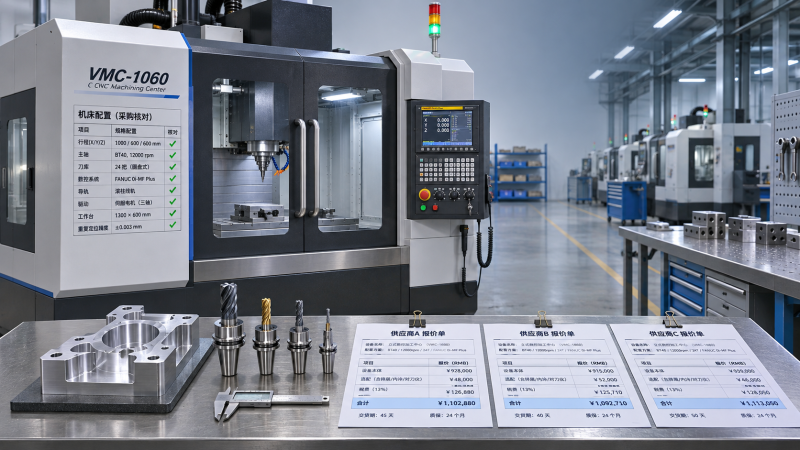
Comparing machine tool prices across supplier quotes requires more than identifying the lowest purchase price. Differences in specifications, tooling, installation, warranty coverage, and ongoing costs can make apparently similar offers difficult to assess.
For procurement teams, understanding machine tool market pricing means establishing a consistent comparison and identifying expenses that may arise after purchase. The strongest offer meets production requirements at an acceptable lifetime cost and risk.
This guide explains how to normalize supplier quotes, verify technical claims, calculate ownership costs, and negotiate terms that support a defensible purchasing decision.
Start with a common specification
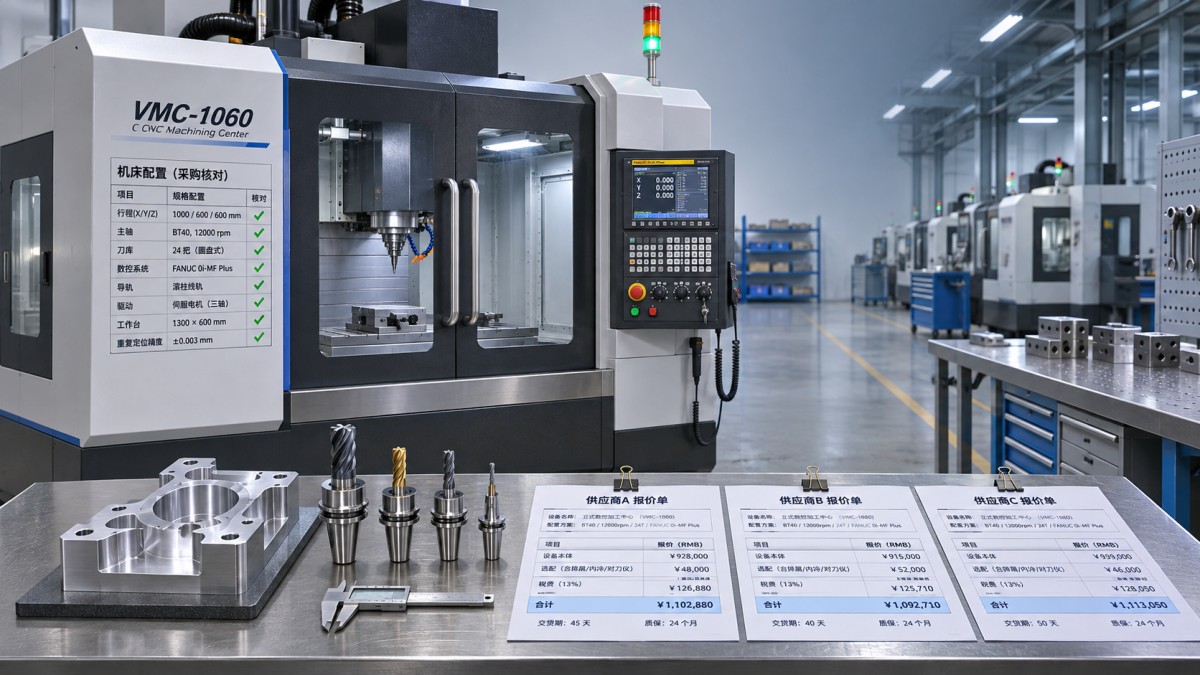
Before comparing prices, confirm that every supplier has quoted against the same production requirements. A lower figure may simply exclude capabilities needed to produce the intended parts.
Define the workpieces, materials, annual volumes, required tolerances, surface finish, and expected production schedule. Include representative drawings and identify the operations the machine must perform.
Specify the required machine configuration: axis travel, spindle power and speed, torque, tool magazine capacity, control system, automation interface, and workholding provisions where relevant.
Distinguish mandatory requirements from preferences. This prevents a supplier from winning on attractive extras while failing a critical production requirement, and helps procurement avoid paying for unnecessary features.
Ask each supplier to complete the same compliance matrix, marking every requirement as included, optional, excluded, or subject to clarification. Require references to the relevant quotation sections.
Compare the complete delivered and installed price
The quoted machine price is only one part of the investment. Build a comparison in a single currency, using a stated exchange rate and quotation date.
For each offer, identify the machine base price, options, freight, insurance, duties, taxes, unloading, rigging, installation, commissioning, training, and any required site modifications.
Use applicable Incoterms and the named delivery location to establish where cost and risk transfer. An offer delivered to a port is different from one delivered to your factory.
Check whether quoted taxes are recoverable for your business. Show recoverable amounts separately from costs that remain with the project, with finance or tax review where necessary.
Request line-item prices for missing essentials, including transformers, coolant systems, chip conveyors, filtration, probes, fixtures, initial tooling, software licenses, and connectivity equipment where applicable.
Allow for foundations, electrical capacity, compressed air, environmental controls, and network connections if the machine requires them. Obtain site-specific estimates instead of assuming every installation has equal cost.
Record payment milestones alongside price. Deposits, progress payments, final acceptance payments, and financing charges can change cash flow and the buyer’s exposure before the machine is operational.
Use a comparison table to reveal hidden differences
A normalized table gives decision-makers a shared view of each offer. Keep quoted amounts and procurement estimates in separate columns so assumptions remain visible and auditable.
In this illustrative example, Supplier B’s base price is $15,000 lower, but its estimated installed cost is $7,000 higher. Actual costs depend on location and contract terms.
Do not treat an unpriced item as free. Mark it as an estimate or an open question, assign an owner, and request a binding clarification before approval.
Verify performance against the parts you need to produce
Two machines can have similar published specifications and deliver different results in production. Ask suppliers to demonstrate performance using your materials, part geometry, and intended machining conditions.
Separate positioning accuracy, repeatability, and finished-part tolerances. These measures describe different outcomes, and a machine specification alone does not guarantee that a particular part will meet drawing requirements.
Where suppliers cite ISO, JIS, or other standards, request the exact standard and edition, test conditions, measurement method, and results relevant to the machine being offered.
For five-axis work, clarify whether the application requires simultaneous machining or indexed positioning. Confirm the quoted control functions, rotary-axis capability, and associated software support the required process.
Ask for a cycle-time study showing tooling, cutting parameters, loading method, inspection, and assumptions about material removal. Check whether setup changes and operator intervention are included.
For critical purchases, arrange a witnessed test cut and agree on acceptance criteria in advance. Define the sample quantity, measurement equipment, operating conditions, and response to failure.
Calculate total cost of ownership over a useful period
Installed cost establishes the initial investment. Total cost of ownership adds the expenses expected over a defined period, such as five years, using consistent assumptions across suppliers.
A practical calculation is: installed cost plus operating, maintenance, tooling, software, and downtime costs, minus expected residual value. State the period and whether future cash flows are discounted.
Estimate energy costs from expected operating hours, measured or credible power consumption, and local electricity rates. Separate cutting, standby, and auxiliary equipment loads when meaningful data is available.
Include preventive maintenance, replacement parts, service contracts, calibration, coolant, lubricants, filters, and consumables. Use supplier schedules as a starting point and validate them against your operating pattern.
Tooling costs deserve attention when machines use different interfaces or processes. Compare expected tool life and replacement costs using the same material, production volume, and quality requirements.
For software, identify recurring fees for control features, programming, simulation, monitoring, and updates. Confirm license duration, transfer rights, support coverage, and whether operation depends on renewal.
Estimate downtime exposure using expected lost production hours and a finance-approved cost per hour. Avoid counting lost margin, labor, and replacement production twice if they overlap.
Residual value is uncertain, particularly for specialized machines. Show it separately and test the decision with a conservative value, rather than relying on an optimistic resale estimate.
Test the financial assumptions with a simple scenario
Suppose two technically compliant machines have installed costs of $200,000 and $220,000. The more expensive machine is estimated to save $7,000 annually in maintenance and consumables.
On those assumptions, the $20,000 price difference has a simple payback of approximately 2.9 years. This excludes financing, taxes, discounting, residual value, and any productivity differences.
Now test the result at lower savings. If annual savings are only $3,000, simple payback rises to about 6.7 years, which may exceed the project’s investment threshold.
Ask engineering and finance to review the inputs, especially operating hours and maintenance costs. A savings estimate based on full utilization can mislead when demand is variable.
Where output differs, compare cost per acceptable part as well as annual cost. Account for scrap, inspection, labor, and capacity constraints, and avoid assuming additional capacity always generates sales.
Assess supplier support before accepting a lower price
Service capability can materially affect production continuity. Ask where technicians and spare parts are located, which services are available locally, and what response commitments appear in the contract.
Distinguish response time from resolution time. A supplier may promise a quick acknowledgment without guaranteeing an on-site visit, a replacement component, or a return to production.
Review warranty duration, start date, covered components, labor, travel, exclusions, and the claims process. Confirm whether coverage begins at shipment, installation, or formal acceptance.
Ask for a recommended critical-spares list with prices, availability, and lead times. Check the expected availability of replacement controls and components over your planned ownership period.
Request references from customers with comparable machines and applications. Where possible, verify installation experience, service performance, recurring faults, and the accuracy of delivery commitments.
Check supplier financial stability and reliance on subcontractors for controls, service, and replacement parts. A low quote carries more risk if support depends on an uncertain supply chain.
Compare delivery dates and contractual risk
Define delivery in terms of a specific milestone: shipment, arrival at site, installation completion, or acceptance. These dates can differ substantially and affect the production launch.
Ask suppliers to identify manufacturing lead time, transport assumptions, site readiness requirements, and dependencies on customer-provided tooling or drawings. Document the process for reporting schedule changes.
For a time-sensitive project, estimate the cost of a delayed start using realistic production and revenue assumptions. Consider contractual remedies where both parties can agree on measurable milestones.
Review cancellation rights, change orders, price validity, escalation clauses, and currency exposure. Clarify whether deposits are refundable and what happens if the supplier misses agreed obligations.
Link final payment to objective acceptance criteria where commercially feasible. The contract should describe how deficiencies are recorded, corrected, and retested without leaving acceptance indefinitely unresolved.
Negotiate from a documented comparison
Share the same clarification questions with shortlisted suppliers and request revised, itemized offers. This gives each supplier an opportunity to correct exclusions and propose a comparable scope.
Negotiate the elements that matter to your operation, not just the headline discount. Installation, training, spare parts, warranty terms, and payment milestones may offer more measurable value.
Use current, comparable quotes to assess machine tool market pricing, but account for geography, configuration, lead time, service coverage, and order volume before drawing conclusions from price differences.
If a quote is unusually low, ask how the supplier achieved the saving. Verify whether it reflects a simpler configuration, a limited warranty, an inventory machine, or commercial incentives.
Document the final technical and commercial baseline in the purchase order and its attachments. Resolve conflicts between the quotation, specification, service agreement, and supplier terms before signing.
Make the final decision with a clear approval record
First eliminate offers that fail mandatory technical, safety, or contractual requirements. For the remaining suppliers, compare normalized installed cost, ownership costs, demonstrated performance, delivery, and support.
Use a weighted scorecard if several factors matter, but set weights before reviewing final offers. Keep critical pass-or-fail requirements separate so a low price cannot offset a fundamental gap.
Record the preferred supplier, key assumptions, outstanding risks, and reasons for the decision. Obtain input from engineering, maintenance, operations, finance, and procurement before issuing the purchase order.
The best-value quote is the one that meets the production requirement at an acceptable total cost and risk. A transparent comparison makes that choice easier to defend and implement.
Facing technical bottlenecks in manufacturing or looking for more efficient industrial solutions? Leave your details below and let the engineering experts at G-PME solve them for you.
We respect your privacy. Your information is strictly confidential.
Recommended News
 How to select manufacturing materials for high-temperature useMaterial selection for manufacturing guide: compare high-temperature materials by strength, creep, environment and fabrication to choose with confidence.
 What causes car electronics to drain the battery when parked?Car electronics can drain your battery while parked. Discover common causes, from hidden lights to faulty modules, and learn how to pinpoint the problem.
 How to compare machine tool prices across supplier quotesUnderstand machine tool market pricing and compare supplier quotes with confidence. Uncover hidden costs, assess performance, and negotiate better terms.
 How machine thermal stability affects machining accuracyMachine thermal stability directly affects machining accuracy. Discover how to measure thermal drift, evaluate test results, and maintain tighter tolerances.
 How to assess an industrial machining factory's inspection processAssess an industrial machining factory’s inspection process with practical checks for measurement methods, traceability, sampling, and quality records.
 Can AI CNC programming reduce setup time in European factories?Can AI CNC programming in Europe reduce setup time? Discover where it saves effort, what affects results and how to run a practical factory pilot.
 Which medical scrubs are most comfortable for long shifts?Find comfortable medical scrubs for long shifts. Compare fabrics, fit, breathability, and practical features to choose a set that moves with you all day.
 How to compare quotes from shipping agentsCompare shipping agents with confidence. Learn how to assess total costs, hidden fees, Incoterms, insurance, and cargo handling before you book.
 Can a manufacturing capability assessment identify capacity risks?A manufacturing capability assessment can uncover bottlenecks and capacity risks before they delay your project. Discover how to evaluate suppliers and protect delivery dates.
 How supplier sourcing solutions support incoming quality inspectionExplore supplier sourcing solutions quality assurance practices that strengthen incoming inspections, improve traceability, and reduce supply risks.
 How to verify FDA clearance when choosing an aesthetics device supplier in the USAChoosing an aesthetics devices supplier in USA? Learn how to verify FDA records, match device configurations, and compare costs with confidence.
 How technical specification support helps verify semiconductor compatibilityTechnical specification support for semiconductors helps verify compatibility, identify hidden risks, and guide confident component selection. Explore the key checks.
 How to assess shelf life when buying bath bombs wholesaleBuying bathbombswholesale? Learn how to assess shelf-life claims, packaging and remaining selling time to protect margins and make smarter purchasing decisions.
 How reshoring affects CNC industry investment in the USAExplore how reshoring shapes CNC industry investment in the USA, from machine purchases and automation to supply chain risks and smarter capital decisions.
 How to keep application engineering support documentation currentKeep application engineering support documentation current with practical guidance on ownership, change control, supplier updates, and reliable handovers.
 When is a scraper chip conveyor system suitable for CNC swarf?Is a scraper chip conveyor system right for your CNC swarf? Explore chip types, coolant filtration, capacity and wear to make a confident choice.
 How to size a CNC surface grinding machine for your workpiecesChoose the right surface cnc grinding machine with practical guidance on travel, clearance, load capacity and accuracy for your workpieces.
 How application engineering support improves product selectionApplication engineering support improves product selection by aligning specifications with real operating conditions. Discover how to compare options with confidence.
 What affects the price of an industrial air compressor?Understand what affects air compressors price, from capacity and controls to installation and energy costs. Compare quotes and choose the best-value system.
 How to check whether a bulletproof vest is NIJ certifiedLearn how to verify bulletproofvests on the official NIJ Compliant Products List, match labels and configurations, and avoid misleading certification claims.
 How to verify organic cotton baby clothes certificationShopping for organiccottonbabyclothes? Learn how to verify GOTS and OCS claims, check certificate details, and choose baby clothing with confidence.












Search News
Popular Tags