How to keep application engineering support documentation current
Outdated application engineering support documentation can turn a minor design change into a project delay, a compliance concern, or an equipment failure. Keeping technical guidance current takes more than an annual review. It requires clear ownership, controlled revisions, and timely input from engineering, suppliers, and operations teams. The aim is to keep specifications, procedures, and support information aligned with the equipment actually being designed, installed, and maintained.
Start with the documents people rely on to make decisions
A documentation review often begins with a shared folder full of drawings and manuals. That is useful, but a folder inventory alone will not reveal which information controls a decision. Start instead with the questions people need to answer: Which material is approved for this component? What operating limits apply to this pump? Which installation procedure matches the seal being delivered?
Build a register that connects each critical answer to its authoritative source. Depending on the project, that may include design specifications, calculations, drawings, bills of materials, supplier manuals, commissioning procedures, inspection plans, and field service instructions. Record the document owner, current revision, approval status, applicable equipment or project scope, and location of the controlled copy.
Be specific about applicability. A supplier manual may cover several product configurations, while the project uses only one. A general lubrication guide may not reflect the actual lubricant approved for a particular machine. Both can be valid documents and still lead a technician to the wrong instruction if the configuration is unclear.
Not every reference needs the same level of control. A background training article can be useful without being treated like an approved installation procedure. Separate guidance that informs a decision from documents that authorize one.
Give every critical document an owner and a decision path
“Engineering owns the manual” is not enough when a change crosses disciplines. One person or role should be accountable for maintaining each controlled document, even when several teams contribute. That owner does not need to be the sole author; they need the authority to gather input, resolve comments, and move a revision through approval.
A project manager can maintain the register and chase overdue actions, while technical authorities retain responsibility for the content. For a pump package, for example, the mechanical engineer may own the equipment specification, the supplier may maintain its product manual, and operations may validate whether the maintenance instructions can actually be used on site.
Document who approves the change as well as who edits it. A corrected spelling error does not need the same review as a revised pressure limit or a substituted seal material. Set that distinction in the project’s change procedure, and make sure the approval route reflects contractual requirements and the organization’s safety controls.
Make documentation part of the change workflow
The most common failure is not a missing review meeting. It is an engineering change that closes before anyone checks the documents affected downstream. Add a documentation impact check to the existing engineering change process rather than creating a separate system people must remember to use.
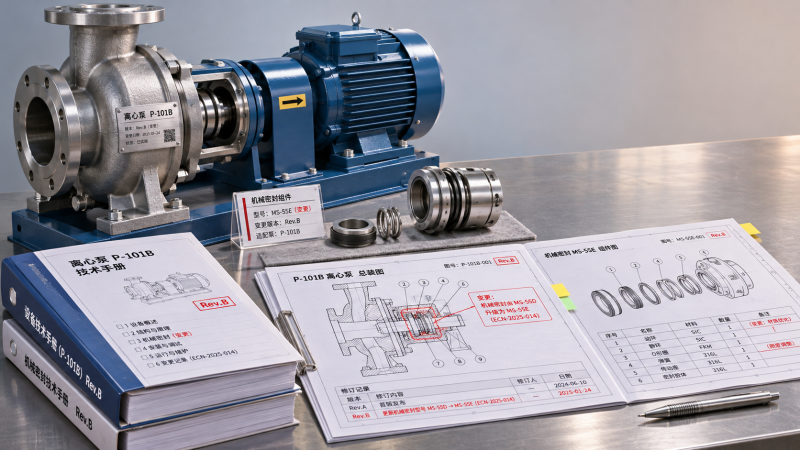
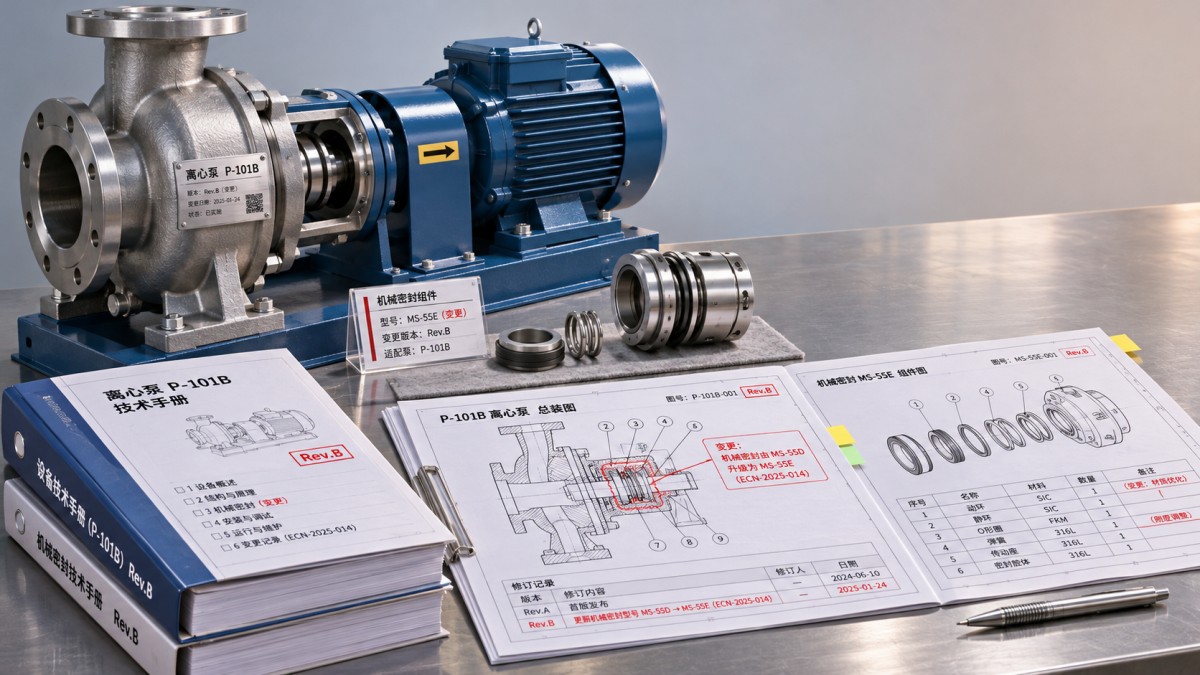
Consider a proposed change to a mechanical seal material. The immediate drawing or purchase specification may need revision, but the review should also ask whether the change affects fluid compatibility, operating limits, installation instructions, spare parts, inspection requirements, or maintenance guidance. Which items actually change depends on the application and supplier evidence; the point is to make the question unavoidable.
A practical change record should link the reason for the change, the affected equipment and documents, the technical assessment, approvals, and the implementation point. That implementation point matters: a revision may apply only to units built after a particular release, or only after an existing unit has been modified. Without that distinction, a correct new instruction can be applied to the wrong equipment.
Do not close the change merely because updated files have been uploaded. Confirm that affected teams can find them and that obsolete instructions have been withdrawn from the places where work is performed. If an urgent field change must proceed before the full document set is revised, issue an authorized interim instruction with a defined scope, owner, and expiry or review point. Track it until the permanent documents are updated.
Control revisions without hiding the history
A controlled repository should make the current approved revision easy to identify and prevent unapproved drafts from being mistaken for working instructions. At a minimum, each controlled document needs an identifier, revision, approval status, date, and clear applicability. A concise change summary helps readers judge what has changed; it is not a substitute for reviewing the technical content.
Keep superseded versions accessible to authorized users for traceability, but label them clearly and separate them from the active set. Old documents may be needed to understand what was built, purchased, or approved at an earlier point. Deleting them can make an investigation harder; leaving them alongside current work instructions can make an error more likely.
Pay particular attention to copies outside the repository: downloaded PDFs, printed shop-floor instructions, contractor portals, and attachments in email chains. A document system cannot guarantee that these copies disappear. Assign someone to notify affected users, replace controlled printouts where applicable, and confirm receipt when the change affects a critical task.
When sources disagree
Do not assume that the newest document automatically wins. A recent supplier manual may be generic, while an older project specification may contain an approved application-specific requirement. Establish a document precedence or conflict-resolution process in the contract and project procedures, then escalate contradictions to the responsible technical authority. Record the resolution and update the affected documents rather than relying on an email explanation.
Treat supplier information as a change input, not a finished answer
Supplier documents are essential, but receiving a new revision does not mean it can be adopted without review. Check the equipment model and configuration, the scope of the change, and whether the revised guidance affects the project’s approved design or operating conditions. Ask for clarification when a change notice is vague, especially where material compatibility, pressure boundaries, torque instructions, or maintenance intervals are involved.
The reverse is also true: an internal design change can make a supplier instruction incomplete. A change to a pumped fluid, process temperature, or cleaning chemical may require engineering and the supplier to reassess existing guidance. Keep the correspondence linked to the equipment record so the reasoning is not lost when project personnel move on.
For outsourced machining or die-casting, include drawing revisions, inspection criteria, and approved deviations in the same conversation. A revised component drawing is of limited use if the supplier is still working from an earlier inspection plan. Procurement should know which revision forms part of the purchase order and how later changes will be communicated and accepted.
Review against the installed configuration and field experience
Scheduled reviews catch deterioration that individual change notices miss. Set review intervals according to risk, frequency of change, and the project phase rather than imposing one calendar on every document. Commissioning procedures may need close attention during startup; stable reference material may need less frequent review unless a change triggers it.
Use reviews to compare documentation with what is actually installed. Check equipment tags and configurations, approved deviations, modifications, open technical queries, and commissioning records. A procedure that was correct at design freeze may no longer describe the delivered assembly. Conversely, an as-built drawing should not be assumed accurate simply because it carries an as-built label; it still needs verification against the project’s handover process.
Invite technicians and service engineers to flag instructions that are ambiguous or impractical. Ask them to identify the document, step, equipment configuration, and observed problem. A note such as “access is blocked by the installed guard” is more actionable than “procedure needs improvement.” Route safety-related observations for prompt assessment rather than waiting for the next routine review.
Check standards and references in context
Engineering teams may work with ISO, DIN, ASME, or JIS references across machining, fastening, fluid control, and other disciplines. A standard’s appearance in a document does not establish that it applies to every project or that a later edition has automatically replaced the specified one. Check the applicable edition, contractual requirements, local rules, and any approved project-specific interpretation with the responsible specialists.
Technical intelligence sources such as G-PME can help teams identify questions across machining, sealing, pumps, molds, and industrial lubricants. They should support—not replace—the controlled project documents, supplier evidence, and qualified engineering judgment needed for a particular application.
Make the handover a controlled transition
A document package is not ready for handover simply because every expected file is present. Check that it describes the delivered configuration, that outstanding changes and deviations are visible, and that operations knows where to find the approved information. Transfer ownership of the document register and open actions to named roles; otherwise, the documentation process can stop on the day the project team leaves.
A useful final test is to pick a maintenance task and follow the trail from the equipment tag to the applicable drawing, procedure, and spare-parts information. If the team cannot tell which revision applies without asking the original project engineer, the handover needs more work. Resolve that uncertainty before it becomes a field decision made under time pressure.
Recommended News
 China Extends Tariff Pause as US Renews Section 301 ExemptionsChina extends its tariff pause as the US renews Section 301 exemptions. Discover what the measures mean for machinery, seals and trade costs.
 How reshoring affects CNC industry investment in the USAExplore how reshoring shapes CNC industry investment in the USA, from machine purchases and automation to supply chain risks and smarter capital decisions.
 How to keep application engineering support documentation currentKeep application engineering support documentation current with practical guidance on ownership, change control, supplier updates, and reliable handovers.
 When is a scraper chip conveyor system suitable for CNC swarf?Is a scraper chip conveyor system right for your CNC swarf? Explore chip types, coolant filtration, capacity and wear to make a confident choice.
 Which ISO and ASME standards apply to precision part drawings?Which ISO and ASME standards matter for precision part sourcing? Discover key drawing, tolerance and inspection requirements to source with confidence.
 How to compare high-pressure pump suppliers using pressure stability test dataHow do I shortlist the right high-pressure pumps supplier for stable pressure? Compare test data, pressure traces and operating conditions with this practical guide.
 How to verify tight tolerances in custom machining solutionsVerify custom machining solutions tight tolerance requirements with practical guidance on inspection methods, measurement uncertainty and reliable acceptance decisions.
 How to measure spindle nose runout with a dial indicatorMeasure spindle nose run out with a dial indicator. Learn how to set up safely, calculate TIR, and compare results with the right specification.
 How to evaluate 5-axis machining suppliers in North AmericaEvaluate 5 axis machining North America suppliers with confidence. Compare capabilities, quality controls, lead times, and total costs before you commit.
 How do tungsten price changes affect cutting tool costs?Explore tungsten price impact on cutting tool costs, learn how to assess supplier increases, and find smarter ways to control machining costs.
 CISA Releases Early-November Prices and Indices for Eight Major Steel ProductsCISA steel prices and indices for eight major products offer a market reference for procurement and cost planning. Explore what buyers should verify.
 How to size a CNC surface grinding machine for your workpiecesChoose the right surface cnc grinding machine with practical guidance on travel, clearance, load capacity and accuracy for your workpieces.
 When does pneumatic clamping suit a machining operation?Pneumatic clamping system machining: discover when fast, repeatable workholding makes sense, and how to assess cutting forces, part distortion and safety.
 How application engineering support improves product selectionApplication engineering support improves product selection by aligning specifications with real operating conditions. Discover how to compare options with confidence.
 What affects the price of an industrial air compressor?Understand what affects air compressors price, from capacity and controls to installation and energy costs. Compare quotes and choose the best-value system.
 How mold temperature affects high-precision die castingSee how high precision die casting mold temperature affects tolerances, defects, and tool life—and learn what evidence to request from suppliers.
 How to verify quality standards when selecting mechanical sealsProduct selection guidance for mechanical seals: verify quality standards, material traceability, certifications, and test evidence before you buy.
 Tungsten Prices Rise as Ore Quotes Lead Gains, Adding Pressure on Tool CostsTungsten prices are rising as ore quotes climb, putting pressure on carbide and cutting tool costs. Discover what buyers should watch next.
 How ISO 230-1 addresses machine tool static stiffness testingMachine tool stiffness ISO testing explained: discover how ISO 230-1 guides force-deflection measurements and supports meaningful machine comparisons.
 How to check whether a bulletproof vest is NIJ certifiedLearn how to verify bulletproofvests on the official NIJ Compliant Products List, match labels and configurations, and avoid misleading certification claims.
 How to assess a lubricants supplier's delivery reliabilityAssess a lubricants supplier with practical checks on delivery records, stock availability and contingency plans to reduce supply risks and make confident sourcing decisions.




















Search News
Popular Tags