
Why Thick-Food Filling Drifts: A Pump Troubleshooting Guide
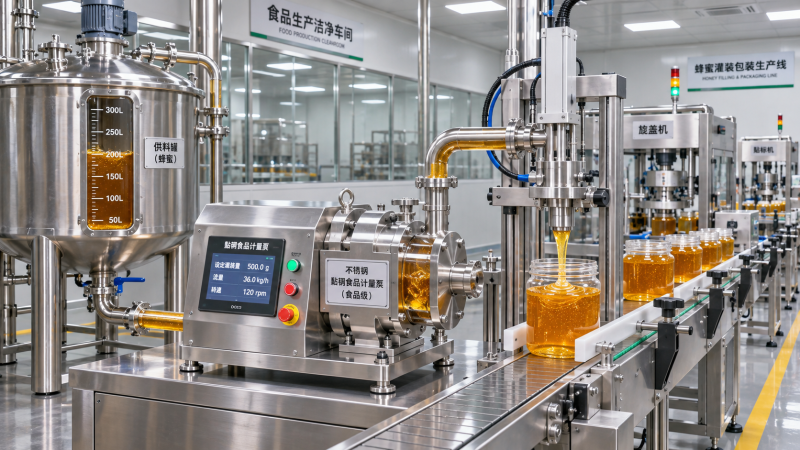
A filling line can pass its morning check and then begin to underfill by lunch. Operators turn up the pump, the next containers overshoot, and production stops while everyone argues about whether the machine is faulty. With honey, jam, chocolate spread, nut paste or a dense condiment, this pattern often reflects a change in the product or flow path as much as a change in the pump. A useful investigation therefore follows the material from the supply vessel to the package and measures each step.
A high-viscosity food metering pump is intended to move and dose difficult, thick products. The Xingyuan product page describes a wide, smooth internal flow path and discusses foods such as honey, jam, chocolate spread and peanut butter. It also describes several possible positive-displacement mechanisms. The exact mechanism and materials of a quoted unit must be confirmed from its current drawing and bill of materials. That distinction matters because a troubleshooting step suitable for one design may be wrong for another.
First isolate the measurement problem
Before adjusting anything, define what “drift” means. Are all fills low, or do high and low fills alternate? Does the error appear only at start-up, after a pause, near the end of a vessel or when the line accelerates? Is the result measured by container weight, volume, level or an in-line meter? A check based on a small number of packages can be distorted by container tare variation, product temperature, trapped air or an inconsistent sampling method.
Collect a short, time-stamped sequence of fill results along with product temperature, vessel level, pump speed or stroke setting, cycle time and line speed. Record a sample at the pump outlet if the process allows it. If outlet delivery is stable but package weight varies, the fault may lie in the nozzle, cut-off, container handling or weighing system. If delivery is unstable before the nozzle, inspect the suction and pump conditions. Separating these zones prevents unnecessary replacement of a functioning pump.
Keep food safety in the investigation. Any temporary sampling point, hose or measuring vessel must be suitable for product contact and managed under the plant’s hygiene procedure. Do not bypass guards, pressure protection or sanitation controls for a faster test.
Symptom: the pump starves as the tank empties
A pump cannot meter a consistent amount if it receives an inconsistent supply. Thick foods may not flow freely toward a bottom outlet, particularly when the vessel level drops or the material becomes cooler. A long, narrow or sharply bent suction route increases resistance. A partially closed valve, blocked strainer or undersized connection can create a similar pattern. The pump may still run at its commanded speed while the amount entering each displacement cycle falls.
Check the actual tank level at the time the problem begins. Inspect the suction line for restrictions, closed valves, collapsed flexible sections and product build-up. Verify that any feed hopper or transfer system delivers material to the pump at the required rate. If the product forms a bridge or void near the outlet, ask the process engineer whether vessel geometry, agitation or a suitable feed assist should change. Do not simply increase pump speed; faster rotation can make an inadequate inlet condition worse.
Compare the observed suction pressure or vacuum, where instrumentation is available, with the equipment supplier’s permitted operating range. The correct limit depends on the actual pump and food product. A catalogue claim about self-priming does not remove the need to design a viable inlet.
Symptom: output changes when temperature changes
Many thick foods are highly temperature sensitive. A modest temperature shift can change how easily a product flows, how it coats a surface and how cleanly it breaks at the nozzle. Chocolate-based products may also have process-specific crystallization requirements. A pump setting that worked with a warm trial batch may deliver a different result after the supply line cools during a stop. The answer is to measure product temperature at meaningful points, not to assume the vessel display tells the whole story.
Record temperature in the supply vessel, at the pump inlet and near the filling head during the period of drift. Inspect any jacket, heating line or insulation for cold spots and uneven control. If the food contains particulates, evaluate whether heating or agitation changes texture and particle distribution. Any process adjustment must remain within the product’s approved recipe and food safety limits.
For product trials, test across the expected operating temperature range. A single result at an ideal laboratory temperature cannot establish stability on a line that starts cold, pauses for cleaning and resumes during a long production shift.
Symptom: fills vary randomly or contain bubbles
Air can enter through a low supply level, a leaking inlet connection, a poorly primed line or vigorous mixing that entrains bubbles. Compressible air changes the relationship between commanded displacement and delivered food, and it can make a cut-off nozzle spit or leave a trailing tail. In a clear test line, bubbles may be visible; in an opaque system, the evidence may be intermittent fill weight and irregular sound or pressure behavior.
Inspect inlet gaskets, clamps and seals under the conditions that produce the fault. Check whether the tank outlet remains covered and whether product is being poured or mixed in a way that traps air. Prime and vent the system according to the equipment procedure, then repeat the measurement sequence. If the problem improves temporarily and returns, investigate where air re-enters rather than treating repeated priming as the permanent fix.
Air is not the only cause of random variation. A worn check valve, inconsistent actuator response, unstable control signal or product pieces intermittently blocking a passage can produce similar symptoms. Evidence from pressure, timing and product observation helps distinguish them.
Symptom: the first containers after a pause are wrong
Start-up and restart conditions are different from steady operation. Product can cool in the line, settle in a vessel, separate at an interface or dry near the nozzle. A pump may also restart before the downstream valve or conveyor is ready. Identify whether the first error is repeatably high or low, and how many cycles pass before stable filling resumes.
Review the start sequence: supply confirmation, temperature check, prime, pump enable, valve timing, nozzle position and weight verification. If a pause requires a purge or a controlled number of trial fills, define the procedure and account for the food loss explicitly. Do not quietly discard inconsistent packages without identifying why the transient occurs. A reproducible restart problem is an opportunity to improve the sequence, not an unavoidable feature of viscous filling.
For food that can separate, take samples from the vessel and line at the beginning and end of a pause. The plant’s quality team should decide whether the restart material remains within specification. A mechanical adjustment cannot correct a product that has changed composition.
Use this fault map before changing settings
When the pump itself needs attention
After inlet, temperature and downstream causes have been evaluated, inspect the pump under the manufacturer’s maintenance procedure. Wear in a displacement element, damaged seals, product build-up or incorrect assembly can change delivery. Do not infer wear solely from age. Compare performance against a baseline at a defined product condition, speed and discharge pressure. If the unit uses gears, screws or a plunger, its inspection points and allowable clearances will differ.
Confirm that product-contact materials, elastomers and lubricants are appropriate for the food and cleaning chemistry. The product page discusses stainless steel and food-contact material options, but the final configuration should be confirmed for the supplied unit. A substitution in seal material can affect cleaning compatibility or service life. Document the exact replacement part and the reason for replacement so the next technician can understand the history.
Calibration also needs context. A calibration made with water may establish basic mechanical delivery but may not predict thick-food performance. Verify actual fills with the intended product across the operating range, using a sampling method approved by quality control. If the plant changes recipes, temperatures or package sizes frequently, define a repeatable verification routine for each changeover.
Build a trial that answers the real buying question
If the current system cannot handle a new product, write a process brief before requesting another pump. Include the food’s expected viscosity range at operating temperature, particle content, permitted shear, target fill size, acceptable variation, line speed, cleaning method and available inlet conditions. State whether the product must be heated, mixed or protected from air. These details determine the right pump and the equipment around it.
During a supplier trial, ask for a continuous run with the actual food or an agreed representative material. Test start-up, steady state, a pause, restart and a low-vessel condition. Measure fill results and product temperature at each stage. Inspect cleanability and the time needed to change seals or contact parts. A short demonstration of smooth transfer is valuable, but it does not answer whether the full filling process can repeat day after day.
Finally, identify who owns the controls interface between pump, valve, conveyor and checkweigher. Many apparent pump faults are synchronization faults. A clear responsibility matrix makes commissioning faster and gives maintenance staff a path to diagnose future drift without guessing.
FAQ
Does a high-viscosity pump guarantee accurate filling?
No. Actual accuracy depends on product condition, inlet supply, pump configuration, control timing, nozzle behavior and the measurement method. A supplier claim should be tested with the intended food and an agreed acceptance plan.
Should operators increase pump speed when fills fall low?
Only after checking that the pump is properly supplied. If the inlet is starved, higher speed may increase the mismatch between command and delivered quantity.
Why do fills change after cleaning?
Possible causes include incomplete reassembly, changed seals, retained rinse water, air in the line or a reset control parameter. Compare the post-cleaning state with a documented baseline before changing the product recipe.
Can one pump cover honey, jam and nut paste?
Possibly, but the foods differ in temperature behavior, particles, shear sensitivity and cleaning needs. Each product requires its own trial and approved operating window.
Facing technical bottlenecks in manufacturing or looking for more efficient industrial solutions? Leave your details below and let the engineering experts at G-PME solve them for you.
We respect your privacy. Your information is strictly confidential.
Recommended News
 Why Thick-Food Filling Drifts: A Pump Troubleshooting GuideDiagnose inconsistent high-viscosity food filling by checking temperature, suction, air, flow path, controls and cleaning before changing a metering pump.
 What pressure stability data should a pump supplier provide?How do I shortlist the right high-pressure pumps supplier for stable pressure? Learn which test data to request and compare bids with confidence.
 Why Fluid Dosing Drifts: Fixing Air Locks, Backpressure, and CalibrationImprove fluid dosing solutions by diagnosing air locks, backpressure, and calibration drift. Discover practical checks to restore reliable delivery and reduce costly dosing errors.
 How to verify CE certification for industrial pumps before installationIndustrial pumps CE certified? Learn how to verify declarations, documentation, hazardous-area suitability, and installation compliance before commissioning.
 How to size high pressure pumps for stable chemical injection ratesHigh pressure pumps sizing guide for stable chemical injection rates—learn how to balance flow range, pressure, suction conditions, materials, and controls for reliable dosing.
 How Do I Choose Fluid Control Components for Corrosive Media?How do I choose fluid control components for corrosive media? Explore material compatibility, seals, pressure ratings, and expert selection tips for safer, longer-lasting systems.
 Which medical grade materials withstand repeated sterilization in pumps?Medical grade materials for sterilizable pumps: compare 316L, PEEK, PPSU, PTFE, silicone, and EPDM for steam, radiation, and chemical resistance.
 How to Compare Vacuum Pump Systems for Flow Rate, Vacuum Level, and Maintenance LoadVacuum pump systems compared by flow rate, vacuum level, and maintenance load. Learn how to choose the right setup for reliable performance, lower downtime, and smarter lifecycle cost.
 How to Compare High Pressure Pumps in Europe for Industrial Cleaning and Fluid TransferHigh pressure pumps Europe buyers trust should be compared by pressure-flow balance, material compatibility, compliance, and service support. Learn how to choose the right pump with confidence.
 Home Healthcare Costs Breakdown: Equipment, Services, and Insurance Questions to AskHome healthcare costs explained: compare equipment, in-home services, insurance limits, and hidden fees so you can budget smarter and choose care with confidence.
 Agrochemicals Explained: Main Types, Field Uses, and Common Handling RisksAgrochemicals explained clearly: explore main types, field uses, application best practices, and common handling risks to improve safety, compliance, and crop performance.
 Vertical Farming Technology in Urban Food Production: Systems, Limits, and ROIVertical farming technology explained for urban food production: compare systems, key limits, maintenance risks, and ROI drivers to choose a scalable, profitable setup.
 How to Choose Irrigation Equipment for Farms, Landscapes, and GreenhousesIrrigation equipment selection starts with system fit. Learn how farms, landscapes, and greenhouses can improve water efficiency, reliability, and long-term cost control.
 Bottling Lines Selection Guide: Capacity, Automation Level, Changeover, and MaintenanceBottling lines selection guide covering capacity, automation, changeover, and maintenance. Learn how to compare suppliers, cut downtime, and choose a line built for lasting ROI.
 How to Choose Fluid Control for Accurate DosingFluid control for accurate dosing: learn how to compare pumps, valves, materials, and system design to improve precision, reduce waste, and choose a reliable, cost-efficient solution.




Search News
Popular Tags