
What pressure stability data should a pump supplier provide?
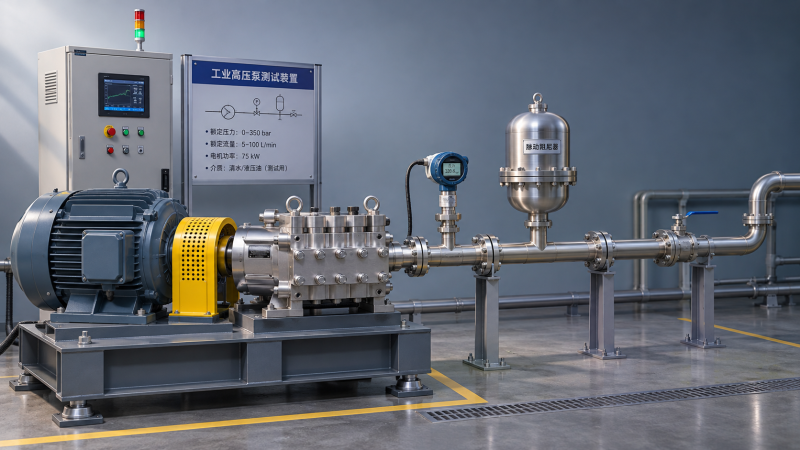
If you’re asking, “how do I shortlist the right high-pressure pumps supplier for this application for stable pressure?”, start by requesting evidence under your actual operating conditions. A credible supplier should provide pressure-versus-flow curves, pulsation measurements, transient response data, and test results across the specified operating range. For procurement teams, comparing test methods, operating conditions, and acceptance criteria makes it easier to identify pumps that can deliver consistent pressure without adding avoidable operating costs.
The distinction matters because a pump can reach the required pressure and still be unsuitable. A unit that holds pressure during a steady factory test may behave differently when a valve closes, fluid viscosity changes, or production demand drops. The purchasing question is not simply whether the equipment can produce pressure; it is whether the proposed pump system can maintain acceptable pressure where and when the process needs it.
Define “stable pressure” before requesting quotations
Suppliers cannot provide comparable evidence if each one interprets stability differently. Before issuing an RFQ, work with engineering and operations to describe the duty in measurable terms. Identify the normal and maximum discharge pressures, required flow range, fluid properties, temperature range, suction conditions, operating schedule, and expected changes in demand.
Specify the pressure measurement point as well. Pressure at the pump discharge is not necessarily the pressure at a distant nozzle, injection point, or process manifold. Pipe losses, valves, accumulators, and changes in elevation can all affect what the process receives. If the requirement applies at the point of use, say so explicitly.
Translate the process requirement into acceptance criteria: an allowable steady-state pressure band, a permissible pulsation level, and acceptable overshoot and settling behavior after a defined disturbance. Use limits established by the process owner rather than adopting an arbitrary percentage from a supplier’s brochure.
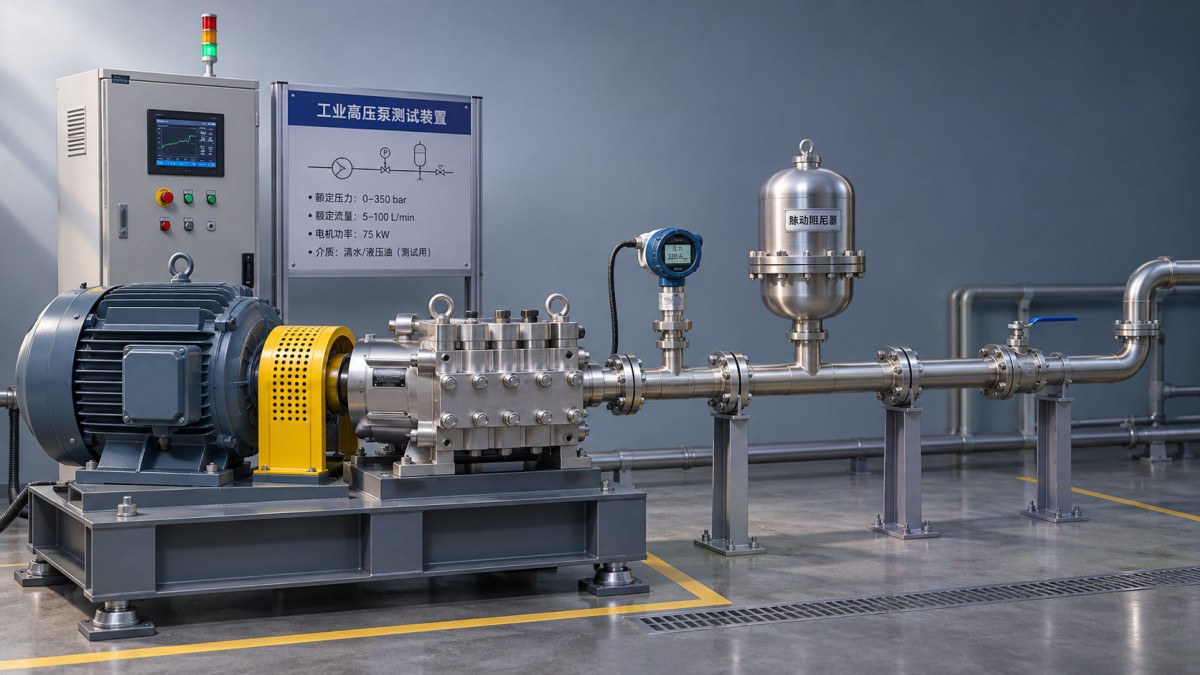
The pressure stability data a pump supplier should provide
A useful submission combines performance curves with measured operating data. Ask whether each result comes from a test of the offered unit, a representative unit, a calculation, or a previous installation. Each can inform a decision, but they are not equally strong evidence.
Pressure-versus-flow performance
Request curves covering the full operating envelope, not just a single rated duty point. The presentation depends on pump design: a centrifugal pump is commonly characterized by head-versus-flow curves at specified speeds, while a positive-displacement pump may be described by flow, speed, and differential pressure, including the effects of internal leakage.
The supplier should identify fluid properties, rotational speed, inlet pressure, temperature, and test tolerances. Ask how the pump behaves at minimum, normal, and maximum demand, and whether the proposed operating points fall within the manufacturer’s permitted range. For variable-speed packages, request curves or performance data at relevant speeds.
A curve alone does not prove stable pressure. It does, however, reveal whether the selected pump has enough operating margin and whether the control system is being asked to compensate for a poor equipment match.
Pulsation measurements and pressure traces
For reciprocating and other positive-displacement pumps, pressure pulsation can be central to the purchasing decision. Ask for measured pressure traces at representative flow rates and discharge pressures, with and without the proposed pulsation dampener if practical. Rotary and centrifugal systems can also experience pressure fluctuations caused by controls, piping, or operating conditions.
The report should state whether pulsation is expressed as peak-to-peak pressure, a percentage of mean pressure, or another measure. It should also identify the sensor location, sampling rate, measurement duration, and relevant frequency range. A single averaged pressure reading can conceal short peaks that affect instruments, fittings, seals, or product quality.
Check whether auxiliary equipment is part of the result. A pump tested with a dampener, particular pipe layout, and carefully tuned controller should not be assumed to deliver the same trace when supplied as a bare pump.
Transient response under changing demand
Processes rarely remain at one set point all day. Request pressure-versus-time plots for disturbances relevant to the application, such as a specified flow increase, a set-point change, or a controlled valve movement. The useful data includes pressure overshoot or undershoot, recovery or settling time, and any sustained oscillation.
Ask the supplier to describe the starting conditions, size and timing of the disturbance, control settings, and final acceptance criteria. A fast recovery may look attractive, but excessive overshoot can still be unacceptable. Conversely, a smooth response that takes too long to recover may interrupt a dosing or cleaning cycle.
Where emergency shutdowns or rapid valve closures are credible, request an assessment of pressure surges for the complete system. These events can involve piping and protective devices beyond the pump supplier’s standard scope, so establish who is responsible for the analysis.
Repeatability and extended operation
A short demonstration may not show how pressure changes as the fluid warms, components wear in, or operating conditions shift. Request available test results covering repeated starts, relevant load changes, and a sustained run at agreed duty points. The test duration should reflect the application and be agreed before ordering; there is no universal duration that proves suitability for every process.
For metering duties, also ask for flow accuracy and repeatability at the specified back pressures and stroke or speed settings. Stable discharge pressure does not, by itself, demonstrate accurate dosing.
Make test results comparable across the shortlist
Two suppliers may submit convincing graphs that cannot be compared. One might use water at ambient temperature; another may calculate performance using the specified fluid. One may measure immediately downstream of a dampener, while another measures at the pump outlet. Neither result should be dismissed automatically, but the differences must be visible.
Where possible, issue a common response sheet with the RFQ. Suppliers can still explain their own test methods, but they should also map results to the same duty points and units. If comparable testing is unavailable before award, ask for a priced test option and agree on what happens if acceptance criteria are not met.
Separate pump performance from package and system performance
A stable-pressure package may depend on a variable-speed drive, pressure transmitter, controller, relief valve, accumulator, or pulsation dampener. These are not interchangeable accessories. Their sizing, location, and control settings can determine whether the process sees a steady pressure.
Ask for a scope boundary drawing and a component list. Who selects the pressure sensor? Is commissioning and control tuning included? Does the quoted dampener require a particular precharge or maintenance routine? Who checks that the relief device protects the system without compromising normal control? Clear answers reduce the risk of buying a pump that needs substantial additional equipment before it can meet the duty.
For high-pressure installations, pressure ratings must be appropriate for the complete assembly, including fittings, seals, hoses, and instrumentation, as well as the pump. Confirm the design pressure and temperature basis and the applicable standards or project specifications with the responsible engineer. References to ISO, ASME, or other standards are useful only when the supplier identifies the relevant edition, scope, and evidence of conformity; a general standards claim is not a substitute for a test report.
Turn pressure stability into a commercial comparison
The lowest quotation may exclude the very items needed to achieve the required pressure band. Evaluate the installed package and expected operating expenditure, not only the pump price. A practical bid comparison should include:
- Included equipment: drives, controls, pulsation dampeners, instrumentation, relief devices, and required accessories.
- Testing and documentation: factory test fees, witness options, calibration records, pressure traces, and final reports.
- Installation and startup: commissioning support, control tuning, training, and any specialist services required at site.
- Operating costs: expected power consumption at representative duty points, maintenance intervals, and consumables where estimates are available.
- Supply continuity: recommended spare parts, quoted lead times, repair support, and availability of critical seals or valves.
Request assumptions alongside each cost estimate. Energy use calculated at maximum flow around the clock can misrepresent a process that normally runs at partial load; an optimistic maintenance allowance can be equally misleading. Use the same operating profile for each bidder and treat uncertain costs as ranges rather than facts.
What to include in the RFQ and acceptance plan
A strong RFQ gives suppliers enough information to propose an appropriate design while preventing important gaps from moving into contract negotiations. Alongside the process conditions and stability limits, include the following requests:
- Identify the proposed pump technology and explain how it meets the full pressure and flow range.
- Provide applicable performance curves and pressure stability evidence, clearly distinguishing measured from predicted results.
- List all components required to achieve the stated performance and identify exclusions.
- Describe the proposed factory acceptance test, including duty points, disturbances, measurement locations, instruments, and pass/fail criteria.
- State what site conditions or customer-supplied equipment could affect the result.
- Provide a plan for investigation and corrective action if an agreed test fails.
Define whether acceptance takes place at the supplier’s factory, at site, or in stages. A factory test offers a controlled comparison, but it may not reproduce the actual fluid, pipework, or process demand. Site acceptance can verify performance at the point of use, provided both parties agree on the operating conditions and responsibilities beforehand.
Warning signs during supplier evaluation
Be cautious when a bidder promises “constant pressure” without defining the measurement point or tolerance. Other concerns include a curve that stops short of the required operating range, pulsation figures without a test method, or a stability claim dependent on equipment missing from the quotation.
A limited data set is not always a reason to reject a supplier. For a new configuration or unusual fluid, an honest engineering estimate supported by a sensible test plan may be more useful than an impressive but irrelevant historical graph. The important question is whether the supplier can explain uncertainty and agree on how performance will be verified.
The strongest shortlist combines fit-for-duty design, comparable evidence, a complete package scope, and a workable acceptance plan. That gives procurement a firmer basis for comparing cost—and gives the operations team a better chance of receiving the stable pressure it actually needs.
Recommended News
 How coating thickness affects carbide tool coating costsCarbide coating cost analysis: discover how thickness affects tool prices, wear and cost per part, and learn when a premium coating is worth the investment.
 What pressure stability data should a pump supplier provide?How do I shortlist the right high-pressure pumps supplier for stable pressure? Learn which test data to request and compare bids with confidence.
 How to evaluate an industrial supplier's delivery reliabilityStrengthen industrial procurement support and supplier evaluation with practical checks for delivery records, lead times, capacity, and recovery plans.
 Stonepeak Completes 65% Castrol Acquisition; Former Shell CEO to ChairStonepeak's 65% Castrol acquisition brings new leadership as former Shell CEO Ben van Beurden becomes chair. Explore potential implications for lubricant buyers and suppliers.
 How to inspect welded iron pipes for seam defectsInspect weldedironpipes for seam defects with a practical guide to visual checks, NDT methods, acceptance criteria, and safe repair decisions.
 How to assess electronics manufacturing solutions in North America for production capacityAssess electronics manufacturing solutions North America teams can rely on. Compare capacity, supply risks and quality controls to choose the right production partner.
 How to reduce thermal cracking in die casting mold insertsReduce thermal cracking in die casting mold inserts with practical tips on temperature control, cooling, steel selection and maintenance to extend tool life.
 Can portable telemedicine devices work with poor connectivity?Telemedicine hardware portable devices can support care with poor connectivity. Discover what works offline and how to evaluate reliable remote care workflows.
 How to choose rugs and carpets for high-traffic roomsDiscover how to choose rugs and carpets for high-traffic rooms. Compare materials, construction, cleaning needs, and fit to find a practical, lasting option.
 What affects the wholesale price of EPS sandwich panels?Compare EPS sandwich panels wholesale prices and discover how core density, steel facings, order size, and delivery costs affect your project budget.
 Japan's Machine Tool Export Controls Accelerate China's Five-Axis SubstitutionJapan's machine tool export controls are accelerating China's five-axis CNC substitution. Explore the implications for buyers and supply chains.
 Why do automatic mechanical watches stop when not worn?Why do automaticmechanicalwatches stop when unworn? Discover how power reserve works, how to restart your watch, and when to seek professional help.
 Choosing high-tensile bolts for industrial fastening in EuropeIndustrial fastening Europe: Learn how to select high-tensile bolts, coatings and standards for reliable joints, accurate preload and safer assembly.
 How does excess inventory affect fashion retail profitability?Discover how excess inventory erodes fashion retail profits through markdowns and holding costs, and learn practical ways to protect margins and free up cash.
 US Adds 50% Section 338 Tariff on Canadian Seals and Other ProductsUS Section 338 tariffs add 50% to covered Canadian seals, lubricants and other goods. Explore the potential impact on sourcing and supply chain costs.
 Can lean manufacturing reduce changeover time in injection molding?Discover how lean manufacturing can reduce injection molding changeover time with SMED, better preparation, standardized processes, and quality controls.
 How to estimate the payback period for a CNC machining centerEstimate your CNC machining center investment payback with a practical formula, installed cost checklist, cash-flow examples, and risk analysis.
 How cloud computing supports remote CNC machine monitoringDiscover how cloud computing enables remote CNC machine monitoring, from real-time alerts and troubleshooting to secure integration and smarter pilot decisions.
 LANXESS and BPCL to Explore Immersion Cooling Fluids and Advanced LubricantsLANXESS and BPCL are exploring immersion cooling fluids and advanced lubricants. Discover what the proposed collaboration could mean for buyers and suppliers.
 What OEM manufacturing support is needed for smart actuator testing?Explore OEM manufacturing support for smart devices: precision fixtures, firmware access, load testing, and traceable results. Learn what to demand for reliable smart actuator validation.
 How minimum order quantities affect wholesale bedding set costsBuying bedding sets wholesale? Discover how minimum order quantities affect unit prices, inventory risks, and total costs—and learn to negotiate smarter deals.












Search News
Popular Tags