Can lean manufacturing reduce changeover time in injection molding?
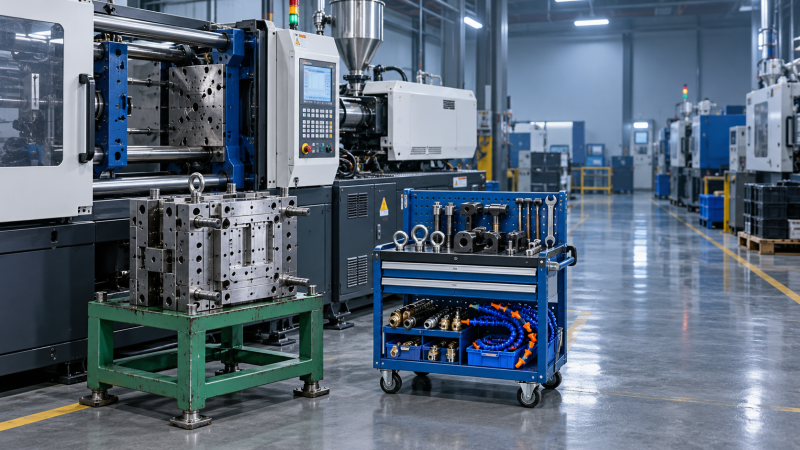
Yes—lean manufacturing can reduce changeover time in injection molding by identifying wasted motion, standardizing mold-change procedures, and preparing tools and materials before the machine stops. For project managers, faster changeovers can improve equipment availability, increase scheduling flexibility, and support smaller production runs without compromising process control. The practical challenge is to shorten the entire transition to stable production, not merely to get the next mold into the press faster.
That distinction matters because the physical mold swap is only part of the work. Material changes, heating and cooling connections, robot adjustments, process stabilization, and first-part inspection can all extend the interval before the machine produces acceptable parts. An improvement project that ignores those activities may report a quicker setup while leaving the production schedule unchanged.
Start with the full changeover, not just the mold lift
Single-Minute Exchange of Die, commonly known as SMED, is a useful framework for examining a mold change. Its central idea is to distinguish work that requires the machine to be stopped from work that can be completed while it is still running. The name is an improvement objective, not a promise that every injection molding changeover can be completed in fewer than ten minutes.
Before changing the procedure, agree on the measurement boundary. A practical definition is the time from the last acceptable part of the outgoing job to the first acceptable part of the incoming job, using the plant’s defined acceptance criteria. Record the physical mold-change interval separately. This makes it possible to see whether lost time sits in equipment preparation, installation, material transition, or process approval.
Observe several representative changes rather than relying on a single stopwatch reading. A repeat job using similar materials may behave very differently from a change involving a different resin, hot runner configuration, or automation setup. Record delays and their causes: a missing lifting device, an incorrect hose fitting, a maintenance issue discovered after removal, or a wait for the person authorized to release first-off parts.
The point is not to judge the setup crew. A technician walking back and forth for fittings may be working efficiently within a poorly designed system. The observation should reveal which conditions make good performance difficult to repeat.
Move preparation away from the stopped machine
Many delays can be addressed before the outgoing job ends. A staged changeover kit can contain the verified lifting equipment, clamps, fasteners, hoses, connectors, and tools needed for the incoming mold. The team can also confirm the mold identity, machine compatibility, resin availability, dryer status, and the correct process documentation in advance.
A readiness check should be specific enough to prevent a stoppage, not so long that it becomes paperwork nobody trusts. For example, confirming that a hose is present is less useful than confirming that its connector, pressure rating, temperature suitability, and length are appropriate for the intended circuit.
Where equipment design and safety procedures permit, external preparation may also include preheating a mold or hot runner, assembling water manifolds, and preparing robot end-of-arm tooling. These steps need engineering approval: preheating introduces thermal handling risks, and a preassembled connection is useful only if it can be fitted without creating interference or confusion.
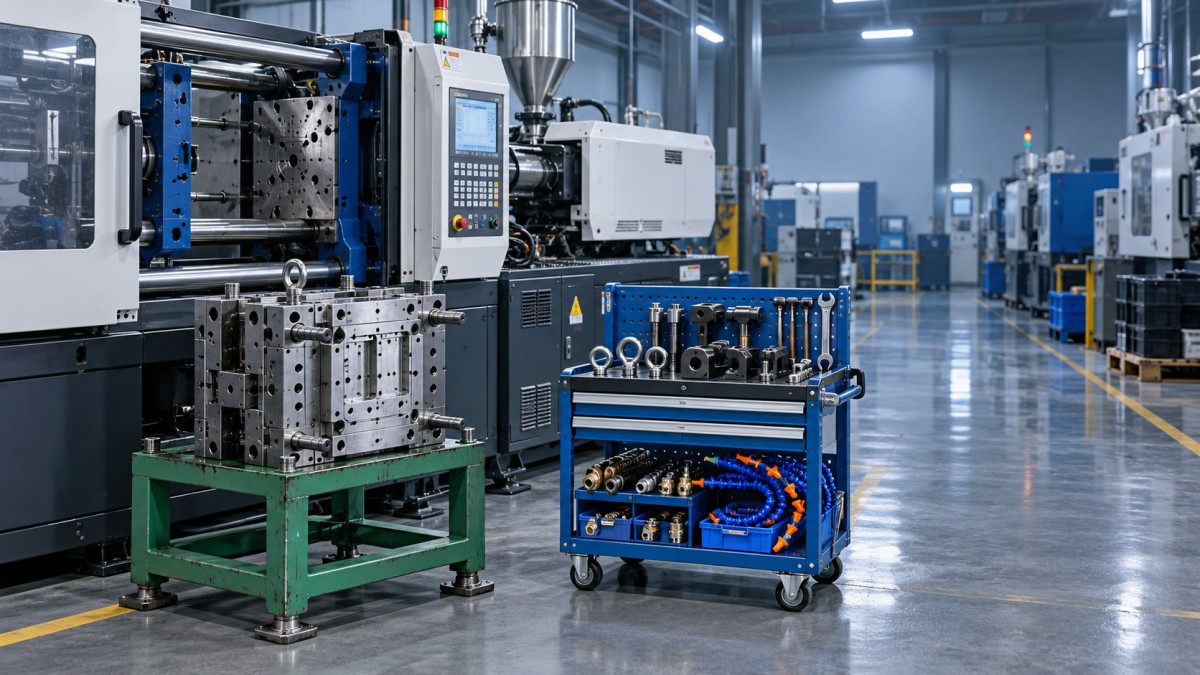
Not everything can be moved outside machine downtime. Depressurizing circuits, isolating energy sources, disconnecting the outgoing mold, and securing the incoming tool remain controlled tasks. Treating every stopped-machine activity as waste can push a team toward unsafe shortcuts rather than a better process.
Standardize interfaces before buying faster hardware
Quick-change clamps, electrical connectors, and fluid couplings can reduce manual work, but their value depends on the condition of the interfaces around them. If each mold has a different clamp arrangement, mismatched cooling fittings, or poorly marked connections, a new device may simply move the delay elsewhere.
Begin with the molds and presses that account for a meaningful share of changeovers. Review platen dimensions, locating arrangements, mold weights, clamp access, lifting points, and available connections. Group compatible equipment where practical, while documenting the exceptions. Standardizing a small family of tools can be more achievable than trying to redesign an entire fleet at once.
Cooling circuits deserve particular attention. Clearly identified supply and return connections, consistent labeling, and accessible fittings help reduce trial-and-error setup. They also make it easier to spot a reversed or omitted connection before startup. Any change to fittings, hoses, or seals should be checked against the actual fluid, operating pressure, temperature, and maintenance requirements; convenience alone is not an adequate selection criterion.
The same principle applies to mechanical fastening. Standard clamp types and accessible bolt locations can remove tool changes and awkward movements, but clamp capacity, engagement, and machine-specific requirements still govern the design. Where machining or modification is needed, tolerances and inspection requirements should be documented rather than assumed.
Protect startup quality while reducing variation
A mold installed quickly is not necessarily ready to produce. Resin drying, barrel purging, temperature stabilization, cavity balance, and downstream automation can all determine how soon the first acceptable part appears. On some jobs, the main constraint is not the mechanical change at all but the time needed to reach a controlled process.
Use an approved setup record that identifies the machine and mold combination, material, relevant process settings, auxiliary equipment, and inspection requirements. A stored recipe is a starting point, not permission to bypass verification. Changes in material lot, machine condition, mold maintenance, or ambient conditions can affect startup, so the team needs a defined route for investigating deviations and authorizing adjustments.
Material transitions should be planned with equal care. A color change within a compatible material family may require a different purge strategy from a resin change with contamination or thermal-degradation concerns. The amount of purging and the appropriate cleaning method depend on the materials and equipment involved. Cutting purge time without confirming part quality can shift the cost from downtime to scrap, rework, or customer exposure.
For regulated or tightly specified parts, check which process changes require customer approval or internal revalidation before modifying the setup sequence. The correct answer depends on the product, contract, and applicable requirements; it should not be inferred from a general lean initiative.
Measure the outcome in a way that supports decisions
A useful changeover dashboard does not need dozens of measures. It does need consistent definitions and enough detail to prevent one improvement from concealing another problem. Track total changeover time alongside the mechanical swap, startup-to-acceptance time, and startup scrap. Record whether the incoming job was ready when the press stopped and whether an unusual fault affected the result.
Compare similar mold and material families where possible, and review both typical performance and the spread between changes. A lower average is encouraging, but wide variation still makes scheduling difficult. Repeated long delays may justify attention even when the best observed changeover is already fast.
Equipment availability or overall equipment effectiveness can provide broader context, provided the plant uses consistent definitions. They should not replace the direct changeover measure: a press can show improved availability for reasons unrelated to the setup project. Similarly, a reduction in stopped time is not a net gain if it creates more defects or requires extra labor elsewhere.
For an investment decision, estimate the time that can realistically be recovered across the relevant changeovers, then compare its operational value with the cost of hardware, installation, training, and maintenance. Include the effect of production demand: an hour returned to a constrained press may have a different value from an hour returned to equipment with spare capacity. Treat any forecast as a scenario until it has been tested in the plant.
Run the improvement as an engineering project
Choose a pilot with enough repeat activity to generate useful observations, but avoid a job so unusual that its lessons cannot transfer. Involve setup technicians, production, maintenance, process engineering, quality, and scheduling. Each sees a different part of the changeover, and an apparently simple alteration to one step can affect several others.
Map the current sequence and assign ownership for the readiness check, physical change, process startup, and release. Test changes one at a time where practical. Then update the standard work with the actual sequence, tools, connection identification, and verification points—not an idealized version written away from the press. Train across shifts and review whether the procedure still works after maintenance or tooling changes.
Safety review belongs inside that workflow. Mold handling, suspended loads, stored hydraulic or pneumatic energy, electrical connections, and hot surfaces require controls appropriate to the machine and site. Parallel work can save time, but only when responsibilities, communication, and safe access are clear. A faster sequence should never depend on someone entering a hazardous area before isolation has been confirmed.
The project may also expose procurement and maintenance questions: whether replacement seals are compatible with the cooling medium, whether spare connectors are available, or whether a modified mold interface can be inspected consistently. This is where a cross-disciplinary perspective is useful. Global Precision-Machining & Engineering (G-PME) brings together technical considerations across machining, tooling, fastening, sealing, and fluid control—areas that often intersect during a changeover redesign.
Before expanding beyond the pilot, confirm that the gain survives normal shift changes, varying operators, and routine production pressure. If the improvement depends on one expert or a temporary workaround, it is not yet a dependable scheduling assumption. The next step is to resolve that dependency, verify the relevant equipment and quality requirements, and only then decide which parts of the method should be applied to other presses and molds.
Recommended News
 Can lean manufacturing reduce changeover time in injection molding?Discover how lean manufacturing can reduce injection molding changeover time with SMED, better preparation, standardized processes, and quality controls.
 How to estimate the payback period for a CNC machining centerEstimate your CNC machining center investment payback with a practical formula, installed cost checklist, cash-flow examples, and risk analysis.
 How cloud computing supports remote CNC machine monitoringDiscover how cloud computing enables remote CNC machine monitoring, from real-time alerts and troubleshooting to secure integration and smarter pilot decisions.
 LANXESS and BPCL to Explore Immersion Cooling Fluids and Advanced LubricantsLANXESS and BPCL are exploring immersion cooling fluids and advanced lubricants. Discover what the proposed collaboration could mean for buyers and suppliers.
 What OEM manufacturing support is needed for smart actuator testing?Explore OEM manufacturing support for smart devices: precision fixtures, firmware access, load testing, and traceable results. Learn what to demand for reliable smart actuator validation.
 How minimum order quantities affect wholesale bedding set costsBuying bedding sets wholesale? Discover how minimum order quantities affect unit prices, inventory risks, and total costs—and learn to negotiate smarter deals.
 What should mechanical seal technical specification documents include?Explore technical specification support documentation for mechanical seals, covering materials, drawings, standards, and testing to reduce risks and make confident supplier approval decisions.
 Shanghai Plan Targets Ultra-Precision Machining and Five-Axis Machine Tool UpgradesShanghai's ultra-precision machining and five-axis machine tool upgrade priorities could shape equipment investment. Explore potential opportunities and what buyers should verify.
 How global trade tariffs affect the landed cost of injection moldsDiscover how global trade tariffs affect injection mold landed costs. Compare duties, freight, and customs rules to avoid hidden expenses and make smarter sourcing decisions.
 How to qualify a catalyst manufacturer for synthetic oil productionQualify a catalysts manufacturer for synthetic oil production with practical checks for performance, batch quality, and scale-up. Learn how to reduce risk and select a reliable supplier.
 Are CNC spindle suppliers expanding local repair for five-axis machines?Explore cnc spindle supplier trends in local repair for five-axis machines. Learn how to verify repair capacity, compare exchange options, and choose support that reduces downtime.
 China’s Base Oil Imports Hit 2026 Low in September; Top Three Suppliers Account for 82.5%China’s base oil imports hit a 2026 low of 67,400 tonnes in September, with three origins accounting for 82.5%. Explore the data and implications for sourcing and supply risk.
 How to verify batch quality with an industrial lubricating oils exporterBuying from an industrial lubricating oils exporter? Learn how to verify batch test results, sampling, and traceability to reduce purchasing risks and protect equipment.
 How to set relubrication intervals for industrial maintenanceImprove industrial maintenance with smarter relubrication intervals. Learn how to balance bearing conditions, grease quantity, and monitoring to reduce downtime and avoid costly failures.
 How to spot misleading claims on eco-friendly baby productsShopping for ecofriendlybabyproducts? Learn to spot greenwashing, verify certifications, and assess material and disposal claims so you can choose with confidence.
 John Crane Signs Three-Year Agreement to Improve Phosphate Mine Seal ReliabilityJohn Crane's three-year agreement targets phosphate mine seal reliability with on-site expertise and mechanical seal solutions. Explore its potential to reduce downtime.
 CNC Routing Plywood: Testing Tooling and Hold-Down TogetherExplore ZD1325 plywood routing capabilities by testing tooling and hold-down together. Learn how to assess edge quality, part retention, and repeatability before you invest.
 How Often Should CNC Cutting Tools Be Replaced in Production?What is the difference between precision tooling and standard tooling? Learn when to replace CNC cutting tools using wear limits and quality checks to reduce downtime and protect part quality.
 What Is the Difference Between Precision Tooling and Standard Tooling?When is die casting cheaper than CNC machining? Compare precision and standard tooling, uncover cost drivers, and learn how to choose the right process for reliable parts at lower total cost.
 Which Die Casting Defects Should You Check Before Supplier Approval?What die casting defects should be checked before supplier approval? Explore key defects, inspection methods, and acceptance limits to qualify suppliers confidently and reduce costly failures.
 Heat-Activated Liquid Sealants: Cure Temperature, Time, and Joint DesignExplore thermal reactive liquid sealing compounds: learn how cure temperature, dwell time, and joint design affect seal reliability, and choose the right process for your assembly.







Search News
Popular Tags