
What Should Be Included in a CNC Machining RFQ?

A CNC machining RFQ should define the part, the acceptance criteria, the order quantities, and the commercial conditions under which it must be supplied. At minimum, it needs revision-controlled drawings and CAD files, material requirements, tolerances, surface finishes, inspection deliverables, and delivery expectations. Without that shared baseline, competing prices may represent different products or different levels of verification.
Standardizing machining specifications across suppliers does not mean prescribing identical machines or manufacturing methods. It means making every supplier quote the same required outcome—and disclose any exceptions. A lower price becomes meaningful only when material, finished-part condition, inspection scope, and delivery obligations are comparable.
Define one authoritative technical package
Identify each component by part number, description, and revision. Include an RFQ reference and a document register listing every applicable drawing, model, specification, and supplementary instruction. File names alone are insufficient: a model called “final” cannot reliably establish which design a supplier priced.
For many machined components, the most useful combination is a neutral-format 3D model, such as STEP, plus a controlled drawing defining acceptance requirements. The model communicates geometry and supports programming; the drawing communicates dimensions, tolerances, datums, finishes, and notes. Neither automatically replaces the other.
State which document governs if information conflicts, but require suppliers to raise discrepancies rather than silently choosing an interpretation. Identify units explicitly. Where a digital model is authoritative, specify how suppliers will access its product and manufacturing information and which deliverables preserve that definition.
If a requirement changes during quotation, issue a controlled amendment to every bidder. Otherwise, the resulting price comparison may mix different revisions.
Specify the material beyond its common name
“Aluminum,” “stainless steel,” and “tool steel” are not procurement specifications. Define the grade, applicable material standard, condition or temper, and product form where these affect performance. A grade designation alone may not distinguish bar from plate, annealed stock from hardened stock, or the required delivery condition.
An aluminum part specified as 6061-T6, for example, still needs an applicable product specification and any additional requirements relevant to its use. For steel components, distinguish the incoming material condition from the required final hardness after heat treatment.
State whether equivalent materials are permitted. Cross-standard equivalents should not be accepted solely because a commercial comparison chart lists them together; composition limits, mechanical properties, product form, and testing requirements can differ. Require proposed substitutions to be identified and approved before manufacture.
Documentation also belongs in the RFQ. Specify whether the order requires a certificate of conformity, mill test documentation, heat or lot traceability, or traceability through outside processing. These deliverables create different sourcing and recordkeeping obligations. If a particular inspection certificate under EN 10204 is necessary, name the required type rather than requesting a generic “material certificate.”
Separate functional tolerances from unnecessary precision
Tolerance requirements influence machining strategy, workholding, inspection effort, and rejection risk. A blanket tight tolerance can make a simple component expensive without improving its function. Conversely, leaving critical relationships undefined can produce individually conforming dimensions that do not assemble correctly.
The RFQ package should distinguish general tolerances from feature-specific requirements. Identify the governing dimensional and geometrical tolerancing system and its applicable edition. ASME Y14.5 and the ISO GPS framework should not be treated as interchangeable rulebooks; similar-looking annotations can carry different interpretation requirements.
Where a general tolerance standard is used, identify the applicable class and scope. Avoid legacy shorthand unless the referenced requirements are genuinely intended and understood. General tolerances do not replace explicit controls for bearing seats, sealing interfaces, alignment features, or other functionally sensitive geometry.
A complete specification establishes:
- Datum features and the relationships needed for assembly or operation.
- Critical sizes, fits, positions, orientations, and form requirements.
- Thread standard, size, pitch, tolerance class, and required depth.
- Any requirements for edge breaks, radii, burr removal, and otherwise undefined edges.
- Whether acceptance applies before or after coating, plating, or heat treatment.
The last distinction is particularly important. A bore that meets its dimensional requirement before coating may fail afterward. The RFQ should define the finished acceptance condition and identify features requiring masking or controlled coating buildup.
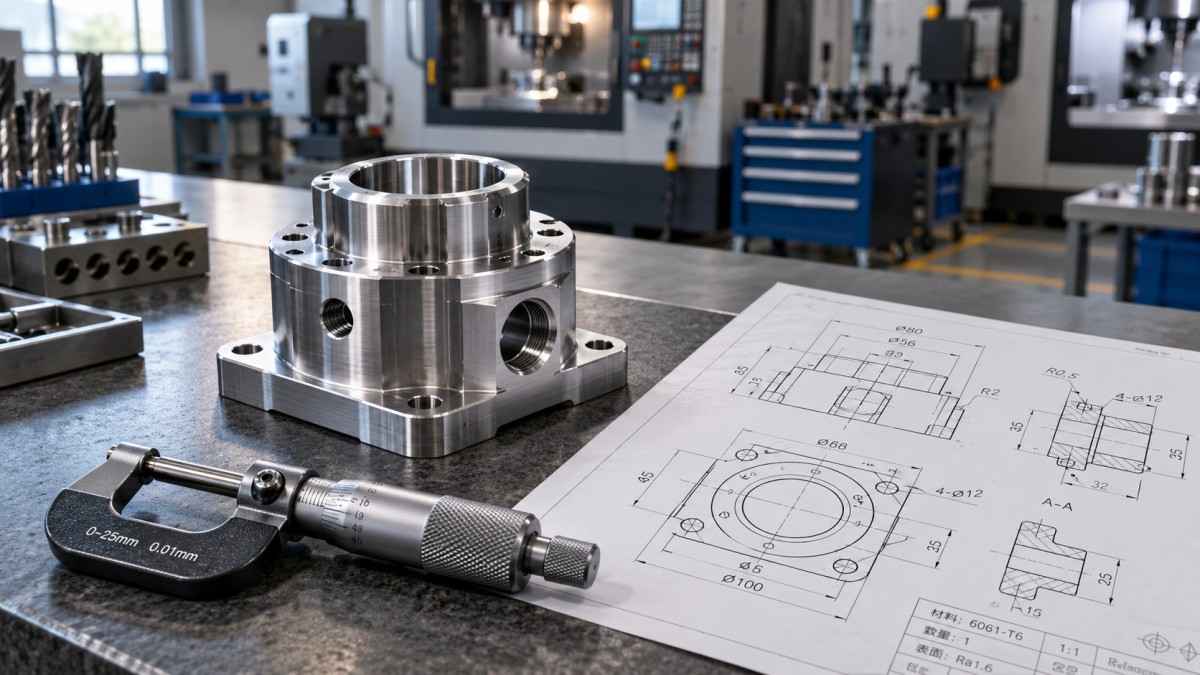
For thin walls, slender shafts, and other flexible parts, define any necessary restraint or measurement condition. Otherwise, different fixturing during inspection can produce conflicting acceptance decisions even when suppliers use calibrated equipment.
Describe the finished surface, not just the process name
“As machined” leaves room for different tool marks, edge conditions, and cosmetic appearance. “Anodized” does not fully define the coating. Separate surface texture, protective treatment, and appearance requirements because each controls a different outcome.
For surface texture, identify the parameter, limit, applicable standard, and surfaces concerned. An Ra value alone may be insufficient for a directional sealing surface or a feature whose measurement conditions materially affect the result. Add lay or measurement instructions where function requires them, rather than applying an unnecessarily demanding finish everywhere.
For coatings and treatments, specify the governing process specification, type or class where applicable, thickness requirements, color where relevant, masking, and any post-treatment operation. Define final hardness or other acceptance properties when heat treatment is required.
Cosmetic requirements need boundaries too. Identify visible surfaces and acceptance criteria, using an approved reference sample if necessary. A vague instruction such as “no scratches” can create disputes unless viewing conditions and acceptable defects are defined. For internal passages, state cleanliness or residual contamination requirements when ordinary deburring and cleaning would not establish suitability.
Quote the actual buying pattern
A price for ten prototypes is not a reliable basis for estimating repeated production orders. Setup, programming, fixtures, raw-material purchasing, and inspection planning are distributed differently across quantities.
Provide the quantities to be quoted as separate breaks. Distinguish the initial order, expected release quantities, and any nonbinding annual forecast. If the requirement is 2,000 pieces annually in releases of 100, requesting only a 2,000-piece price can conceal inventory and repeated setup costs.
Ask suppliers to separate recurring unit prices from programming, tooling, fixtures, first-article work, and other nonrecurring charges. Define ownership, storage, maintenance, and reuse terms for dedicated tooling when these matter to subsequent orders.
Prototype and production requirements should remain distinct. A prototype may permit a substitute material or simplified inspection to answer a design question. Such concessions should be explicitly limited; they should not silently become the production baseline.
Make inspection deliverables part of the price
“Inspection included” can describe anything from basic shop checks to a documented dimensional report covering every drawing characteristic. Those scopes are not commercially equivalent.
Define the required evidence: for example, a certificate of conformity, a ballooned drawing with a dimensional report, material documentation, treatment certificates, or specified test results. State whether reports are needed for every shipment, every manufacturing lot, or only the initial submission.
For production orders, distinguish first-article verification from ongoing acceptance. If AS9102 first article inspection is required, name it explicitly and define the submission scope. A generic request for a “first article” does not automatically establish AS9102 documentation requirements.
Likewise, distinguish 100% inspection from sampling. Identify characteristics requiring individual verification and provide the sampling plan or acceptance rules for others. For capability studies, specify the characteristics, study conditions, and required evidence; a capability target without an agreed study basis does not create comparable quotations.
A supplier’s ISO 9001 certification concerns its quality management system. It does not replace part-specific inspection requirements or demonstrate that a particular feature can be measured adequately. For demanding characteristics, request the proposed measurement method and any limitations before award.
Define delivery and commercial boundaries
Lead time is comparable only when its starting point and endpoint are clear. Specify whether it runs from purchase-order receipt, technical approval, material availability, or first-article approval. Distinguish readiness for dispatch from arrival at the required destination.
Include the requested delivery date, delivery location, packaging requirements, and any staged approval milestones. Precision surfaces, matched components, or corrosion-sensitive materials may need individual protection or preservation beyond ordinary bulk packaging.
For international purchases, identify the agreed Incoterms® rule, named place, and version—for example, Incoterms® 2020. This clarifies delivery responsibilities and risk allocation, but does not by itself settle payment terms, ownership transfer, or every customs-related obligation.
Request the quote currency, validity period, payment terms, freight treatment, and any exclusions. Where applicable, state restrictions on subcontracting, manufacturing location, outside processors, export-controlled data handling, and required approvals. Obtain any necessary confidentiality agreement before releasing sensitive files.
Require a common response, not a common manufacturing route
A standardized RFQ should allow suppliers to use different equipment and processes unless a particular method is necessary for compliance. Requiring five-axis machining merely because a component looks complex can exclude a capable supplier with a different, economical process route. Specify the result; constrain the method only when it affects acceptance or an approved process requirement.
Require a compliant base quotation and place proposed alternatives in a separate section. This preserves the baseline while allowing useful design-for-manufacture suggestions.
Shared clarifications should be issued to all bidders, while supplier-specific proprietary methods remain confidential. Before comparing prices, reconcile exclusions: one quotation may omit coating, another may include full dimensional reporting, and a third may depend on an unapproved material substitution.
The award baseline should preserve the agreed drawings, specifications, clarifications, and accepted deviations—not just the supplier’s total price. That controlled record turns an RFQ from a request for estimates into a dependable basis for manufacture, inspection, and repeat purchasing.
Recommended News
 Can portable telemedicine devices work with poor connectivity?Telemedicine hardware portable devices can support care with poor connectivity. Discover what works offline and how to evaluate reliable remote care workflows.
 How to choose rugs and carpets for high-traffic roomsDiscover how to choose rugs and carpets for high-traffic rooms. Compare materials, construction, cleaning needs, and fit to find a practical, lasting option.
 What affects the wholesale price of EPS sandwich panels?Compare EPS sandwich panels wholesale prices and discover how core density, steel facings, order size, and delivery costs affect your project budget.
 Japan's Machine Tool Export Controls Accelerate China's Five-Axis SubstitutionJapan's machine tool export controls are accelerating China's five-axis CNC substitution. Explore the implications for buyers and supply chains.
 Why do automatic mechanical watches stop when not worn?Why do automaticmechanicalwatches stop when unworn? Discover how power reserve works, how to restart your watch, and when to seek professional help.
 Choosing high-tensile bolts for industrial fastening in EuropeIndustrial fastening Europe: Learn how to select high-tensile bolts, coatings and standards for reliable joints, accurate preload and safer assembly.
 How does excess inventory affect fashion retail profitability?Discover how excess inventory erodes fashion retail profits through markdowns and holding costs, and learn practical ways to protect margins and free up cash.
 US Adds 50% Section 338 Tariff on Canadian Seals and Other ProductsUS Section 338 tariffs add 50% to covered Canadian seals, lubricants and other goods. Explore the potential impact on sourcing and supply chain costs.
 Can lean manufacturing reduce changeover time in injection molding?Discover how lean manufacturing can reduce injection molding changeover time with SMED, better preparation, standardized processes, and quality controls.
 How to estimate the payback period for a CNC machining centerEstimate your CNC machining center investment payback with a practical formula, installed cost checklist, cash-flow examples, and risk analysis.
 How cloud computing supports remote CNC machine monitoringDiscover how cloud computing enables remote CNC machine monitoring, from real-time alerts and troubleshooting to secure integration and smarter pilot decisions.
 LANXESS and BPCL to Explore Immersion Cooling Fluids and Advanced LubricantsLANXESS and BPCL are exploring immersion cooling fluids and advanced lubricants. Discover what the proposed collaboration could mean for buyers and suppliers.
 What OEM manufacturing support is needed for smart actuator testing?Explore OEM manufacturing support for smart devices: precision fixtures, firmware access, load testing, and traceable results. Learn what to demand for reliable smart actuator validation.
 How minimum order quantities affect wholesale bedding set costsBuying bedding sets wholesale? Discover how minimum order quantities affect unit prices, inventory risks, and total costs—and learn to negotiate smarter deals.
 What should mechanical seal technical specification documents include?Explore technical specification support documentation for mechanical seals, covering materials, drawings, standards, and testing to reduce risks and make confident supplier approval decisions.
 Shanghai Plan Targets Ultra-Precision Machining and Five-Axis Machine Tool UpgradesShanghai's ultra-precision machining and five-axis machine tool upgrade priorities could shape equipment investment. Explore potential opportunities and what buyers should verify.
 How global trade tariffs affect the landed cost of injection moldsDiscover how global trade tariffs affect injection mold landed costs. Compare duties, freight, and customs rules to avoid hidden expenses and make smarter sourcing decisions.
 How to qualify a catalyst manufacturer for synthetic oil productionQualify a catalysts manufacturer for synthetic oil production with practical checks for performance, batch quality, and scale-up. Learn how to reduce risk and select a reliable supplier.
 Are CNC spindle suppliers expanding local repair for five-axis machines?Explore cnc spindle supplier trends in local repair for five-axis machines. Learn how to verify repair capacity, compare exchange options, and choose support that reduces downtime.
 China’s Base Oil Imports Hit 2026 Low in September; Top Three Suppliers Account for 82.5%China’s base oil imports hit a 2026 low of 67,400 tonnes in September, with three origins accounting for 82.5%. Explore the data and implications for sourcing and supply risk.
 How to verify batch quality with an industrial lubricating oils exporterBuying from an industrial lubricating oils exporter? Learn how to verify batch test results, sampling, and traceability to reduce purchasing risks and protect equipment.


















Search News
Popular Tags