
How to avoid quality risks in carbide inserts wholesale

In carbide inserts wholesale, quality risks can quickly escalate into tool failure, unstable machining accuracy, and costly safety incidents. For quality control and safety systems, prevention begins with disciplined verification, not price comparison alone.
A reliable carbide inserts wholesale process depends on material consistency, documented traceability, coating stability, and repeatable machining performance. When any of these elements are weak, hidden losses spread across production, maintenance, and compliance.
Within global industrial sourcing, carbide inserts wholesale decisions affect aerospace parts, automotive lines, mold production, energy equipment, and precision machining workflows. Strong controls reduce scrap, protect machines, and improve long-term supply resilience.
Quality risk basics in carbide inserts wholesale
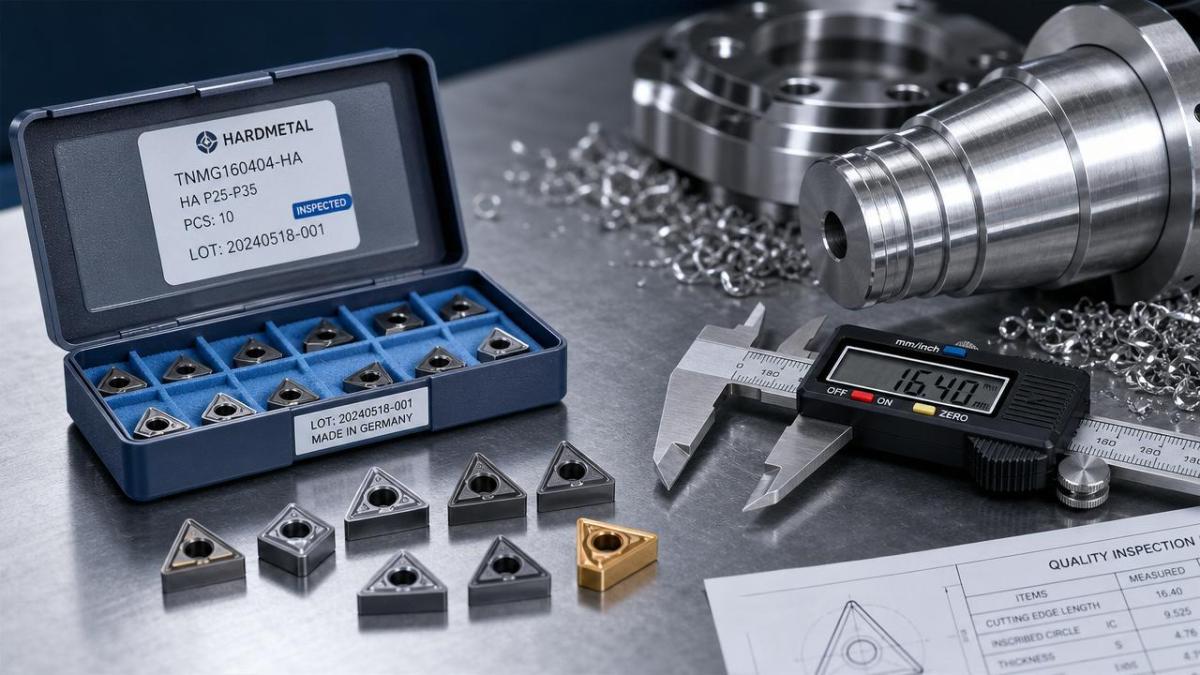
Carbide inserts are indexable cutting tools used in turning, milling, grooving, drilling, and threading. In carbide inserts wholesale, risk appears when the delivered insert does not match the declared grade, geometry, or coating specification.
The most common failures include edge chipping, crater wear, thermal cracking, premature flank wear, and dimensional drift. These issues are rarely isolated. They usually reflect upstream weaknesses in powder quality, sintering, coating, or packaging control.
Wholesale buying increases exposure because batches are larger and more widely distributed. A single nonconforming lot can affect multiple machines, operators, part numbers, and delivery schedules across several production cells.
For this reason, carbide inserts wholesale should be treated as a technical procurement category. It is not only a purchasing task. It requires engineering review, process validation, and documented acceptance criteria.
Core risk categories
- Material risk: inconsistent tungsten carbide grain size, cobalt content, or contamination.
- Geometry risk: nose radius, relief angle, chipbreaker, or edge preparation outside tolerance.
- Coating risk: poor adhesion, uneven thickness, or wrong coating stack.
- Traceability risk: incomplete lot coding, unclear origin, or missing inspection records.
- Logistics risk: moisture exposure, mixed batches, damaged packaging, or relabeling errors.
Current industry signals and sourcing pressure points
The market for carbide inserts wholesale is shaped by volatile raw materials, tighter machining tolerances, and pressure for uninterrupted output. These forces make technical verification more important than ever.
Global Precision-Machining & Engineering supports this environment through data-driven benchmarking across tooling, machining assets, and industrial standards. Such cross-checking helps separate nominal compliance from proven operational performance.
A frequent mistake in carbide inserts wholesale is assuming that visual similarity proves equivalence. Two inserts may look identical, yet perform very differently because of substrate design, edge hone, or coating microstructure.
Operational value of stronger wholesale quality control
Reducing quality risk in carbide inserts wholesale creates value far beyond tool cost. Stable inserts protect spindle utilization, reduce tool change frequency, and support predictable cycle times.
More consistent insert performance also supports dimensional capability. In high-precision work, even minor edge instability can push parts out of tolerance, forcing rework, extra measurement, or complete scrap.
Safety value is equally important. Unexpected insert fracture can damage holders, workpieces, guarding systems, and nearby equipment. In automated cells, one bad batch may stop an entire line.
Business outcomes from lower risk
- Lower scrap and rework cost
- Better machine uptime and schedule reliability
- More accurate forecasting of tool consumption
- Improved compliance documentation for regulated sectors
- Stronger leverage in supplier performance reviews
For broad industrial operations, carbide inserts wholesale control is therefore part of production governance. It influences quality assurance, maintenance planning, and customer delivery performance at the same time.
Typical risk scenarios by application and insert type
Not every application carries the same risk profile. Carbide inserts wholesale should be reviewed against material, machine condition, coolant strategy, and tolerance sensitivity.
This application-based view makes carbide inserts wholesale more practical. It links quality checks to actual cutting conditions, not just catalog descriptions or generic test reports.
Practical methods to avoid quality risks in carbide inserts wholesale
The most effective control model combines supplier qualification, incoming inspection, and process validation. Each stage should have measurable criteria and documented release authority.
1. Verify supplier capability beyond brochures
- Confirm manufacturing site, not only trading entity.
- Review quality system records and calibration status.
- Request process flow for powder, pressing, sintering, and coating.
- Check change-control practices for grade or coating updates.
2. Define a technical purchasing specification
A purchase order should state insert designation, substrate grade, coating type, tolerance class, edge treatment, packaging requirements, and traceability format. Generic naming leaves too much room for variation.
3. Require traceability at batch level
For carbide inserts wholesale, every carton and inner box should map to a lot number. Supporting records should include inspection release date, production site, and material or coating batch references.
4. Use incoming inspection with risk-based sampling
Inspect geometry, coating appearance, labeling accuracy, and package integrity. For critical applications, confirm dimensions by optical systems and compare weight or magnetic behavior where relevant.
5. Validate by controlled cutting trials
Trial testing should mirror real spindle speed, feed, depth of cut, and coolant conditions. Compare tool life, wear mode, chip control, and surface finish against an approved benchmark insert.
6. Monitor field performance continuously
Wholesale quality control does not end at receiving. Track scrap, breakage, abnormal wear, and machine stoppages by insert lot. Trends often reveal hidden instability before major failures occur.
Implementation checkpoints for a more reliable sourcing process
A structured review system turns carbide inserts wholesale from reactive firefighting into controlled risk management. The following checkpoints support that transition.
- Create approved specifications for each insert family and application.
- Qualify suppliers by site, process, and historical consistency.
- Set acceptance plans for dimensions, coating, and traceability.
- Run comparative machining trials before volume release.
- Record lot-based performance data and corrective actions.
- Review suppliers periodically against delivery and failure metrics.
In complex industrial environments, independent technical intelligence also adds value. Cross-referencing inserts against ISO, DIN, ASME, and JIS-linked expectations strengthens confidence in wholesale sourcing decisions.
The next practical step is to audit the current carbide inserts wholesale flow, identify missing specifications and traceability gaps, then pilot a risk-based validation plan on one critical insert category first.
Recommended News
 How to verify CE certification for industrial pumps before installationIndustrial pumps CE certified? Learn how to verify declarations, documentation, hazardous-area suitability, and installation compliance before commissioning.
 How to compare a plasma cutting machine supplier before placing an orderCompare a plasma cutting machine supplier with confidence—evaluate cut quality, total cost, consumables, and after-sales support before you order.
 Which factory upgrade projects benefit most from industrial technology solutions?Industrial technology solutions factory upgrade projects deliver the most value when they remove bottlenecks, cut downtime, improve quality, and strengthen resilience. Explore high-impact priorities.
 When a high precision CNC grinding machine justifies its costDiscover when a high precision CNC grinding machine delivers real ROI through repeatable quality, lower scrap, faster verification, and controlled production.
 When do industrial lubricants for compressors need oil analysis?Industrial lubricants for compressors need oil analysis at baseline, under harsh operating conditions, and after warning signs. Learn how testing prevents downtime and protects equipment.
 How CNC controller processing speed affects cycle times in EuropeCNC controller processing speed Europe: discover how look-ahead, interpolation and CAM optimisation can cut cycle times while protecting precision and surface quality.
 What to verify before using supplier sourcing solutions in EuropeSupplier sourcing solutions Europe: verify capabilities, compliance, traceability, total cost, and supply resilience before choosing reliable industrial partners.
 When smart fabrics are reliable enough for industrial wearablesSmart fabrics for industrial wearables: learn how to validate durability, signal quality, cleaning resilience, and safe failure performance before deployment.
 How supply chain management for exporters reduces customs delaysSupply chain management for exporters helps prevent customs delays with accurate data, origin checks, importer readiness, and proactive shipment controls. Explore practical strategies now.
 What to verify before approving an OEM electronics supplierOEM electronics supplier approval checklist: verify BOM control, traceability, testing, sourcing risk, capacity, and commercial terms before committing to volume production.
 When do CNC-machined precision components require five-axis milling?Precision components CNC machined with five-axis milling deliver better access, tighter datum control, and lower setup risk. Learn when five-axis machining is the smart choice.
 What should a restaurant POS system handle during a lunch rush?restaurantPOSsystems keep lunch rushes moving with fast ordering, smart kitchen routing, flexible payments, live inventory, and reliable service controls.
 How CNC controller cycle time speed affects machining throughputCNC controller cycle time speed can raise machining throughput by sustaining feed rates on complex toolpaths. Learn how to optimize CAM, look-ahead, and machine dynamics.
 When a 4 axis vertical machining center is the better fit than 3-axisDiscover when a 4 axis vertical machining center outperforms 3-axis machining—reduce setups, improve datum control, and boost efficiency for complex multi-face parts.
 When industrial fasteners bolts need traceable material certificationIndustrial fasteners bolts need traceable material certification for critical applications. Learn what QA teams should verify to reduce risk and ensure compliance.
 How to size pump systems for cooling circuits for stable flow ratesPump systems for cooling circuits: learn how to match flow, total dynamic head, NPSH, and controls for reliable, energy-efficient cooling performance.
 When does software as a service reduce CNC data management costs?Software as a service can lower CNC data management costs by reducing IT overhead, manual reporting, and disconnected records. Discover when SaaS delivers measurable savings.
 CNC investment trends 2026: are automation upgrades taking priority?CNC investment trends 2026 reveal why automation upgrades are reshaping capacity plans. Compare robots, pallet systems, and new machines for smarter CNC growth.
 How to size high pressure pumps for stable chemical injection ratesHigh pressure pumps sizing guide for stable chemical injection rates—learn how to balance flow range, pressure, suction conditions, materials, and controls for reliable dosing.
 When organic chemicals are suitable feedstocks for synthetic lubricantsOrganic chemicals can unlock high-performance synthetic lubricants. Learn how purity, stability, compatibility, and supply control shape reliable industrial formulations.
 What machine tool market size reveals about capital spending cyclesMachine tool market size reveals capital spending cycles through order mix, automation, replacement demand, and capacity signals. Discover what drives smarter investment decisions.



















Search News
Popular Tags