
How advanced materials improve wear resistance in mechanical seals
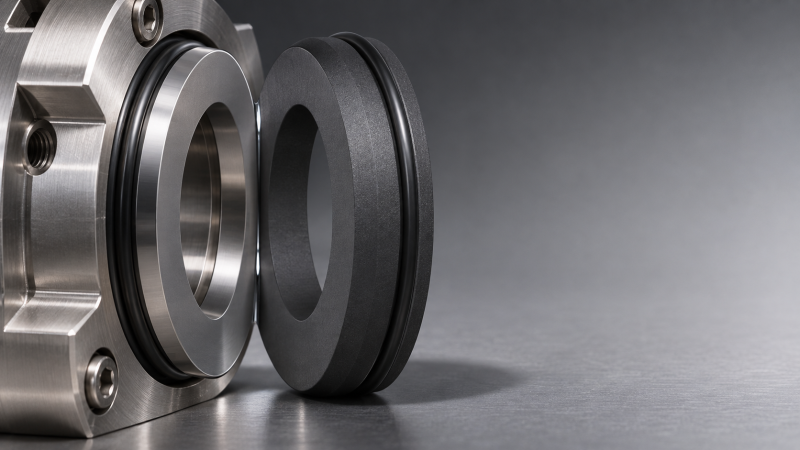
Advanced materials improve mechanical seal wear resistance by helping the sealing faces retain their shape and surface condition under contact, heat and chemical exposure. Silicon carbide, tungsten carbide, carbon graphite and engineered polymers each address different parts of that problem. Their value depends on the fluid, the mating material and the conditions at the seal faces—not simply on which material has the highest hardness.
For a technical evaluator, the starting point is the expected failure mechanism. Hard faces can resist damage from abrasive particles, but they may be less forgiving during dry running or thermal shock. A carbon face can accommodate short periods of marginal lubrication and provide a conformable surface, yet it may wear quickly in abrasive service. Material selection therefore begins with the complete face pair and its operating environment.
How seal faces wear
A mechanical seal controls leakage at the interface between a rotating face and a stationary face. The faces are held close together by hydraulic forces and mechanical loading, while the sealed fluid can form a thin lubricating film between them. In stable operation, that film helps carry load and remove heat. Its condition changes with pressure, speed, temperature, fluid properties and the availability of liquid at the seal.
Wear accelerates when the interface cannot maintain suitable lubrication or when particles enter the contact region. Several mechanisms may be present at once:
- Abrasive wear: Solid particles trapped between the faces cut or polish the surfaces. Harder faces can reduce material removal, although particle size, hardness and concentration also matter.
- Adhesive wear and frictional damage: Direct contact under poor lubrication can raise friction and local temperatures, damaging one or both faces.
- Thermal distortion and cracking: Uneven heating can change face geometry or generate stresses that damage brittle materials. A distorted face may also lose the film that limits further heating.
- Chemical or corrosion-assisted damage: The fluid can attack a face material, its binder or its impregnant, weakening the surface and making wear more likely.
These mechanisms explain why a material change alone may not solve a short seal life. A seal exposed to flashing liquid, inadequate cooling, shaft movement or persistent solids ingress may continue to fail even with harder faces. The material has to work within a seal design and support arrangement that keep the interface stable.
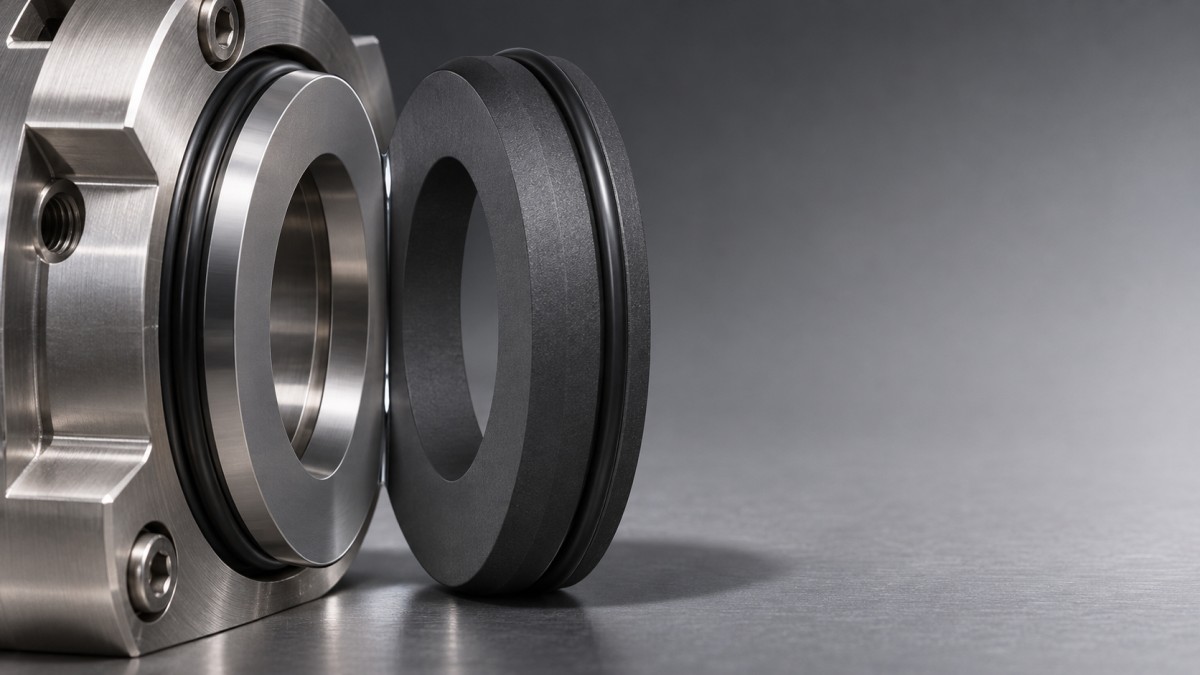
What different face materials contribute
Silicon carbide: hardness and chemical resistance
Silicon carbide is used for seal faces where abrasion resistance, stiffness and heat transfer are important. Its hardness helps protect the face against many particles carried by the process fluid. Its thermal conductivity can help move heat away from the contact area, reducing local temperature gradients when the rest of the seal assembly can also dissipate heat.
Silicon carbide is available in different grades and manufacturing forms. Their performance is not interchangeable: microstructure, porosity and any secondary phases can affect chemical compatibility, strength and frictional behavior. When evaluating a grade, request information for the specific fluid and temperature range rather than relying on the generic material name.
A silicon carbide pair can be attractive in abrasive liquids, but two hard faces do not eliminate the need for a lubricating film. Under dry-running or severely starved conditions, friction and heat can still cause rapid damage. Silicon carbide is also brittle compared with metals, so assembly loads, impact, thermal gradients and face support deserve attention.
Tungsten carbide: a hard face with binder-dependent performance
Tungsten carbide combines hard carbide particles with a metallic binder. It can provide strong resistance to abrasion and mechanical damage, making it a candidate for duties involving suspended solids or demanding contact conditions.
The binder is central to the selection. Chemical attack on the binder can undermine the face even when the carbide itself remains hard. Compatibility should therefore be assessed for the specified binder and process fluid, including cleaning chemicals and temperature excursions. Two faces described only as “tungsten carbide” may behave differently in corrosive service.
Tungsten carbide also needs an appropriate mating face and adequate lubrication. Its resistance to abrasive wear should be evaluated alongside heat generation, corrosion behavior and the consequences of a loss of liquid at the seal.
Carbon graphite: controlled friction and conformability
Carbon graphite is often paired with a harder face. Its relatively low friction and ability to conform to small irregularities can help the pair operate when lubrication is marginal. In many designs, the carbon face acts as the more readily worn member, protecting the harder mating face from some forms of damage.
That trade-off has limits. Abrasive particles can remove carbon quickly, and certain grades or impregnants may be unsuitable for particular chemicals or temperatures. Permeability, strength and wear behavior vary with grade and impregnation. A carbon face selected for a clean, lubricating liquid should not be assumed suitable for a hot, abrasive slurry.
Conformability also does not compensate indefinitely for poor alignment, excessive face loading or dry operation. If a carbon face shows heavy, uneven wear, the evaluator should examine the mechanical and hydraulic conditions as well as the material grade.
Engineered polymers and coatings: targeted functions
Engineered polymers can contribute low friction, chemical resistance or compliance in selected seal components. Depending on the design, they may be used in secondary sealing elements, support components or certain face applications. Their suitability depends on temperature, pressure, chemical exposure, creep and dimensional stability. A polymer that performs well as a static secondary seal may not be appropriate as a loaded running face.
Coatings and surface treatments can modify properties at the contact surface, including hardness, friction or corrosion resistance. Their benefit depends on the coating system, substrate, adhesion, thickness and finish. A hard coating over an inadequately supported or chemically vulnerable substrate may fail through cracking, delamination or wear-through. Evaluation should cover the behavior of the whole coated component, including what happens if the coating is locally damaged.
Compare the pair against the fluid and duty
Seal faces should be selected as a pair because each surface influences the wear of the other. A hard face against carbon offers a different balance of conformability and abrasion resistance from a hard face against another hard face. Neither arrangement is universally superior.
For a clean liquid with good lubricating properties, a carbon-to-hard-face combination may offer a practical balance of friction and wear. If the same equipment handles a fluid containing hard particles, the carbon face may become the limiting component and a hard-to-hard pair may warrant evaluation. The change should still account for particle ingress, flushing arrangements and the risk of face contact during startup or process interruptions.
For a poorly lubricating or volatile liquid, the ability to maintain a stable liquid film can dominate the decision. A harder material may resist scratching but cannot prevent vapor formation or restore a starved interface. Pressure at the seal chamber, temperature, circulation and heat removal need to be considered alongside face composition.
Corrosive service adds another layer. Assess every wetted material: the face, binder or impregnant, secondary seal and relevant metal components. Normal process composition is only part of the exposure. Cleaning agents, intermittent contaminants and temperature changes may govern compatibility or cause the greatest damage.
Use failure evidence to test the material choice
A material specification is more useful when it is tied to an observable failure mechanism. Before replacing a worn seal with a different face pair, inspect both faces and record the service conditions around the failure. Grooves may point toward abrasive particles; cracking or heat discoloration may suggest a thermal event; chemical attack on a binder or impregnant may indicate incompatibility. None of these observations proves a cause on its own. Handling damage, deposits and changes after shutdown can complicate interpretation.
Preserve information about the seal chamber, operating pressure and temperature, speed, fluid composition, solids, flushing and any dry-running events. Also check shaft and bearing condition, installation practices and face loading. These details help distinguish a material limitation from a system condition that would damage a replacement seal as well.
When comparing candidate materials, ask for the exact grades and face combination, not only generic names. The technical evaluation should address chemical compatibility, expected lubrication, temperature limits and evidence relevant to the proposed duty. Where performance claims are supported by tests, examine the test fluid, pressure, temperature, speed and duration: a result obtained under stable, clean lubrication may have limited value for a solids-laden or intermittently dry application.
Applicable equipment and seal specifications can provide requirements for design, materials, inspection and documentation. For example, API 682 addresses shaft sealing systems for centrifugal and rotary pumps within its stated scope; its relevance depends on the equipment and project requirements. Compliance with a specification supports a disciplined evaluation, but it does not by itself establish that a particular face pair will resist the wear mechanism in a given service.
The strongest material choice is the one that preserves a stable interface under the duty the seal will actually see. If the expected damage comes from hard particles, compare face hardness and solids control together. If failures follow loss of liquid or overheating, resolve those operating conditions before treating a change in face material as the remedy.
Facing technical bottlenecks in manufacturing or looking for more efficient industrial solutions? Leave your details below and let the engineering experts at G-PME solve them for you.
We respect your privacy. Your information is strictly confidential.
Recommended News
 How advanced materials improve wear resistance in mechanical sealsDiscover how advanced materials improve mechanical seal wear resistance, and learn to select the right face pair for abrasive, corrosive and demanding operating conditions.
 How to verify quality standards when selecting mechanical sealsProduct selection guidance for mechanical seals: verify quality standards, material traceability, certifications, and test evidence before you buy.
 What should mechanical seal technical specification documents include?Explore technical specification support documentation for mechanical seals, covering materials, drawings, standards, and testing to reduce risks and make confident supplier approval decisions.
 John Crane Signs Three-Year Agreement to Improve Phosphate Mine Seal ReliabilityJohn Crane's three-year agreement targets phosphate mine seal reliability with on-site expertise and mechanical seal solutions. Explore its potential to reduce downtime.
 How to select low-friction industrial seals for centrifugal pumpsChoose industrial seals for low friction in centrifugal pumps. Compare face materials, lubrication and support systems to reduce wear and operating losses. Find the right fit.
 John Crane to Showcase Emissions and Downtime Reduction Technologies at ADIPEC 2026John Crane at ADIPEC 2026: Explore technologies targeting lower emissions and compressor downtime, and discover what reported savings could mean for your operations.
 How Do You Select a Mechanical Seal for Chemical Service?How do I select a mechanical seal for chemical service? Explore material compatibility, single vs. dual seals, and support systems to reduce leakage risks and choose with confidence.
 Why Do Mechanical Seals Fail Prematurely?Why do mechanical seals fail prematurely? Discover how dry running, poor flushing, and misalignment cause leaks—and learn practical checks to prevent repeat failures and reduce downtime.
 When aerospace metal traceability certification is required for sealsAerospace metal traceability certification for seals: learn when it is required, which records matter, and how to protect compliance, quality, and release decisions.
 How to select mechanical seals for mixers handling abrasive slurriesMechanical seals for mixers: learn how to select durable seal arrangements, face materials, and support systems for abrasive slurry service.
 EU Adopts EN 1514-2:2026 for Mechanical Seals, Mandatory From September 2026EU Adopts EN 1514-2:2026 for Mechanical Seals: learn the key compliance changes, CE marking risks, and exporter actions required before the September 2026 deadline.
 How to Evaluate an Aerospace Seals Supplier for Material Traceability and Compliance RequirementsAerospace seals supplier selection starts with traceability and compliance. Learn how to assess records, cert control, and audit readiness before costly sourcing mistakes.
 China-Uzbekistan AEO Deal Speeds Precision ExportsChina-Uzbekistan AEO Deal speeds precision exports by cutting clearance time and compliance costs, helping exporters boost delivery reliability in Uzbekistan’s growing industrial market.
 Advanced CNC Machining Stainless Steel: How Tolerances Affect Seal PerformanceAdvanced CNC machining stainless steel directly impacts seal reliability. Learn how tolerances, surface finish, and inspection control leakage, wear, and performance.
 REACH Rule Takes Effect for PFAS in Mechanical SealsREACH Rule Takes Effect for PFAS in Mechanical Seals: learn how SVHC notification, SDS compliance, and EU export readiness may affect customs, delivery, and market access.
 What to Review Before Choosing an Aerospace Seals Manufacturer for AS9100 ProjectsAerospace seals manufacturer selection for AS9100 projects starts with risk, traceability, material control, and change management. Review key factors before approving a supplier.
 Industrial Sealing Systems in Europe: What to Check Before Supplier ApprovalIndustrial sealing systems Europe buyers can use this practical guide to verify compliance, traceability, technical fit, and supplier reliability before approval.
 How PTFE Industrial Sealing Systems Reduce Chemical Leaks in High-Pressure LinesPTFE industrial sealing systems help reduce chemical leaks in high-pressure lines by matching seal design, hardware condition, and installation control for safer, longer-lasting performance.
 EU REACH Adds PFHxA, PFHxS to SVHC ListEU REACH adds PFHxA and PFHxS to the SVHC list, raising SCIP and supply chain compliance risks for EU exporters. Learn what it means for seals, gaskets and casting processes.
 How to Evaluate an Aerospace Seals Manufacturer for Reliability and ComplianceAerospace seals manufacturer selection starts with reliability and compliance. Learn how to assess certifications, traceability, process control, and supply stability before you approve a supplier.
 O-Rings and Seals: Key Material Differences and How to Match Them to FluidsOringsandseals guide: compare NBR, FKM, EPDM, silicone, and FFKM to match fluids, heat, and pressure correctly—reduce leaks, downtime, and costly seal failures.

Search News
Popular Tags