
Why Do Mechanical Seals Fail Prematurely?
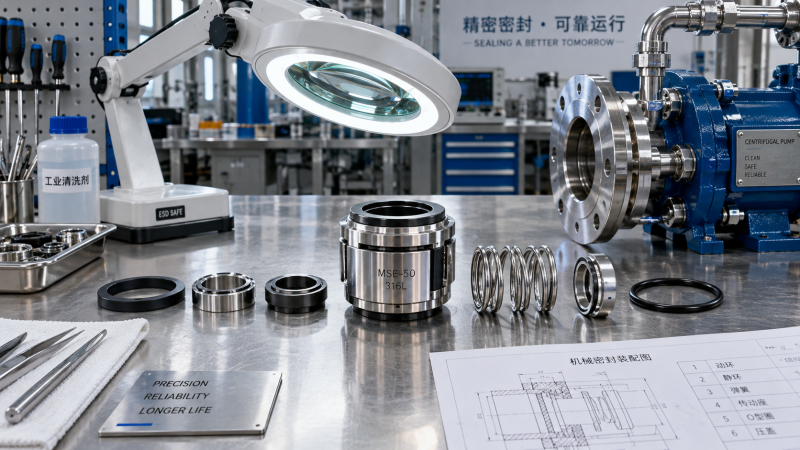
Why do mechanical seals fail prematurely? Usually, the seal faces lose the conditions they need to operate reliably: a stable lubricating film, controlled temperature, suitable pressure, and consistent alignment. Dry running, blocked flushing, chemical incompatibility, installation damage, and excessive shaft movement can all disrupt those conditions. A defective seal is possible, but replacing the seal alone often leaves the cause untouched.
The most useful starting point is the failure pattern. A seal that leaks immediately after installation raises different questions from one that fails during startup, after a cleaning cycle, or only at reduced flow. Connecting the damage to operating events helps distinguish a selection problem from an installation fault or a pumping-system issue.
How does a mechanical seal fail before its expected service life?
A conventional contacting mechanical seal has two precision-finished faces: one rotates with the shaft, while the other remains stationary. Spring force and hydraulic forces keep them closely engaged. A very thin fluid film between the faces provides lubrication and carries away some of the frictional heat. Secondary seals, such as O-rings, prevent leakage around other interfaces.
Premature failure occurs when wear, heat, chemical attack, or mechanical damage exceeds what the assembly can tolerate. The visible leak may appear at the faces, but its origin could be a hardened O-ring, a sticking spring mechanism, or a shaft that moves excessively.
There is no universal service-life figure for mechanical seals. Continuous operation with a clean, stable liquid differs substantially from frequent starts, abrasive slurry service, or fluids that crystallize during shutdown. Compare failures against similar equipment and operating conditions, rather than treating a calendar interval as proof of acceptable life.
Why is dry running so damaging?
Standard wet-running seals depend on liquid at the sealing interface. If the pump starts before it is properly filled and vented, or loses liquid during operation, the faces can generate heat faster than the surrounding system removes it. The resulting temperature rise can damage the face materials and secondary seals.
A pump can contain liquid and still provide poor lubrication at the seal. Trapped gas, intermittent suction supply, or local vapor formation may interrupt the film. A hot liquid close to its boiling condition can vaporize in the seal chamber if the local pressure falls sufficiently. Checking only the tank level will miss these conditions.
Look at startup procedures, priming, venting, suction restrictions, and low-level protection. For hot or volatile liquids, evaluate the temperature and pressure in the seal chamber together. Restoring reliable liquid supply and an adequate margin against vaporization is more useful than repeatedly fitting a harder face material.
Can a flush system cause early seal failure?
Yes. A flush arrangement may supply clean fluid, remove heat, or help keep solids away from the seal, depending on its design. If a passage blocks, a valve remains closed, or the available pressure becomes inadequate, the seal can lose that protection while the pump continues running.
A connected flush line does not prove that fluid is flowing. Deposits can restrict small passages, filters can foul, and piping changes can alter the pressure difference that drives flow. An incorrectly routed connection may also prevent the intended circulation.
Check the actual flow path and operating conditions against the specified seal-support arrangement. More flow is not automatically better: an unsuitable flush can dilute the product, introduce incompatible chemicals, or disturb the process. The fluid must be clean enough, chemically acceptable, and supplied under appropriate conditions.
For dual seals, distinguish the support arrangements. A pressurized barrier fluid operates above the specified process-side pressure; an unpressurized buffer arrangement serves a different purpose. Loss of barrier pressure can allow process fluid into a space intended for clean barrier fluid. Reservoir level alone cannot establish that the system is working correctly.
How do alignment, vibration, and shaft movement affect the seal?
Mechanical seals tolerate only a limited amount of movement while maintaining the required face relationship. Shaft runout, bearing wear, excessive axial movement, and distortion of the seal mounting surfaces can disturb that relationship. The faces may experience uneven loading, intermittent separation, or localized heating.
Coupling misalignment is one possible contributor, but it is not the only one. Pipe strain can distort the pump casing, an unstable base can allow movement, and hydraulic forces can deflect the shaft. A coupling alignment check therefore needs to sit alongside checks of bearings, shaft condition, mounting, and piping loads.
Pump operation also matters. Depending on the pump design, sustained operation far from its intended operating region can increase vibration, internal recirculation, and shaft loading. Cavitation can add instability. A seal upgrade cannot compensate indefinitely for a pump experiencing damaging mechanical or hydraulic conditions.
Which materials are most likely to be incompatible?
Compatibility must cover the complete seal assembly: faces, elastomers, metal parts, and any other wetted components. A suitable face pairing does not protect an O-ring that swells in the process fluid or loses elasticity at the operating temperature.
Include cleaning agents, sterilization conditions, and occasional process contaminants in the assessment. A seal may tolerate the normal product but deteriorate during cleaning. Swollen elastomers can restrict movement; hardened or cracked elastomers can lose their sealing function.
Face selection involves tradeoffs. Carbon against silicon carbide is common in suitable liquid services, while hard-face combinations may be appropriate where abrasion is significant. Hardness alone does not establish suitability. Lubrication, chemical compatibility, thermal behavior, and the specific material grade all influence performance.
Give the seal supplier the fluid composition, concentration, temperature range, solids content, and operating excursions. A broad description such as “chemical solution” or “wastewater” can conceal the conditions that determine material selection.
Why do solids and crystallization shorten seal life?
Abrasive particles can score the faces and wear surrounding components. Solids can also collect around springs or sliding parts, preventing the seal from following normal movement. The resulting leakage may come from restricted motion as well as surface wear.
Dissolved material creates another failure route. A liquid that appears clean while circulating may crystallize as it cools or evaporates near the seal. Sticky products can leave deposits during shutdown. A seal that works during continuous operation may then fail when restarted.
The remedy depends on the process. An appropriate clean flush, a seal geometry that reduces deposit accumulation, or a suitably designed dual-seal arrangement may help. Any introduced fluid must be compatible with product-quality requirements. Where shutdown deposits are involved, the cleaning and shutdown procedure deserves as much attention as the seal specification.
Can installation mistakes make a new seal leak immediately?
Yes. Mechanical seal faces are precision surfaces. Handling damage, trapped contamination, incorrect assembly dimensions, uneven gland tightening, or damaged secondary seals can prevent a new assembly from sealing correctly. Leakage can also come from a gasket, sleeve interface, or connection near the seal, so locate the leak before diagnosing face failure.
Cartridge seals simplify assembly by keeping several components preset. They still require correct mounting, an acceptable shaft or sleeve surface, and the specified setting-device procedure. Removing setting devices at the wrong stage, or leaving them engaged during operation, can cause damage.
Use the installation instructions for the actual seal model. Check dimensions, cleanliness, tightening requirements, and approved assembly lubricant. If several new seals fail soon after fitting, investigate the installation process and equipment condition before attributing the pattern to poor seal quality.
What can the damaged seal tell you?
Damage patterns help narrow the investigation, but they rarely identify a cause by themselves. Heat damage, for example, may follow dry running, inadequate cooling, or excessive face loading. Several mechanisms can leave similar marks.
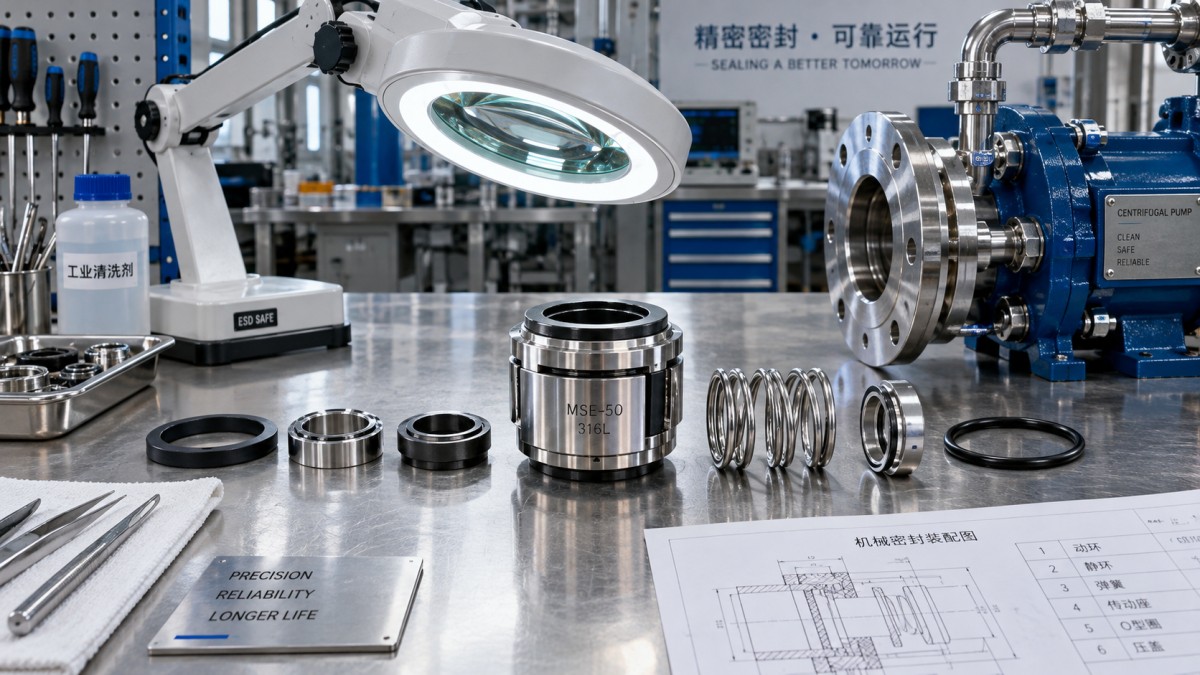
Photograph the assembly before cleaning and record where deposits and damage occur. Preserve its orientation where practical. Removing every trace of residue before inspection can erase evidence that explains why movement or lubrication was lost.
What should be checked before ordering another seal?
Make the investigation follow the failure event. Begin with safe shutdown, isolation, depressurization, and the required handling precautions for the process fluid. Then collect enough information to connect the failed component with its operating conditions.
- Confirm the leak location. Separate face leakage from leaks at secondary seals, gaskets, sleeves, and nearby connections.
- Establish when failure began. Record startup, shutdown, cleaning, duty changes, and any loss of suction or support-fluid supply.
- Check actual service conditions. Include chamber pressure and temperature, speed, fluid composition, solids, and operating excursions.
- Assess the equipment. Examine shaft and sleeve condition, bearings, movement, alignment, mounting, and pipe strain.
- Inspect the support system. Confirm its routing, cleanliness, flow, pressure, cooling, and instrumentation as applicable.
- Match the replacement to the cause. Decide whether the correction involves materials, seal design, installation, support equipment, or pump operation.
Replacement specifications should describe the required duty as well as the dimensions. A seal that fits can still be unsuitable for the fluid or operating range. Compare candidates against the complete service envelope, including startup and cleaning, rather than choosing solely by face material or purchase price.
Does every repeated failure require a different seal design?
No. If the existing design is suitable but repeatedly loses flush supply, fixing the support system may resolve the problem. If the service contains persistent solids, has demanding containment requirements, or regularly exposes the faces to unstable lubrication, a different arrangement may be justified.
A balanced seal can reduce hydraulic face loading in an appropriate application, but it does not eliminate dry-running damage. A dual seal can provide a controlled environment around the process-side seal, but its support system adds operating requirements. Select a design because it addresses an identified mechanism.
Can a leaking mechanical seal simply be tightened?
A mechanical seal is not adjusted like compression packing. Tightening gland fasteners beyond the specified requirement can distort components without correcting damaged faces. Locate the leak and identify the failed interface before making adjustments. Fastener correction is appropriate only where the assembly requirements and inspection support it.
Is any leakage normal, and can the seal be repaired?
A contacting mechanical seal relies on a fluid film, so zero transfer across the faces is not a universal expectation. However, visible dripping, increasing leakage, or hazardous-fluid release should not be dismissed as normal. Assess leakage against the seal design, service requirements, and specified acceptance criteria.
Some assemblies can be professionally refurbished if their components remain suitable for reuse. Repair requires inspection and restoration of the precision surfaces and assembly condition. Whether repaired or replaced, the next seal needs the operating conditions that the failed one lacked; otherwise, restoring the hardware merely restarts the same failure cycle.
Recommended News
 How to assess five-axis machine tool thermal stability data in Latin AmericaReview machine tool thermal stability data Latin America suppliers provide. Discover how to assess five-axis drift, ISO 230-3 tests, and site conditions for smarter purchasing decisions.
 How thick should fiberglass acoustic insulation be for wall cavities?Fiberglass acoustic insulation: how thick should it be? Explore 3.5- and 5.5-inch wall cavity options, tested STC requirements, and installation tips to avoid costly mistakes.
 How bending radius affects the service life of high-voltage cablesProtect highvoltagecables from bending damage. Discover how bend radius affects service life, which installation limits matter, and practical checks for lasting reliability.
 Why Do Mechanical Seals Fail Prematurely?Why do mechanical seals fail prematurely? Discover how dry running, poor flushing, and misalignment cause leaks—and learn practical checks to prevent repeat failures and reduce downtime.
 OEM Manufacturing Design Support: What to Resolve Before Tooling StartsOEM manufacturing design support helps resolve materials, tolerances, and inspection before tooling starts. Discover how to avoid costly rework and make confident tooling decisions.
 How to size extrusion equipment for a target production outputSize extrusion equipment to meet your production targets. Learn how to calculate throughput, identify line bottlenecks, and verify capacity to avoid costly sizing mistakes.
 How to assess 5-axis demand in machining center market analysisStrengthen your machining center market analysis: learn how to assess 5-axis workloads, buyer readiness, and investment costs to build credible demand forecasts and avoid costly overestimates.
 Can procurement support reduce contract manufacturing tooling delays?Discover industrial procurement support contract manufacturing teams can use to cut avoidable tooling delays, secure materials, and keep production launches on track.
 Which export insights matter when entering a new market?Export insights for new-market entry: assess demand, standards, delivered costs, supply resilience, and buyer approval paths to build a profitable expansion plan.
 How industrial technology solutions in Southeast Asia handle humid sitesIndustrial technology solutions Southeast Asia: learn how site-adapted materials, sealing, condensation control, and maintenance strategies improve reliability in humid, coastal, and high-corrosion industrial environments.
 How hospitals can size telemedicine hardware for peak virtual visitsTelemedicine hardware for hospitals: learn how to size reliable endpoints for peak virtual visits, optimize reserves, workflows, network readiness, and uptime.
 Which electronic components most affect smart actuator reliability?Electronic components that shape smart actuator reliability: evaluate power supplies, motor drives, sensors, control boards, and connectors for demanding industrial performance.
 When do reshoring CNC investment opportunities justify 5-axis capacity?Explore when reshoring CNC investment opportunities justify 5-axis capacity—reduce setups, strengthen quality control, cut supply-chain risk, and build a resilient local machining strategy.
 What compliance documents should an industrial chemicals exporter provide?Industrial chemicals exporter compliance guide: learn which SDS, CoA, transport, customs, and market-access documents help prevent delays and risks.
 How to assess a smart device manufacturing solutions factoryAssess a smart device manufacturing solutions factory with practical insights on engineering, quality, testing, supply-chain resilience, and pilot builds.
 What CE certification means for a CNC controller systemCNC controller system CE certified: learn what CE marking covers, how to verify safety, EMC, documentation, and retrofit compliance for EU machinery.
 When industrial sewing is the right fit for high-volume productionIndustrial sewing for high-volume production: learn how seam design, material control, automation, and quality planning drive reliable output and lower risk.
 How ATC tool change time data reveals hidden cycle-time lossesATC tool change time data reveals hidden cycle-time losses, separates mechanical delays from program motion, and helps manufacturers improve uptime, capacity, and delivery confidence.
 What to verify before selecting a sinker EDM machine supplierChoose a reliable sinker EDM machine supplier with confidence. Verify machining trials, electrode compatibility, automation, service support, and total ownership risk.
 How brass alloy choice affects industrial machining part tolerancesIndustrial machining brass parts: discover how alloy selection influences tolerance stability, tool wear, bore accuracy, threads, and reliable high-volume production.
 What to verify before selecting an electronics contract manufacturerElectronics manufacturing solutions: learn what to verify before choosing a contract manufacturing partner, from quality systems and testing to sourcing, traceability, and change control.




Search News
Popular Tags