
Can procurement support reduce contract manufacturing tooling delays?
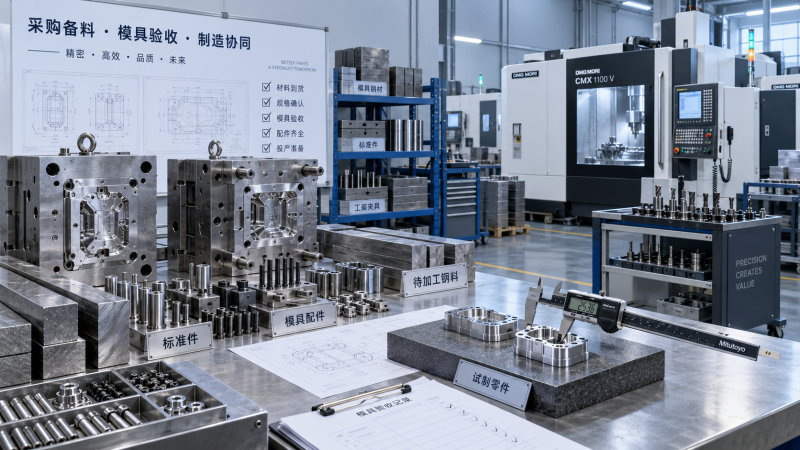
Procurement support can reduce contract manufacturing tooling delays when it removes uncertainty before that uncertainty reaches the toolroom: incomplete specifications, unreserved capacity, unavailable materials, unclear approval responsibilities, and purchase orders that arrive too late. It cannot eliminate the machining, heat treatment, assembly, or validation work required to produce a capable tool. The practical distinction is between shortening avoidable waiting time and attempting to compress necessary technical work.
The greatest benefit comes from involving procurement before tooling release, not after a delivery date has slipped. Once a mold, die, fixture, or dedicated cutting tool is already late, expediting has limited value unless it addresses the actual constraint. A faster shipment will not recover a tool awaiting design approval; an earlier machining slot will not help if the specified steel has not been secured.
Identify what “tooling complete” actually means
A tooling commitment is difficult to manage if its endpoint is ambiguous. A supplier may consider a tool complete when fabrication ends. The manufacturing program may require successful trials, accepted measurement results, delivery to the production facility, and approval for routine production. Those are different dates, with different dependencies.
Establish the required endpoint before comparing quotations. For an injection mold, it might include trials using the specified resin and an agreed production machine configuration. For a stamping die, it could require dimensional acceptance using production-intent strip material. For a machining fixture, it may include proving that the clamping arrangement supports the required tolerances without unacceptable distortion.
Not every project needs identical validation. However, the purchase scope should state which trials, inspection records, corrections, and transfer activities are included. Otherwise, a quotation that appears faster can simply exclude work that another supplier has included.
Work backward from the date accepted production parts are needed. Account for tool transport, installation, trials, inspection, corrective work, and any required production approval. The result is a tooling schedule tied to usable output rather than a shipment promise.
Separate procurement constraints from engineering constraints
A late tool is a symptom, not a diagnosis. Before escalating, identify the next activity that cannot proceed and the condition blocking it. This prevents commercial pressure from being applied to a problem that requires a technical decision.
This separation also clarifies accountability. Procurement should own supplier commitments and commercial dependencies; engineering should own technical decisions; the integrated schedule needs one accountable owner. Shared visibility is useful, but shared responsibility without named decision owners can leave an issue circulating without resolution.
Make the tooling package executable before release
Procurement support has substantial leverage at the quotation and release stages because missing information creates both supplier assumptions and later rework. A supplier needs more than a part drawing to commit credibly to tooling delivery.
The release package should identify the controlled drawing revision, applicable CAD data, material requirements, critical characteristics, intended manufacturing process, and acceptance evidence. Where relevant, it should also specify production equipment interfaces, expected operating conditions, tool life requirements, maintenance access, and ownership of design files.
These requirements affect construction choices. A mold intended for a particular press needs compatible mounting, connections, and operating dimensions. A fixture must match the machine envelope and locating strategy. A die must be compatible with the intended press and feed arrangement. Discovering an interface mismatch during installation converts a documentation omission into physical rework.
Unresolved issues do not always justify stopping all activity. The important distinction is whether they affect irreversible work. Procurement can arrange a staged release for approved standard components or material while cavity geometry remains under review, provided the exposure is understood and authorized. Cutting final features against unsettled geometry is a different risk.
Record supplier assumptions explicitly. If a quotation depends on a particular material condition, customer-supplied component, or approval turnaround, that dependency belongs in the schedule and order terms—not only in an email attachment.
Verify capacity at the operations that govern delivery
General assurances about available capacity are insufficient when a tool depends on constrained equipment or external services. The relevant question is not whether the supplier has room for another order, but whether it has committed slots for the operations that determine completion.
Request a schedule covering the significant stages: design, material receipt, machining, heat treatment where required, finishing, assembly, trials, and corrections. Identify which stages are subcontracted. A toolmaker can control its own machining schedule while remaining exposed to a heat-treatment provider or specialist finishing shop.
Capacity evidence should match the risk. For a straightforward fixture, confirmed machine access and material availability may be enough. For a complex mold, useful evidence could include the assigned design resource, machining sequence, external processing reservations, and availability of a suitable trial machine. Sensitive supplier information need not be disclosed in full, but commitments should be specific enough to test.
Clarify when the delivery clock starts. “Lead time from order” may actually mean from receipt of deposit, approved drawings, or final design authorization. Compare suppliers using the same start conditions and acceptance endpoint.
A lower tooling price can lose its advantage if it depends on an unreserved slot. Where launch timing matters, evaluate the credibility of the execution plan alongside cost rather than treating a quoted lead time as verified capacity.
Secure materials without creating uncontrolled substitution risk
Material availability deserves an early check because it can determine when fabrication starts. Verify the required grade, dimensions, condition, quantity, and documentation—not simply whether the supplier can obtain “tool steel” or an equivalent component.
Availability should refer to usable stock or a confirmed replenishment commitment. An unallocated distributor listing is weaker evidence than a reservation against the order. Purchased items such as mold bases, hot-runner components, sensors, or specialist inserts may also control the schedule even when the main tool material is available.
Procurement can present alternatives, but engineering must assess their consequences. A different steel grade can change heat-treatment requirements, wear behavior, polishability, or repair options. A replacement component may alter interfaces or maintenance requirements. An expedited substitution that creates another validation cycle is not necessarily a time saving.
Early purchasing is most defensible where requirements are stable and the material remains usable if minor design changes occur. For expensive, geometry-specific items, reservation or staged commitments may offer a better balance than immediate purchase.
Track evidence of progress, not percentages
A report stating that tooling is “80% complete” says little about delivery confidence. The remaining work could be routine assembly—or a difficult trial correction with an uncertain duration. Milestones should therefore be tied to observable outputs and the dependencies they unlock.
A useful control sequence connects approved design to material receipt, completed processing, assembly readiness, trial results, corrective action, and final acceptance. Each milestone needs an owner, a planned date, and appropriate completion evidence. That evidence may be an approved design record, material receipt confirmation, inspection report, or trial result.
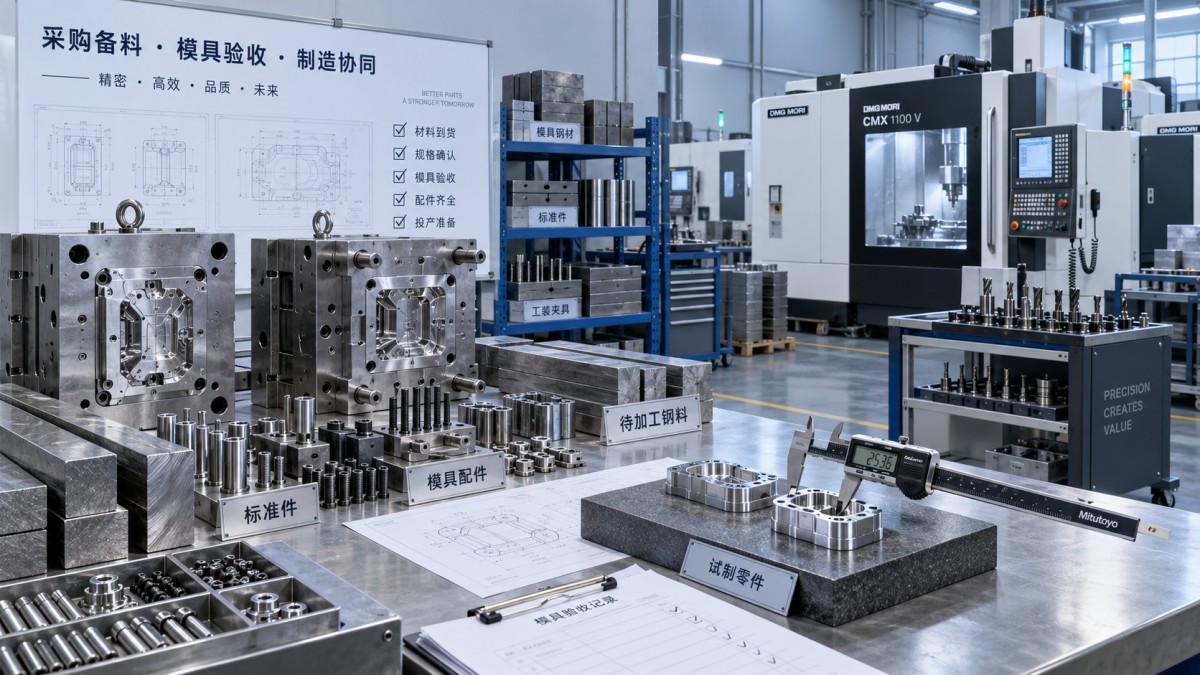
Progress reviews should concentrate on changes to the critical path. If machining finishes early but the trial machine remains unavailable, the program has not necessarily gained time. Conversely, a delayed noncritical component may be manageable if it does not block assembly or validation.
Define escalation triggers before a milestone is missed. A missed material dispatch date, an unresolved design question approaching fabrication release, or loss of a trial slot can justify intervention while recovery options still exist. The trigger should reflect the time needed to respond, not merely the date on which lateness becomes visible.
Purchase orders can reinforce this approach by linking appropriate payments to verifiable deliverables and defining change authorization. Payment structure alone does not guarantee performance, and withholding cash indiscriminately can obstruct execution. Its value is in making obligations and acceptance conditions clear.
Recover a late tool by addressing the limiting dependency
When a delay emerges, obtain a revised sequence rather than accepting a replacement delivery date without explanation. The recovery plan should show remaining operations, available resources, technical uncertainties, and what must change to achieve the revised commitment.
Additional shifts can help when labor or machine access is the constraint and the work can proceed safely. Parallel fabrication can help when elements are genuinely independent. Neither measure fixes unsettled geometry, unavailable material, or a failed trial whose cause has not been established.
Supplier transfer also needs careful evaluation. Moving unfinished tooling requires usable design data, inspection records, compatible equipment, clear ownership rights, and a receiving supplier willing to accept the work. Time spent understanding partially completed work can outweigh the benefit of additional capacity. Maintaining access to tooling documentation supports recovery, but it does not make transfer instantaneous.
A bridge tool or temporary fixture may protect limited production where its capability is sufficient. It should have explicit quantity, quality, operating, and replacement limits. It is not an acceptable shortcut if it cannot produce conforming parts or meet applicable safety requirements.
Evaluate recovery spending against the time it can actually recover on the critical path. Premium freight, overtime, and duplicate tooling each address different constraints. Authorizing them without a demonstrated schedule effect can increase cost while leaving the launch date unchanged.
Keep approval and change control inside the schedule
Industrial procurement support in contract manufacturing is incomplete if it tracks only supplier activity. Customer-side approval delays can stop work just as effectively as a supplier capacity shortage. Design reviews, deviation decisions, and trial acceptance need scheduled response windows and named approvers.
Changes after tooling release should include an assessment of affected work, scrap or rework exposure, additional validation, and the revised completion date. Even a small product change can have a large tooling consequence if it affects completed features or requires a different manufacturing approach.
The operational test is straightforward: can the team identify what blocks the next tooling milestone, who can remove that block, and what evidence confirms it has been removed? Procurement reduces delay when those answers lead to earlier commitments and timely decisions. Where the remaining constraint is technical, its role is to secure the resources and information needed for resolution—not to substitute urgency for engineering acceptance.
Recommended News
 How to size extrusion equipment for a target production outputSize extrusion equipment to meet your production targets. Learn how to calculate throughput, identify line bottlenecks, and verify capacity to avoid costly sizing mistakes.
 How to assess 5-axis demand in machining center market analysisStrengthen your machining center market analysis: learn how to assess 5-axis workloads, buyer readiness, and investment costs to build credible demand forecasts and avoid costly overestimates.
 Can procurement support reduce contract manufacturing tooling delays?Discover industrial procurement support contract manufacturing teams can use to cut avoidable tooling delays, secure materials, and keep production launches on track.
 Which export insights matter when entering a new market?Export insights for new-market entry: assess demand, standards, delivered costs, supply resilience, and buyer approval paths to build a profitable expansion plan.
 How industrial technology solutions in Southeast Asia handle humid sitesIndustrial technology solutions Southeast Asia: learn how site-adapted materials, sealing, condensation control, and maintenance strategies improve reliability in humid, coastal, and high-corrosion industrial environments.
 How hospitals can size telemedicine hardware for peak virtual visitsTelemedicine hardware for hospitals: learn how to size reliable endpoints for peak virtual visits, optimize reserves, workflows, network readiness, and uptime.
 Which electronic components most affect smart actuator reliability?Electronic components that shape smart actuator reliability: evaluate power supplies, motor drives, sensors, control boards, and connectors for demanding industrial performance.
 When do reshoring CNC investment opportunities justify 5-axis capacity?Explore when reshoring CNC investment opportunities justify 5-axis capacity—reduce setups, strengthen quality control, cut supply-chain risk, and build a resilient local machining strategy.
 What compliance documents should an industrial chemicals exporter provide?Industrial chemicals exporter compliance guide: learn which SDS, CoA, transport, customs, and market-access documents help prevent delays and risks.
 How to assess a smart device manufacturing solutions factoryAssess a smart device manufacturing solutions factory with practical insights on engineering, quality, testing, supply-chain resilience, and pilot builds.
 What CE certification means for a CNC controller systemCNC controller system CE certified: learn what CE marking covers, how to verify safety, EMC, documentation, and retrofit compliance for EU machinery.
 When industrial sewing is the right fit for high-volume productionIndustrial sewing for high-volume production: learn how seam design, material control, automation, and quality planning drive reliable output and lower risk.
 How ATC tool change time data reveals hidden cycle-time lossesATC tool change time data reveals hidden cycle-time losses, separates mechanical delays from program motion, and helps manufacturers improve uptime, capacity, and delivery confidence.
 What to verify before selecting a sinker EDM machine supplierChoose a reliable sinker EDM machine supplier with confidence. Verify machining trials, electrode compatibility, automation, service support, and total ownership risk.
 How brass alloy choice affects industrial machining part tolerancesIndustrial machining brass parts: discover how alloy selection influences tolerance stability, tool wear, bore accuracy, threads, and reliable high-volume production.
 What to verify before selecting an electronics contract manufacturerElectronics manufacturing solutions: learn what to verify before choosing a contract manufacturing partner, from quality systems and testing to sourcing, traceability, and change control.
 How to check color accuracy before approving custom enamel pinsCustom enamel pins color accuracy starts before approval. Learn how to review Pantone references, proofs, plating, and samples for confident results.
 When do multilayer carbide coatings extend tool life in dry machining?Multilayer carbide coatings extend tool life in dry machining when heat, adhesion, abrasion, and edge loading are controlled. Learn how to match layers, substrates, and parameters for reliable performance.
 When occupancy controls reduce warehouse lighting energy wasteWarehouse lighting occupancy controls cut energy waste through smarter zoning, sensor placement, dimming, and commissioning. Discover practical strategies for safer, lower-cost operations.
 How to size an ESS for reducing peak-demand chargesESS sizing for peak-demand charge reduction: learn how to match power, usable energy, tariff rules, controls, and recharge strategy to lower billed demand reliably.
 How textile chemicals affect dye-house wastewater treatment costsTextile chemicals can raise dye-house wastewater treatment costs through COD, color, sludge, salt, and fouling. Discover practical ways to assess total chemical cost.





















Search News
Popular Tags