
How to choose industrial gaskets for food safety
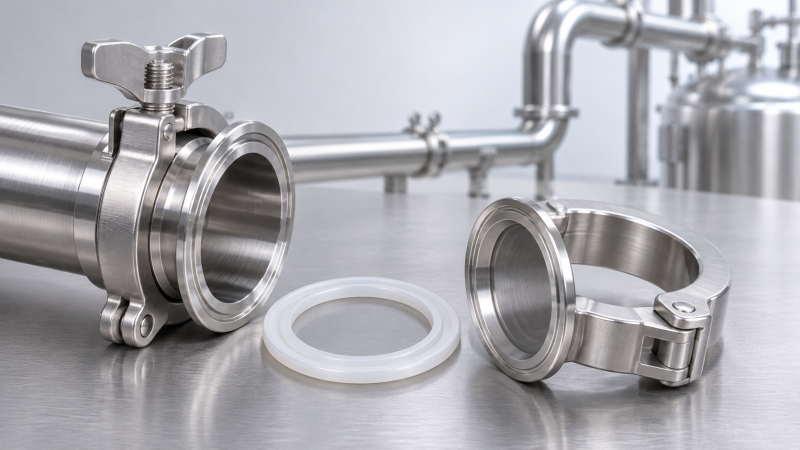
A gasket may be a small component, but choosing the wrong one can put food safety, production continuity, and cleaning effectiveness at risk. A seal that fits perfectly on installation may swell in an oily product, harden under repeated heat exposure, or leave a crevice where residue collects. For quality control and safety managers, the challenge is to look beyond dimensions and a reassuring “food-grade” label.
A sound selection connects four questions: What can contact the gasket? What must the gasket withstand? Can the joint be cleaned and inspected? And can the supplier substantiate the material’s suitability for the intended market and use? The answers are specific to the application, not just to the material family.
Start with the gasket’s actual role in food safety
Map where the gasket sits in the process and how contact could occur. A seal in a product-contact pipe joint has a different risk profile from one on the exterior of a utility line. Also consider indirect routes: a damaged gasket upstream may shed fragments into product, while a leaking joint may allow contamination to enter during downtime or cleaning.
Build an application profile with production, engineering, sanitation, and quality teams. Record the food or beverage involved, including fat content, acidity, alcohol, and any abrasive ingredients. Then capture the complete operating cycle—not only normal production temperature and pressure, but startup, shutdown, vacuum, pressure surges, and cleaning conditions.
For example, a gasket in a cold dairy line may spend much of its life at a low temperature but encounter hot alkaline detergent, acid rinse, and steam during cleaning. Selecting it only for chilled milk overlooks the conditions that may limit its service life.
Compare gasket materials against the whole process
Material names are useful starting points, not guarantees. Formulation, fillers, manufacturing method, hardness, and geometry all influence performance. The table below highlights common choices and the questions worth asking before approval.
Do not assume that every version of a familiar elastomer is suitable for food contact. Two EPDM compounds, for instance, can differ in additives and performance. Request information for the exact compound and finished gasket, then compare the supplier’s compatibility guidance with the full temperature, concentration, and exposure time of each medium.
Where published data is incomplete or the process is particularly demanding, agree on a representative trial. A laboratory soak test may reveal swelling or hardness changes, but it does not necessarily reproduce compression, flow, thermal cycling, and cleaning in the installed joint. Define acceptance criteria and inspection intervals before the trial begins.
Check food-contact compliance without relying on labels alone
“Food-grade” is a useful search term, but it is not a complete specification. Regulatory requirements depend on the destination market, whether contact is direct or indirect, and the conditions of use. Ask the supplier to identify the applicable requirements and provide documentation traceable to the supplied material or product.
- United States: Determine whether the relevant provisions of FDA food-contact regulations apply. For rubber articles intended for repeated use, 21 CFR 177.2600 may be relevant, subject to its conditions and limitations. Do not treat a general statement of “FDA approved” as sufficient evidence.
- European Union: Food-contact materials must meet applicable framework requirements, including Regulation (EC) No 1935/2004 and good manufacturing practice under Regulation (EC) No 2023/2006. Depending on the material and market, additional EU or national rules may apply. Regulation (EU) No 10/2011 concerns plastics and should not automatically be applied to every elastomer gasket.
- Other markets: Confirm local food-contact requirements and any customer-specific specifications before purchasing, particularly when equipment or finished food crosses borders.
A declaration should identify the material or article covered, the applicable requirements, and relevant restrictions, such as food types, temperature, or duration of contact. Where appropriate, request supporting test information or migration evidence for the intended use. Regulatory suitability and hygienic design are related but separate: documentation cannot compensate for a poorly designed joint, and a clean-looking gasket is not proof of compliance.
Evaluate the joint, not just the gasket
A compatible material can still fail if the gasket is installed in the wrong groove or compressed unevenly. Review the flange or fitting standard, dimensions, surface condition, gasket profile, and intended compression together. Use the equipment manufacturer’s requirements for assembly and tightening; excessive compression can damage or extrude a seal, while insufficient compression can leave a leak path.
Pay particular attention to dead spaces and product traps. A gasket that protrudes into the flow path may collect residue or wear under flow. A recessed or distorted seal can create a difficult-to-clean crevice. Hygienic joint design should support the cleaning method actually used, whether the system is cleaned in place or dismantled for inspection.
Visual inspection also has limits. A seal may look intact while having lost elasticity or developed a permanent compression set. Conversely, surface staining does not by itself establish failure. Agree on objective replacement criteria with maintenance and quality, including deformation, cracking, extrusion, leakage, and any signs of material shedding.
Cleaning and sterilization deserve their own review
Request the sanitation recipe rather than a generic statement that the system uses “CIP.” Record detergent and disinfectant chemistry, concentrations, temperatures, contact times, rinse steps, and frequency. If steam-in-place is used, include its temperature, duration, and cycle frequency. A material suitable for occasional hot water exposure may not tolerate repeated aggressive cycles in the same way.
When chemicals or sanitation parameters change, reassess the gasket. A cleaning improvement aimed at one hazard can unintentionally shorten seal life or create a new source of contamination. Include sanitation changes in the site’s change-control process.
What to request from a gasket supplier
A useful supplier discussion should produce more than a catalogue recommendation. Ask for evidence that links the proposed gasket to your application and enables your team to manage it after installation:
- The exact material designation, compound identification, gasket dimensions, and drawing or specification.
- Food-contact declarations applicable to the intended markets and conditions, including any limitations.
- Compatibility guidance for the product, cleaning chemicals, temperature range, and pressure or vacuum conditions.
- Assembly guidance, including compression or tightening requirements where available.
- Lot identification and traceability information, plus a process for notification of material or manufacturing changes.
- Recommended inspection considerations and any evidence supporting the proposed service conditions.
Keep these records with the approved supplier and equipment files. If the supplier substitutes a compound or manufacturing source, assess the change before use; a gasket with the same dimensions and generic material name may not have the same compliance status or operating behavior.
Turn the assessment into a practical decision
Before approving a gasket, compare candidates against mandatory requirements rather than choosing solely on purchase price. Eliminate options that lack suitable food-contact documentation or cannot withstand the known cleaning cycle. Among the remaining candidates, weigh sealing performance, inspectability, availability, traceability, and the operational consequences of failure.
For a high-fat product processed in a heated line, for example, the decision may turn on resistance to both the product and the cleaning regime. An oil-compatible candidate is not automatically the best choice if it cannot tolerate the site’s repeated hot cleaning cycles. Where evidence is uncertain, document the gap and use a controlled trial or seek further technical support instead of treating assumptions as approval.
Once installed, record the gasket type, location, lot, installation date, and inspection findings. Use maintenance history and any leakage or contamination investigations to refine replacement intervals. This creates a feedback loop between procurement, sanitation, and quality control: the next purchasing decision can be based on observed service conditions rather than habit.
G-PME’s industrial sealing and engineering perspective can help teams frame these comparisons against applicable technical standards and operating requirements. The final selection should remain application-specific, supported by supplier evidence and reviewed through the facility’s food safety and change-control procedures.
Facing technical bottlenecks in manufacturing or looking for more efficient industrial solutions? Leave your details below and let the engineering experts at G-PME solve them for you.
We respect your privacy. Your information is strictly confidential.
Recommended News
 How to choose industrial gaskets for food safetyImprove food safety with the right industrial gasket. Compare materials, cleaning compatibility and compliance requirements to make a confident choice.
 How a B2B network can help distributors find gasket suppliersA B2B network helps distributors find gasket suppliers, compare capabilities, verify quality and build reliable supply partnerships. Discover how.
 US Adds 50% Section 338 Tariff on Canadian Seals and Other ProductsUS Section 338 tariffs add 50% to covered Canadian seals, lubricants and other goods. Explore the potential impact on sourcing and supply chain costs.
 EPDM, FKM, or PTFE? Choosing Food Processing Seals for CIP ChemicalsWhich sealing materials are most reliable for food and beverage processing equipment? Compare EPDM, FKM, and PTFE for CIP chemical resistance and learn how to reduce leaks.
 Buying Industrial-Grade Sealing Materials: Which Supplier Data Matters?Searching for sealing materials industrial grade? Learn which supplier tests, batch records, and specifications matter to reduce leakage risks and buy with confidence.
 How Can I Assess Chemical Compatibility Before Purchasing?How can I assess chemical compatibility before purchasing? Learn how to evaluate fluids, temperatures, seals, materials, and testing requirements to prevent costly failures.
 How raw material price development changes gasket sourcing plansRaw material price development reshapes gasket sourcing plans. Learn how to protect specifications, manage lead times, assess alternatives, and reduce project risk.
 silicone products for Sealing Applications: Choosing the Right Grade for Heat and Chemical ExposureSilicone products for sealing applications: learn how to choose the right grade for heat and chemical exposure to improve durability, prevent failure, and boost performance.
 UK Opens S-PVC Dumping Probe on Chinese ImportsUK opens S-PVC dumping probe on Chinese imports, raising new cost, compliance, and customs concerns. See what exporters, buyers, and manufacturers should watch now.
 EU Tightens EN 1092-1 Rules for Gasket ImportsEU Tightens EN 1092-1 Rules for Gasket Imports: learn how the 2026 update impacts Industrial Gaskets, Mechanical Seals, and High-Tensile Bolts for EU compliance, customs, and EPC delivery.
 EN 1515-2:2026 Adds Cryogenic Cycling Test for GasketsEN 1515-2:2026 adds a cryogenic cycling test for industrial gaskets. Learn how the new EU rule affects non-metallic flange gaskets, compliance, and export readiness.
 Medical Grade Materials Explained: Key Properties, Common Uses, and Compliance BasicsMedical grade materials explained clearly: explore key properties, common applications, and compliance basics to choose safer, more reliable materials with confidence.
 Insulation & Waterproofing Explained: Key Materials, Methods, and Where Each Works BestInsulation & Waterproofing explained clearly: compare key materials, installation methods, failure risks, and where each system works best for durable, efficient projects.
![]() Stand Up Pouches for Food Packaging: Types, Barrier Options, and Seal ChoicesStanduppouches for food packaging explained: compare pouch types, barrier options, and seal choices to improve shelf life, reduce risk, and choose smarter packaging solutions.
![]() EPDM Rubber Roofing Wholesale: How to Compare Roll Thickness, Width, and MOQepdm rubber roofing wholesale guide: compare roll thickness, width, and MOQ to cut seam labor, reduce waste, improve logistics, and choose the most cost-effective roofing supply.


Search News
Popular Tags