
How raw material price development changes gasket sourcing plans
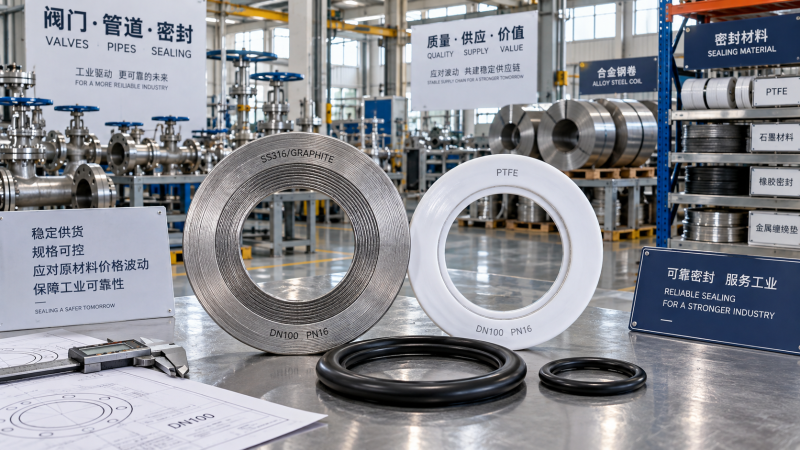
Raw material price development changes gasket sourcing plans long before it appears as a higher line item on a purchase order. The immediate effect may be a revised quotation for a spiral-wound gasket, a PTFE envelope gasket, or an elastomeric sheet. The more consequential effect is that material volatility exposes weaknesses in specification control, supplier qualification, lead-time assumptions, and contingency planning.
For an industrial project, the correct response is not simply to seek the lowest-priced equivalent. A gasket is a pressure-boundary component whose value is determined by leakage control, operating reliability, and installation readiness. When the cost or availability of graphite, fluoropolymers, specialty elastomers, stainless steel strip, or alloying elements shifts, sourcing decisions need to distinguish between a genuine market-driven cost movement and a proposal to alter the sealing system’s technical basis.
Why gasket prices do not move as one market
“Gasket” is a purchasing category, not a single material market. A compressed fiber sheet gasket, a graphite laminate, a spiral-wound gasket, a corrugated metal gasket, and an O-ring-based seal can respond to entirely different cost pressures. Treating them as interchangeable under one raw-material-price assumption creates poor budget forecasts and, more importantly, misleading substitution discussions.
Elastomer-based products are influenced by polymer feedstocks, compounding ingredients, reinforcement materials, curing systems, and the availability of approved compound formulations. NBR, EPDM, FKM, silicone, and perfluoroelastomer families differ materially in both their supply bases and their performance envelopes. A rise in the cost of a base polymer does not automatically justify changing from one elastomer to another: compatibility with fluid media, temperature cycling, compression set, steam exposure, ozone resistance, and required approvals remain decisive.
PTFE-related sealing materials require a similarly careful reading. Virgin PTFE, expanded PTFE, filled PTFE, and PTFE envelope constructions do not carry the same material content or processing complexity. A nominally lower-cost alternative may have a different creep behavior under bolt load, different resistance to permeation, or different suitability for flange face conditions. Where the design relies on controlled cold flow or chemically resistant sealing under a defined load window, raw-material savings can be rapidly outweighed by rework or leakage exposure.
Graphite gasket markets are affected not only by graphite input costs but also by foil quality, reinforcement type, oxidation resistance treatments, metallic insert availability, and fabrication capacity. In high-temperature service, the performance question is rarely whether a material is called “graphite”; it is whether its construction, density, purity, reinforcement, and oxidation limitations match the operating duty. A change in graphite input pricing should therefore trigger review of the actual finished-gasket construction rather than a broad assumption that all graphite items are equivalent.
Metallic gaskets bring another layer of complexity. Spiral-wound and jacketed gasket costs can be sensitive to stainless steel strip, nickel alloys, winding wire, inner and outer ring materials, and the availability of specified grades. The price behavior of standard austenitic stainless grades can differ from that of high-nickel or corrosion-resistant alloys selected for sour, chloride-bearing, high-temperature, or cyclic service. For these products, alloy surcharges, ring geometry, winding density, and certification requirements may matter more than the base metal price quoted in market commentary.
The real sourcing impact is often specification timing
Raw material volatility becomes operationally disruptive when a project has frozen a datasheet but has not yet converted the requirement into a controlled, purchasable gasket schedule. At that stage, several avoidable ambiguities may remain: whether the gasket is to meet a named standard, whether a manufacturer’s proprietary grade is accepted, whether the requested thickness is essential, whether inner and outer rings are mandatory, or whether traceability documentation is required for every line item.
Those ambiguities invite a supplier to quote on a different technical basis when material costs rise or lead times tighten. The quoted item may fit the nominal size and pressure class while differing in filler, winding material, reinforcement, density, facing, or test documentation. Such differences are not automatically unacceptable, but they cannot be assessed through unit price comparison alone.
A useful sourcing plan separates three categories:
- Design-locked items: gaskets tied to process safety, hazardous media, high pressure, elevated temperature, emissions control, critical rotating equipment, or contractual specifications. Material changes require formal engineering review.
- Performance-defined items: items for which the duty conditions and applicable standard are clear, but more than one qualified construction may satisfy the requirement. Alternatives can be evaluated against documented limits.
- Standardized non-critical items: repetitive, low-consequence applications where an approved family of materials and sizes can be stocked or sourced from multiple qualified routes.
This classification prevents a common mistake: applying the same cost-reduction logic to every gasket on a bill of materials. It also allows effort to be concentrated where the combination of failure consequence and supply exposure is highest.
Material volatility changes lead time, not only price
Finished gasket lead time is often governed by the slowest constrained input, not by the physical time needed to cut sheet material or wind a gasket. A supplier may have production capacity but lack a particular alloy strip, graphite grade, elastomer compound, reinforcement layer, or approved ring material. Documentation requirements can add another constraint where material certificates, batch traceability, positive material identification, or project-specific inspection records are required.
This is particularly relevant when gasket procurement is left until flange completion, hydrotest preparation, or turnaround work-pack release. At that point, the project may have little time to assess alternatives, confirm dimensional compatibility, revise documentation, or perform a controlled technical deviation review. The apparent procurement problem then becomes a critical-path problem.
Lead-time exposure should be assessed at the gasket family and service level, not only at total package level. A package can be substantially complete while a small number of specialty gaskets hold up commissioning. High-alloy spiral-wound units, large-diameter custom gaskets, non-standard thicknesses, chemically resistant PTFE constructions, and certified elastomer seals may have sourcing behavior very different from standard catalog items.
It is also important to distinguish a supplier’s stated manufacturing lead time from the total time needed for technical clarification, approval of drawings, confirmation of materials, inspection, packing, freight, customs clearance, and site receipt. Price pressure often causes suppliers to offer alternatives early in the quotation cycle; if the response process is slow, the original delivery promise may no longer be meaningful by the time the order is released.
Index-linked pricing can be more transparent than repeated rebidding
For material-intensive gasket packages, a fixed price can appear simpler but may merely transfer volatility into a larger contingency or a shorter quotation-validity period. When a project has a long procurement horizon, a defined price-adjustment mechanism may offer clearer control than repeated rebidding after each material movement.
The mechanism must be specific enough to be auditable. It should identify the material element subject to adjustment, the reference index or documented supplier surcharge basis, the baseline date, the adjustment frequency, and the treatment of fabrication, testing, packaging, and freight. It should also state whether the adjustment applies to the entire product price or only to the verifiable material-content portion.
A broad clause that permits a supplier to revise prices for “market conditions” provides little protection. Equally, a rigid fixed-price demand without regard to extraordinary changes can encourage suppliers to quote conservatively, restrict validity, or later seek substitutions. The objective is not to eliminate commercial risk completely; it is to make the allocation of risk visible before the procurement decision is made.
For standard consumables, framework agreements with agreed material families, dimensional ranges, and call-off conditions can reduce the need to requalify routine items. For project-specific or high-integrity services, the stronger approach may be to reserve manufacturing slots or secure critical raw materials after technical approval, even if final quantities remain subject to controlled adjustment.
Do not confuse an approved alternate with a cheaper nominal equivalent
Raw material cost pressure commonly brings “equivalent” offers. Equivalence should be demonstrated against the actual joint, not inferred from broad descriptors such as “high temperature,” “chemical resistant,” or “suitable for Class 150.” A gasket’s sealing behavior depends on the interaction among flange facing, bolt load, gasket geometry, compression characteristics, temperature, pressure, media, assembly practice, and cycling conditions.
For flange joints, applicable standards may define dimensions and product forms but do not eliminate the need to verify service suitability. ASME B16.20 covers metallic gaskets for pipe flanges, while ASME B16.21 addresses nonmetallic flat gaskets. EN 1514 series standards address gaskets for flanges and include different gasket types and dimensions. Compliance with a dimensional standard is not, by itself, evidence that a proposed substitute will provide the same leakage performance in a specific duty.
Technical review of a proposed alternate should therefore address the following questions:
- Does the alternative retain compatibility with the process fluid, including cleaning chemicals, contaminants, and abnormal operating conditions?
- Can the flange and bolting system deliver the seating stress and operating load required by the replacement material?
- Are thickness, width, density, winding construction, filler, ring materials, and surface finish requirements unchanged or explicitly reassessed?
- Does the operating temperature include oxidation, thermal cycling, fire exposure, steam, vacuum, or pressure-transient considerations that affect the proposed construction?
- Will the alternative preserve contractual, client, emissions, safety, and traceability requirements?
The last question frequently determines whether a technically workable alternative is usable in the project. A substitution can create a mismatch with approved vendor documentation, piping specifications, inspection plans, or end-user requirements. The cost of revising and reconciling those documents should be included in the decision, particularly when the original gasket was part of a vendor-supplied skid or packaged equipment boundary.
Build market intelligence into the gasket register
A generic commodity dashboard is too remote from the decisions that determine gasket availability. The useful view is a gasket register that links each material-sensitive item to its service criticality, approved construction, source options, lead-time basis, documentation requirements, and substitution authority.
For each critical line, the register should identify the material that is actually likely to constrain supply. For a spiral-wound gasket, that may be the winding alloy or filler rather than the outer ring. For a PTFE product, it may be a particular filled grade or envelope construction. For an elastomeric seal, the risk may sit in the approved compound formulation and curing capacity rather than in the polymer category named on the datasheet.
That level of detail makes raw material price development actionable. It allows commercial teams to ask suppliers focused questions: what input is driving the revision, what share of the finished product is affected, what alternative constructions are already qualified, what inventory is committed, and what documentation remains available if a different production batch or material source is used.
It also improves internal decision speed. A request for a price increase or material substitution can be routed with the operating conditions, joint details, acceptance criteria, and contractual constraints already attached. Without this information, technical decisions are often made under schedule pressure and based on incomplete descriptions.
Lifecycle exposure is larger than the purchase variance
The gasket itself is usually a modest fraction of total installed cost. Its failure consequences may include lost commissioning time, unplanned tightening work, contaminated insulation, fluid release, retesting, permit delays, or damage to adjacent equipment. This does not mean that all premium materials are justified. It means that savings should be judged against the failure consequence of the particular joint and the certainty of installation conditions.
For routine utilities with stable conditions and standardized flanges, material flexibility may offer a legitimate route to lower sourcing exposure. For high-consequence process lines, the more resilient plan is often to protect the approved sealing construction, establish a qualified secondary route where feasible, and order early enough to avoid rushed technical deviations.
Material markets will continue to influence gasket costs unevenly because gasket performance depends on multiple inputs and controlled manufacturing steps. The practical sourcing advantage lies in seeing that volatility early, mapping it to the actual sealing duty, and treating price, availability, specification integrity, and critical-path delivery as one connected decision rather than four separate procurement issues.
Recommended News
 Where machine shop digital transformation delivers the fastest paybackMachine shop digital transformation delivers faster payback by reducing downtime, setup delays, quality risks, and capacity constraints with focused, measurable workflows.
 When a semiconductor manufacturing solutions provider can shorten process ramp-upA semiconductor manufacturing solutions provider can shorten ramp-up through validated hardware, change control, field support, and resilient supply chains.
 How to evaluate CNC tooling suppliers in Europe for repeatable precisionCNC tooling Europe: learn how to evaluate suppliers for repeatable precision, stable tool life, application support, traceability, and resilient delivery.
 When does manufacturing competitiveness consulting pay off for a plant?Manufacturing competitiveness consulting pays off when plants face costly constraints, capital decisions, quality risks, or supply disruptions. Learn how to build a measurable ROI case.
 How to order acoustic ceiling tiles in bulk without overbuyingAcoustic ceiling tiles bulk buying made simple: calculate accurate quantities, control waste, secure spare stock, and plan phased deliveries to avoid costly overordering.
 Which laboratory microscopes fit routine quality inspection work?Laboratory microscopes for routine quality inspection: compare stereo, digital, compound, and measuring options to improve defect detection, documentation, and throughput.
 Can AI for multi axis machining reduce errors in complex toolpaths?AI for multi axis machining helps reduce complex toolpath errors through smarter collision detection, kinematic analysis, post validation, and machine-data insights. Learn how to improve precision.
 How seamless steel pipes are checked for wall-thickness consistencySeamlesssteelpipes wall-thickness checks explained: learn how ultrasonic scanning, calibration, and tolerance control ensure reliable, pressure-ready pipe quality.
 When a horizontal boring machine for metalworking improves large-part setupHorizontal boring machine for metalworking: learn how stable datums, rotary indexing, and rigid fixturing improve large-part accuracy and setup efficiency.
 What the MTTF standard for CNC means for machine reliabilityMTTF standard for CNC explained: learn how failure definitions, duty cycles, MTTR, and real-world data shape machine reliability and uptime.
 When does company formation offshore reduce cross-border tax risk?Companyformationoffshore can reduce cross-border tax risk when substance, governance, transfer pricing, and supply-chain roles align. Learn the key tests.
 How to read a measuring tape accurately for repeatable cutsMeasuringtape guide for accurate, repeatable cuts: master markings, hook movement, reference edges, kerf control, and stop-block setup.
 How to assess a CNC cutting tools manufacturer before orderingAssess a CNC cutting tools manufacturer with confidence: compare quality control, application support, trial results, supply reliability, and total machining cost before ordering.
 How often should scaffolding be inspected on active job sites?Scaffolding inspection guidance for active job sites: learn when to inspect, key safety triggers, compliance intervals, and practical controls to prevent incidents.
 What to verify when sourcing precision machining tools in EuropePrecision machining tools Europe sourcing guide: verify accuracy, ISO compliance, traceability, service coverage, and delivery resilience to reduce risk and lifecycle costs.
 When electronics require precision manufacturing at micron tolerancesPrecision manufacturing solutions for electronics deliver micron-level control, reliable inspection, and scalable quality for critical housings, thermal parts, and complex assemblies.
 When do cabletrays need corrosion protection in industrial facilities?Cabletrays need corrosion protection when exposed to moisture, chemicals, salt, washdown, or condensation. Learn how to select durable materials and protect critical industrial routes.
 What suppliers must prove for manufacturing standards compliance in Southeast AsiaManufacturing standards compliance Southeast Asia: learn what suppliers must prove, from traceable materials and calibrated tools to controlled processes, safety, and shipment records.
 What to verify in a fluid control manufacturer's quality systemFluid control manufacturer quality checks: verify traceability, testing, calibration, document control, and corrective actions to reduce risk.
 When do smart device manufacturing solutions reduce assembly errors?Smart device manufacturing solutions reduce assembly errors with closed-loop controls, vision inspection, torque verification, and traceable process data. Learn what drives reliable production.
 Import trends reshaping precision tooling supply in 2026Import trends in 2026 are reshaping precision tooling supply. Discover how to reduce landed risk, strengthen sourcing resilience, and protect production performance.



















Search News
Popular Tags