
Buying Industrial-Grade Sealing Materials: Which Supplier Data Matters?
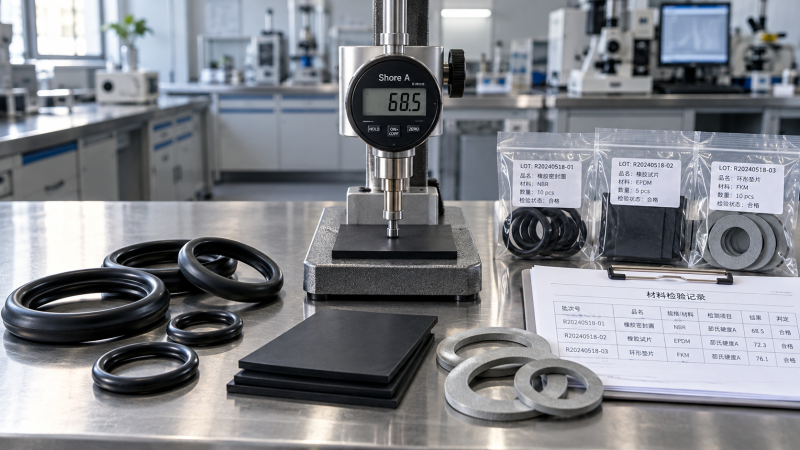
The supplier data that matters most connects an exact sealing compound to the actual service conditions, a documented acceptance specification, and a traceable production batch. A low unit price has limited value when the quotation leaves material identity, test conditions, or replacement availability unresolved. Those gaps create costs through rejected deliveries, installation rework, leakage, and premature replacement.
Searching for “sealing materials industrial grade” produces many broad claims about durability and chemical resistance. Treat “industrial grade” as a description requiring evidence. A useful quotation should establish what will be supplied, why it suits the application, how conformity will be verified, and which changes require approval before shipment.
Define the service conditions before comparing supplier claims
Supplier data becomes meaningful only against an application specification. “Oil resistant,” “high temperature,” and “high pressure” leave too much undefined. Even a detailed material datasheet cannot establish suitability if the fluid composition, seal geometry, or operating cycle remains unknown.
Provide the fluid name and composition, concentration, operating temperature range, pressure and pressure direction, and whether the seal is static or moving. Include startup, shutdown, cleaning, and upset conditions. A seal exposed to a compatible process fluid during production may encounter a much more aggressive cleaning agent between production runs.
For moving seals, surface speed, lubrication, mating-surface finish, and motion type affect wear and heat generation. For flange gaskets, bolt loading, flange condition, gasket thickness, and available seating stress influence sealing performance. These details explain why a material approved for one assembly cannot automatically be substituted into another.
Separate continuous duty from brief excursions. A quoted peak temperature does not establish acceptable service life at that temperature. Similarly, a material’s pressure capability cannot be assessed independently of the gland, extrusion gap, reinforcement, or joint design.
Material identity must reach beyond the polymer family
Descriptions such as NBR, EPDM, FKM, PTFE, or flexible graphite identify broad material families. They do not fully identify the supplied grade. Fillers, cure systems, reinforcement, processing aids, and manufacturing methods influence performance. Two compounds within the same family can differ in compression set, fluid resistance, low-temperature flexibility, or wear behavior.
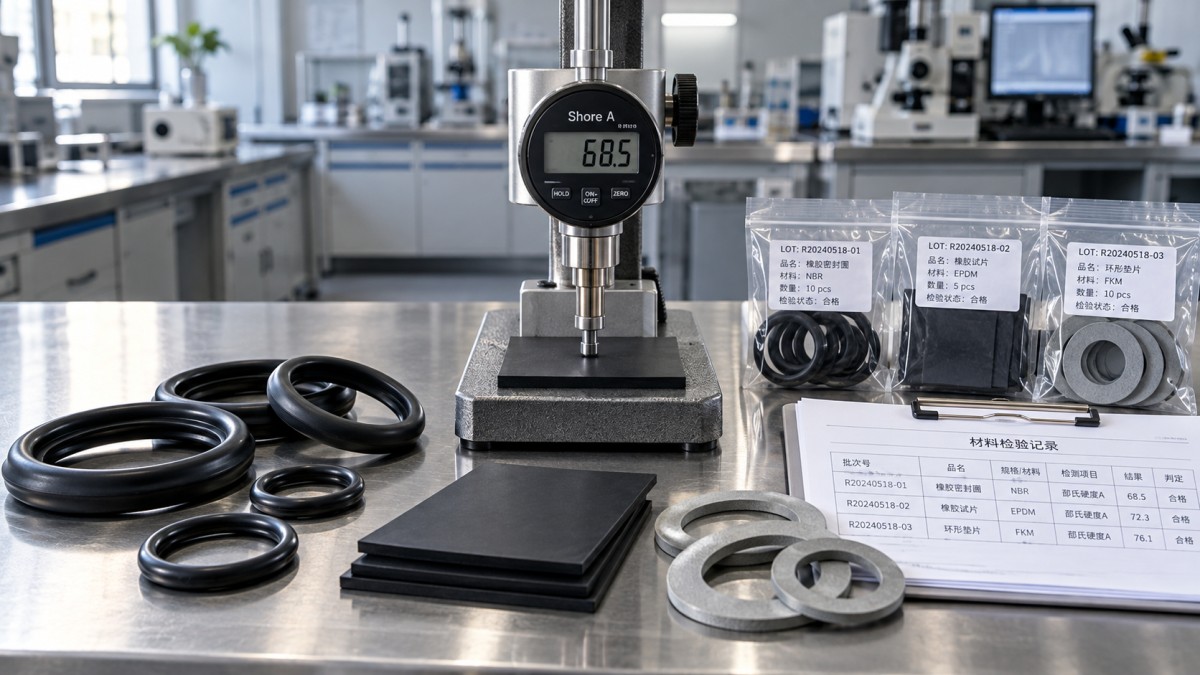
Request a manufacturer-controlled compound or grade designation, together with the properties used to release production. For elastomers, these often include hardness, tensile strength, elongation, and density. Hardness alone is insufficient: matching hardness does not establish matching formulation or chemical resistance.
For filled PTFE, the filler type and specified content matter because they affect creep, wear, and compatibility. For reinforced gasket sheet, identify the fiber, binder, and reinforcement construction. For graphite products, establish the grade, construction, and any inserts or adhesives that will contact the process or affect the joint.
Exact proprietary recipes are rarely necessary for a purchasing specification. What matters is a stable material designation, agreed performance requirements, and a controlled process for formulation changes. If the supplier uses several manufacturing sources, clarify whether the quoted designation represents one qualified compound or a commercial category containing alternatives.
Read test conditions before accepting performance numbers
A result is useful when its method, specimen, conditioning, exposure, and acceptance criteria are visible. A bare statement such as “excellent chemical resistance” offers no basis for comparing suppliers. Even a numerical result can mislead when the exposure period or test temperature differs from the intended service.
Fluid compatibility needs several measurements
For elastomer immersion testing, examine volume change alongside changes in hardness, tensile strength, and elongation. Swelling can alter gland fill and increase friction; shrinkage can reduce sealing contact. A specimen that looks intact after immersion may still have lost mechanical properties needed to retain a seal under load.
The test fluid should represent the actual medium, including concentration and relevant additives. A compatibility chart for a pure chemical does not settle the suitability of a formulated cleaner or mixed process stream. Where the service fluid is poorly defined, testing a representative sample closes a more useful evidence gap than requesting another generic compatibility letter.
Compression and recovery data require context
Compression set indicates how much deformation remains after a defined compression and recovery procedure. Compare results only when specimen geometry, compression, temperature, duration, and recovery conditions align. A lower reported value from a milder test does not establish superior performance.
For gaskets, compressibility and recovery describe different behavior from long-term stress retention. A sheet that conforms readily during assembly may still lose sealing load through relaxation. Ask for evidence relevant to the joint’s loading and temperature, particularly where retightening is impractical.
Where pressure cycling, vacuum, or rapid gas decompression is part of service, generic tensile and hardness results leave important behavior untested. Qualification should address the relevant failure mechanism. A successful static immersion test, for example, does not establish resistance to internal damage during rapid depressurization.
Temperature and pressure ratings belong to the assembly
Temperature limits are often presented as a simple range, but different mechanisms govern each end. At low temperature, reduced flexibility can prevent an elastomer from following movement or maintaining contact. At high temperature, aging, softening, hardening, or chemical attack can shorten useful life. Exposure duration and fluid contact change the outcome.
Ask whether a published range describes continuous operation, intermittent exposure, or an approximate material-family guideline. For demanding service, request the underlying test basis and the criterion used to define acceptable performance. “Survived exposure” is weaker evidence than a report showing retained properties or measured leakage under stated conditions.
Pressure claims need equally careful treatment. An elastomer seal supported by a closely controlled gland behaves differently from the same compound across a larger extrusion gap. Backup rings, thermal expansion, dimensional tolerances, and pressure reversals affect the result. A pressure rating detached from these conditions should not become a purchase-order guarantee.
For gasketed joints, pressure containment also depends on seating stress, flange stiffness, fastener loading, and retained gasket stress. Supplier recommendations should identify the assumptions behind the proposed material and thickness. Increasing thickness to compensate for damaged flanges introduces different compression and relaxation behavior and requires review.
Make standards and traceability auditable
A standards reference should explain what was evaluated. A test-method reference describes how a property was measured; it does not necessarily specify an acceptable result. A material classification can define selected characteristics without proving suitability for the intended application. A quality-management certificate concerns the management system within its stated scope.
Request the applicable document revision, the tested grade, the result, and the acceptance requirement. When a report covers a different thickness, hardness, construction, or production site, establish whether that difference affects its relevance. An accredited laboratory report offers useful assurance about testing within the laboratory’s scope, while the connection between the specimen and the delivered product still needs evidence.
Traceability should connect the shipment label and product designation to a production lot, manufacturing source, and retained records. Where conversion occurs after material manufacture, such as cutting gaskets from sheet, the records should preserve the connection between the finished parts and the original material batch.
Clarify which results are measured on every batch and which come from periodic qualification testing. Destructive application tests are not necessarily repeated for every delivery. The inspection plan should distinguish those activities so that a batch certificate does not imply testing that never occurred.
Storage and age controls also belong in the documentation. Request relevant manufacturing or cure dates, storage conditions, and the supplier’s shelf-life basis. For assemblies, adhesives or secondary components can impose storage limits different from those of the main sealing material.
Compare quotations using the cost of an accepted, usable seal
Normalize quotations against the same grade, drawing revision, dimensions, tolerances, documentation, packaging, and delivery conditions. A cheaper offer may exclude inspection records, use wider thickness tolerances, or substitute a different construction. Those differences need a technical disposition before the prices become comparable.
A practical comparison includes the landed purchase cost, qualification expense, incoming inspection, expected scrap, installation effort, and replacement burden. Downtime estimates should use site-specific assumptions. Unsupported failure probabilities create an appearance of precision without improving the decision.
For a low-consequence static joint with easy access, a standard qualified grade with basic batch documentation may be sufficient. A seal containing hazardous fluid or requiring major disassembly warrants stronger application evidence and tighter change control. Documentation depth should follow the consequences of failure and the uncertainty in the application.
Minimum order quantities and pack sizes also affect cost. Excess stock ties up cash and creates aging or identification problems when consumption is slow. Compare usable inventory over the expected replacement cycle, including any storage restrictions, rather than assuming the largest quantity discount produces the lowest total expense.
Put the evidence into the purchase order
Technical discussions become enforceable purchasing requirements only when the agreed specification reaches the order and supplier acknowledgment. Reference the approved grade, drawing, acceptance limits, required records, packaging identification, and the process for handling deviations. Define whether substitutions require approval before manufacture or shipment.
Delivery reliability needs concrete supporting information: the manufacturing location, whether stock is raw material or finished product, which processing steps remain, and when inspection documents become available. A stock statement is less useful if cutting, molding, curing, or final release still controls the delivery date.
For an unproven source or changed compound, use a qualification order with explicit acceptance criteria before authorizing routine supply. Laboratory results establish material behavior under controlled conditions; a controlled assembly trial addresses fit, installation, and operating conditions that specimen tests cannot reproduce.
The order should leave a clear path from the approved application evidence to the material received. When the supplier proposes a formulation, source, or process change, that connection must be reviewed before the revised product enters service.
Recommended News
 How to verify batch quality with an industrial lubricating oils exporterBuying from an industrial lubricating oils exporter? Learn how to verify batch test results, sampling, and traceability to reduce purchasing risks and protect equipment.
 How to set relubrication intervals for industrial maintenanceImprove industrial maintenance with smarter relubrication intervals. Learn how to balance bearing conditions, grease quantity, and monitoring to reduce downtime and avoid costly failures.
 How to spot misleading claims on eco-friendly baby productsShopping for ecofriendlybabyproducts? Learn to spot greenwashing, verify certifications, and assess material and disposal claims so you can choose with confidence.
 John Crane Signs Three-Year Agreement to Improve Phosphate Mine Seal ReliabilityJohn Crane's three-year agreement targets phosphate mine seal reliability with on-site expertise and mechanical seal solutions. Explore its potential to reduce downtime.
 Which Die Casting Defects Should You Check Before Supplier Approval?What die casting defects should be checked before supplier approval? Explore key defects, inspection methods, and acceptance limits to qualify suppliers confidently and reduce costly failures.
 Buying Industrial-Grade Sealing Materials: Which Supplier Data Matters?Searching for sealing materials industrial grade? Learn which supplier tests, batch records, and specifications matter to reduce leakage risks and buy with confidence.
 What tolerances can zinc precision die casting realistically hold?Can zinc precision die casting hold ±0.025 mm? Discover which features qualify, what affects accuracy, and when machining delivers better results for your parts.
 Which ISO standards apply to five-axis machine accuracy testing?Explore ISO machine accuracy standards for five-axis machining. Learn how ISO 230 and ISO 10791 guide geometry, positioning, and motion tests to define clearer acceptance criteria.
 How to test smart actuators during smart device manufacturingExplore smart device manufacturing solutions testing for smart actuators. Learn how to verify loaded motion, fault responses, and end-of-line performance to improve release confidence.
 Dormer Pramet Unveils Milling and Threading Solutions for Demanding ProductionExplore Dormer Pramet’s four new milling and threading solutions for demanding production, and discover what to check for tooling suitability, performance evidence and purchasing decisions.
 How to select low-friction industrial seals for centrifugal pumpsChoose industrial seals for low friction in centrifugal pumps. Compare face materials, lubrication and support systems to reduce wear and operating losses. Find the right fit.
 A supply chain analysis framework for spotting mold delivery risksUse a supply chain analysis framework to spot mold delivery risks, verify critical dependencies, and protect launch schedules. Discover practical steps to act early.
 How bearing prices shape machine tool spindle production cost trendsExplore how bearing prices shape spindle production cost trends, from assembly and testing to supply risks. Uncover hidden costs and make smarter sourcing decisions.
 Carrier Plans $600 Million Advanced Manufacturing Center With 5-Axis CNC EquipmentCarrier plans a $600M+ advanced manufacturing center with 5-axis CNC equipment in Texas. Explore potential opportunities for machining suppliers and commercial chiller buyers.
 Why do pH meters give unstable readings in metalworking coolants?Unstable pHmeters in metalworking coolants? Learn how to identify probe fouling, verify calibration, and improve sampling for reliable readings before costly coolant adjustments.
 Aluminum vs. titanium for lightweight parts with equal stiffnessEngineering materials comparison: lightweight alloys aluminum and titanium face off at equal stiffness. Discover how geometry, loading, and cost guide the best choice for lighter parts.
 Which engineering materials hold tight tolerances as temperatures change?Explore our engineering materials comparison by tolerance to learn how Invar, ceramics, steel, and aluminum handle temperature changes—and find the right fit for precision designs.
 John Crane to Showcase Emissions and Downtime Reduction Technologies at ADIPEC 2026John Crane at ADIPEC 2026: Explore technologies targeting lower emissions and compressor downtime, and discover what reported savings could mean for your operations.
 When does precision engineering machining need a 5-axis machine?Discover when precision engineering machining needs 5-axis capability. Compare 3+2 and simultaneous machining to improve tool access, control costs, and choose the right process.
 How to check clinical validation of wholesale blood pressure monitorsSourcing blood pressure monitors wholesale? Learn how to verify clinical studies, registry listings, cuff coverage, and model identity before approving your next bulk order.
 How much lithium battery storage do you need for solar energy?Lithium battery storage for solar energy: learn to calculate capacity, account for losses, and check backup power. Avoid costly sizing mistakes and find the right system for your needs.












Search News
Popular Tags