
Which Chemical Documents Are Required for Supplier Approval?
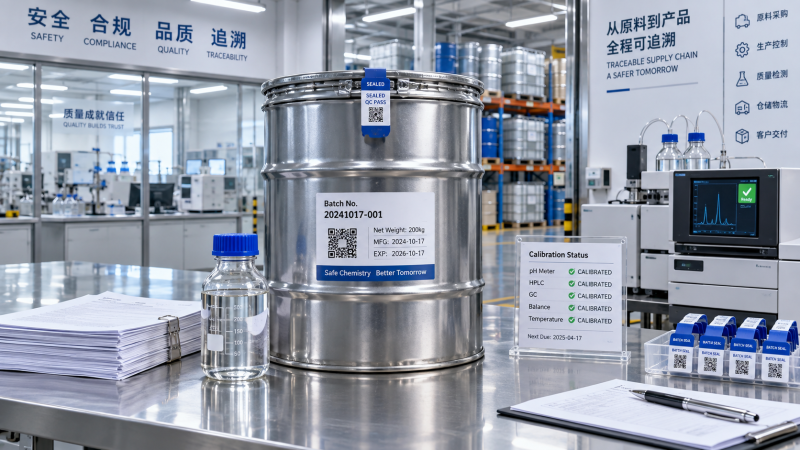
A chemical supplier can look credible on paper long before its material reaches a production line. The real test begins when that material is used in a precision-machining coolant system, a sealing compound, a die-casting release process, a pump lubrication circuit, or a controlled cleaning operation. If the chemistry is undocumented, inconsistent, or non-compliant in the destination market, a low purchase price can quickly turn into rejected batches, worker-safety concerns, equipment damage, or an avoidable production stoppage.
So, what industrial chemical documents are required for supplier approval? The short answer is: documents that prove identity, safe handling, composition control, performance, regulatory status, batch quality, and supply-chain accountability. The exact package varies by chemical class, industry, geography, and application risk. However, several records form the baseline for most industrial procurement and quality-approval processes.
For procurement directors, R&D teams, maintenance managers, and EPC contractors, the goal is not to create paperwork for its own sake. It is to establish a defensible link between the approved product, the approved manufacturing site, the delivered batch, and the conditions under which the chemical can be safely used.
The core approval file: documents most chemical suppliers should provide
A supplier approval review usually starts with a document set rather than a sample. Samples matter, particularly for lubricants, functional fluids, coatings, cleaners, sealants, additives, and process chemicals. Yet a sample only shows what was delivered on one occasion. Documentation reveals whether the supplier has a controlled system behind it.
1. Safety Data Sheet (SDS)
The Safety Data Sheet is normally the first mandatory document. It describes hazards, composition information, first-aid measures, fire response, spill handling, storage conditions, transport classification, disposal considerations, and exposure controls. A current SDS should be supplied in the language and format required by the market where the chemical will be stored or used.
Reviewers should check more than whether an SDS exists. Confirm the revision date, product name, supplier legal entity, emergency contact details, hazard classification, recommended use, and transport information. A mismatch between the SDS, product label, purchase description, and technical data sheet is a warning sign. For substances or mixtures used across multiple jurisdictions, verify alignment with applicable GHS-based requirements, such as EU CLP or OSHA Hazard Communication requirements in the United States.
2. Technical Data Sheet (TDS) or product specification
The Technical Data Sheet translates chemistry into operating expectations. For an industrial lubricant, it may identify viscosity grade, base-oil type, pour point, flash point, corrosion protection, demulsibility, foam behavior, and compatibility guidance. For a metalworking fluid, it may address dilution range, water quality, biological control, material compatibility, and machining suitability. A coating, adhesive, or cleaning chemical may require cure conditions, film properties, evaporation rate, residue profile, or surface-preparation requirements.
A TDS is not a substitute for a contractual specification. It is often a marketing-facing document and may list “typical values” rather than guaranteed limits. During supplier approval, ask for the controlled product specification with test methods, acceptance limits, units, and revision status. That distinction is especially important where sub-micron machining tolerances, surface cleanliness, or long equipment uptime are at stake.
3. Certificate of Analysis (CoA) for each batch or lot
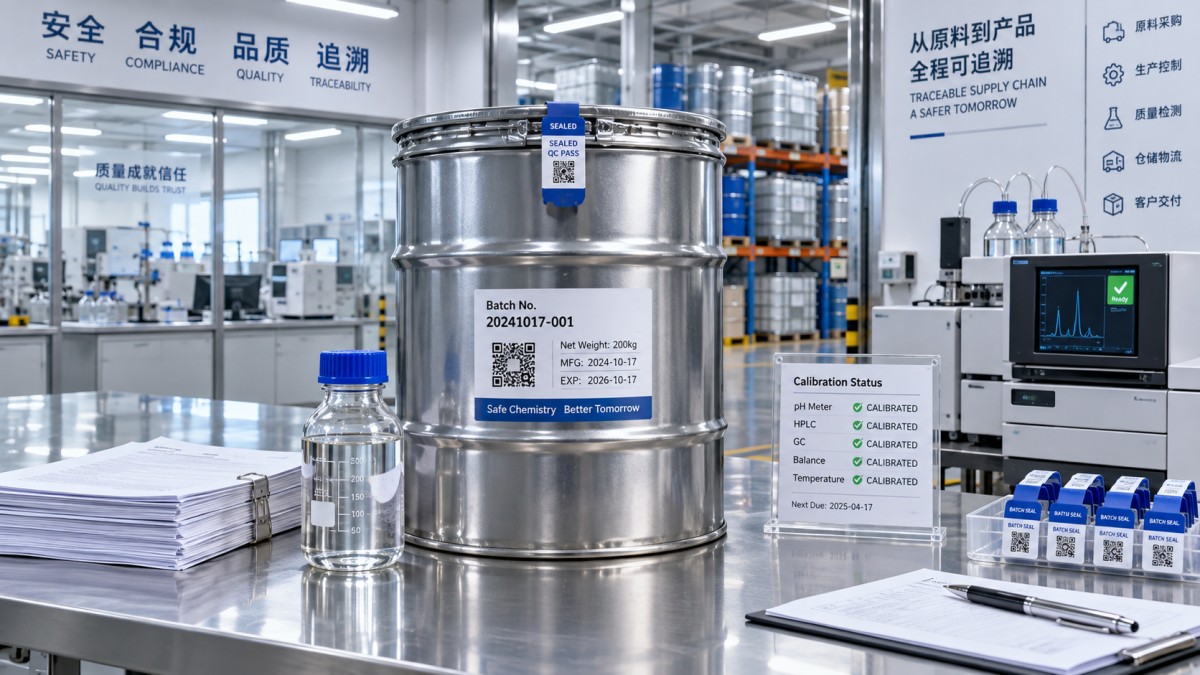
The Certificate of Analysis is the document that connects the delivered material to measurable quality results. It should identify the product, batch or lot number, manufacturing date, expiry or retest date where applicable, test results, specification limits, test methods, and release authorization.
For critical chemicals, a CoA should accompany every shipment or be available electronically before receipt. It is not enough for the CoA to say “Pass.” Procurement and quality teams need the actual values for agreed critical parameters: viscosity, moisture, acid number, purity, density, particle count, active content, color, pH, flash point, or other application-specific controls.
Be careful with generic “certificate of conformity” statements that contain no lot-specific data. A certificate of conformity may support a shipment, but it does not replace a meaningful CoA when process performance depends on chemical consistency.
4. Regulatory compliance declarations
Regulatory declarations demonstrate whether a chemical can legally and responsibly enter a specific market and application. The right declarations depend on where the product is manufactured, sold, transported, and used. A sensible approval file may include confirmations relating to:
- REACH registration, pre-registration status where relevant, or applicable exemption status for the European market;
- SVHC disclosure under REACH and communication obligations for substances of very high concern;
- RoHS compliance where chemicals are used in electrical and electronic supply chains or related manufacturing processes;
- TSCA status for the United States;
- California Proposition 65 disclosure when relevant to the intended market;
- Conflict-minerals, PFAS, halogen, heavy-metal, VOC, or restricted-substance declarations when required by customer specifications or sector rules;
- Food-contact, NSF, potable-water, medical, aerospace, automotive, or marine approvals where the end use calls for them.
These documents should never be treated as universal checkboxes. For example, an industrial hydraulic oil may need a different compliance review from a mold-release agent used on components entering an automotive interior, or a process cleaner used before a medical-device assembly operation. The approval team should define the intended use first, then request the declarations that genuinely apply.
5. Quality management certificates and supplier quality records
A chemical supplier’s quality-system certificate helps establish whether production, testing, document control, nonconformance handling, and corrective actions are managed under a recognized framework. ISO 9001 is commonly requested. Depending on the supply chain, ISO 14001, ISO 45001, IATF 16949, AS9100, or industry-specific certifications may also be relevant.
Certification alone does not prove that a particular product will meet your needs. It does, however, provide useful context. Review the certificate scope, issuing body, site address, expiration date, and whether the manufacturing site named on the certificate is the site producing the chemical. A trading company may hold a quality certificate while the actual blender, formulator, or packager operates under different controls.
For high-risk or high-volume suppliers, approval teams commonly request a supplier quality questionnaire covering manufacturing controls, incoming raw-material qualification, laboratory capability, calibration, retained-sample policy, complaint management, business continuity, and change-control procedures.
Traceability is where many approval files become weak
In industrial chemical procurement, the product name is rarely enough. “EP gear oil,” “water-based coolant,” or “industrial degreaser” can describe broad categories with significant variation in formulation and performance. Traceability records show exactly what was made, where it was made, and how it can be investigated if a problem emerges months later.
Ask the supplier to document the manufacturing location, batch-number logic, packaging date, shelf-life controls, and retained-sample period. A robust supplier should be able to trace finished-product lots back to key raw materials and production records, then identify which customers received the affected lot if a recall or quality alert becomes necessary.
For chemicals used in precision machining, die-casting, sealing systems, and fluid-control equipment, traceability may need to extend to packaging. Drum liner materials, container cleanliness, seal integrity, and labeling accuracy can affect contamination-sensitive products. A high-performing formulation can still fail if it is filled into unsuitable or poorly controlled packaging.
Documents that become essential for specific applications
Not every chemical needs the same expanded dossier. The approval threshold should rise with process sensitivity, safety impact, regulatory exposure, and replacement difficulty.
Compatibility and performance test reports
When a chemical contacts metals, elastomers, coatings, plastics, filters, seals, or precision surfaces, request evidence of compatibility. This may include corrosion testing, elastomer-swell results, copper-strip corrosion data, seal-material compatibility, residue testing, or fluid-filterability assessments.
For a synthetic lubricant used in a high-speed spindle or a high-pressure metering pump, the TDS alone may not answer concerns about seal life, deposit formation, oxidation stability, or interaction with an existing fluid. Application-relevant test reports give engineering teams a more realistic basis for approval.
Transport and dangerous-goods documentation
If the material is classified for transport, the supplier should provide relevant dangerous-goods information, including UN number, proper shipping name, packing group, hazard class, and transport mode requirements. Depending on the shipment and route, this may involve ADR, RID, IMDG, IATA, or local transport requirements.
Procurement should confirm that the packaging configuration, labels, shipping documents, and warehouse arrangements match the classification. A correct SDS does not automatically mean the shipment has been prepared compliantly.
Country of origin, customs, and supply-chain declarations
Global sourcing often requires documents that sit outside conventional quality assurance: country-of-origin declarations, tariff classifications, export-control confirmations, and statements on sanctioned-party compliance. These can be particularly important when functional chemicals contain controlled precursors, fluorinated materials, specialty additives, or substances subject to changing trade restrictions.
For continuity planning, it is also worth asking where key feedstocks are sourced and whether there is a qualified second manufacturing site. The answer may not be public, and confidential details may require a non-disclosure agreement, but a supplier should be able to discuss meaningful contingency arrangements.
How to review a supplier’s documents without missing the practical risks
A common mistake is to collect PDFs, tick a portal checklist, and assume the supplier has been approved. A more reliable approach is to review the documents as a connected set. Does the product identifier on the SDS match the TDS, CoA, label, invoice, and compliance declaration? Is the revision history controlled? Are test methods named? Does the declared shelf life make sense for the product and logistics route? Is the supplier’s legal entity consistent across the documents?
Pay particular attention to vague statements. Phrases such as “REACH compliant,” “non-toxic,” “environmentally friendly,” or “meets international standards” are not sufficient without scope, date, product identification, and an authorized signature or traceable issuer. Compliance language must be specific enough to support a purchasing decision and, if necessary, withstand an audit.
Another frequent oversight is approving a supplier based on one formulation, then allowing silent substitutions later. Industrial chemical formulations can change because of raw-material availability, regulatory pressure, cost changes, or manufacturing transfers. The supplier approval agreement should state which changes require advance notification: changes to raw materials, additive package, concentration, manufacturing location, test method, packaging, label classification, or specification limits.
A practical document hierarchy for procurement teams
When time is limited, categorize documents by release priority. Before initial approval, obtain the SDS, controlled specification or TDS, relevant regulatory declarations, quality-system evidence, and a completed supplier questionnaire. Before first production use, obtain a representative CoA, batch traceability details, application test evidence where needed, and transport documentation for hazardous goods.
For ongoing supply, require lot-specific CoAs, current SDS revisions, notifications of regulatory or formulation changes, and periodic renewal of certificates and declarations. This keeps approval from becoming a one-time event disconnected from actual deliveries.
At G-PME, this layered view is especially relevant across industrial lubricants, functional chemicals, machining operations, sealing systems, and specialized fluid-control equipment. The question is not merely whether a supplier can send documents quickly. It is whether the records create a reliable technical chain from formulation to field performance, with enough transparency to protect production continuity.
Frequently asked questions
Is an SDS enough to approve an industrial chemical supplier?
No. An SDS is essential for safe handling and hazard communication, but it does not prove batch quality, manufacturing control, regulatory fitness for a specific application, or product performance. At minimum, pair it with product specifications, a CoA, compliance declarations, and supplier quality information.
What is the difference between a CoA and a Certificate of Conformity?
A CoA provides actual test results for a specific batch or lot. A Certificate of Conformity generally states that a product meets requirements, but may not show measured values. For process-critical chemicals, a lot-specific CoA is usually the stronger and more useful document.
How often should chemical supplier documents be renewed?
SDSs should be reviewed whenever revised, and at regular intervals within the supplier-management program. Certificates should be checked before expiration. Regulatory declarations should be refreshed when regulations, formulations, production sites, or intended uses change. Lot-specific CoAs should be reviewed with each applicable delivery.
Should confidential formulations be requested during approval?
Not necessarily. Suppliers may legitimately protect proprietary formulations. What matters is obtaining enough disclosure to assess hazards, restricted substances, compatibility, regulatory status, and change-control risk. Where deeper review is necessary, a controlled disclosure under an NDA may be appropriate.
Ultimately, chemical supplier approval is an exercise in disciplined trust. The most useful documents do not simply satisfy an audit folder; they give engineering, EHS, quality, and procurement teams a shared factual basis for deciding whether a material belongs in a critical industrial process.
Recommended News
 What to verify before using supplier sourcing solutions in EuropeSupplier sourcing solutions Europe: verify capabilities, compliance, traceability, total cost, and supply resilience before choosing reliable industrial partners.
 When smart fabrics are reliable enough for industrial wearablesSmart fabrics for industrial wearables: learn how to validate durability, signal quality, cleaning resilience, and safe failure performance before deployment.
 How supply chain management for exporters reduces customs delaysSupply chain management for exporters helps prevent customs delays with accurate data, origin checks, importer readiness, and proactive shipment controls. Explore practical strategies now.
 What to verify before approving an OEM electronics supplierOEM electronics supplier approval checklist: verify BOM control, traceability, testing, sourcing risk, capacity, and commercial terms before committing to volume production.
 When do CNC-machined precision components require five-axis milling?Precision components CNC machined with five-axis milling deliver better access, tighter datum control, and lower setup risk. Learn when five-axis machining is the smart choice.
 What should a restaurant POS system handle during a lunch rush?restaurantPOSsystems keep lunch rushes moving with fast ordering, smart kitchen routing, flexible payments, live inventory, and reliable service controls.
 How CNC controller cycle time speed affects machining throughputCNC controller cycle time speed can raise machining throughput by sustaining feed rates on complex toolpaths. Learn how to optimize CAM, look-ahead, and machine dynamics.
 When a 4 axis vertical machining center is the better fit than 3-axisDiscover when a 4 axis vertical machining center outperforms 3-axis machining—reduce setups, improve datum control, and boost efficiency for complex multi-face parts.
 When industrial fasteners bolts need traceable material certificationIndustrial fasteners bolts need traceable material certification for critical applications. Learn what QA teams should verify to reduce risk and ensure compliance.
 How to size pump systems for cooling circuits for stable flow ratesPump systems for cooling circuits: learn how to match flow, total dynamic head, NPSH, and controls for reliable, energy-efficient cooling performance.
 When does software as a service reduce CNC data management costs?Software as a service can lower CNC data management costs by reducing IT overhead, manual reporting, and disconnected records. Discover when SaaS delivers measurable savings.
 CNC investment trends 2026: are automation upgrades taking priority?CNC investment trends 2026 reveal why automation upgrades are reshaping capacity plans. Compare robots, pallet systems, and new machines for smarter CNC growth.
 How to size high pressure pumps for stable chemical injection ratesHigh pressure pumps sizing guide for stable chemical injection rates—learn how to balance flow range, pressure, suction conditions, materials, and controls for reliable dosing.
 When organic chemicals are suitable feedstocks for synthetic lubricantsOrganic chemicals can unlock high-performance synthetic lubricants. Learn how purity, stability, compatibility, and supply control shape reliable industrial formulations.
 What machine tool market size reveals about capital spending cyclesMachine tool market size reveals capital spending cycles through order mix, automation, replacement demand, and capacity signals. Discover what drives smarter investment decisions.
 What causes solar inverters to trip repeatedly after installationSolar inverters tripping repeatedly? Discover key causes, from grid voltage and DC faults to wiring, settings, heat, and practical troubleshooting steps.
 How a tool life calculation chart improves cutting parameter decisionsTool life calculation chart insights help optimize cutting speed, feed, and depth for predictable tool changes, better part quality, and lower machining costs.
 What to check before choosing an industrial lubricating oils factoryIndustrial lubricating oils factory selection guide: compare quality control, formulation fit, traceability, technical support, and total cost to reduce downtime risks.
 Where machine shop digital transformation delivers the fastest paybackMachine shop digital transformation delivers faster payback by reducing downtime, setup delays, quality risks, and capacity constraints with focused, measurable workflows.
 When a semiconductor manufacturing solutions provider can shorten process ramp-upA semiconductor manufacturing solutions provider can shorten ramp-up through validated hardware, change control, field support, and resilient supply chains.
 How to evaluate CNC tooling suppliers in Europe for repeatable precisionCNC tooling Europe: learn how to evaluate suppliers for repeatable precision, stable tool life, application support, traceability, and resilient delivery.





















Search News
Popular Tags