
Cleanroom equipment application guidance to reduce contamination risk
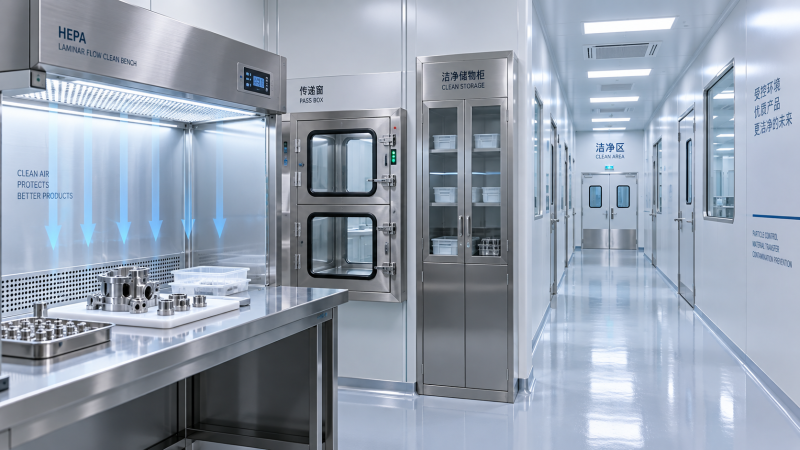
Contamination control fails most often at the point where equipment, process flow, and daily behavior stop working as one system. A high-grade filter cannot compensate for a poorly positioned workstation, a damaged door seal, or tools that carry residue from an uncontrolled area. Effective industrial application guidance for cleanroom equipment therefore starts with the contamination risk created by the actual process, then selects equipment and operating routines that control that risk consistently.
For precision machining, assembly, fluid handling, sealing, die-casting support operations, and chemical preparation, the goal is rarely to create the cleanest possible room at any cost. The practical goal is to keep particles, fibers, oils, vapors, moisture, and cross-contaminants away from the surfaces, materials, and operations that are sensitive to them. Equipment should be chosen and arranged around that objective.
Begin with the contamination path, not the equipment catalogue
Before specifying a filtration unit, clean bench, air shower, or storage cabinet, identify what can enter the controlled area, where it can settle, and what consequence it creates. This prevents a common purchasing error: selecting equipment based on a cleanroom classification label while ignoring the process that takes place inside it.
A contamination path usually has four parts:
- Source: people, packaging, incoming components, machining residue, lubricants, cleaning agents, tools, carts, or outdoor air.
- Transport: airflow, personnel movement, door opening, material transfer, vibration, splashing, or direct contact.
- Receiver: precision surfaces, adhesive interfaces, sealing faces, optical parts, electronic assemblies, fluid-contact components, or inspection samples.
- Failure mode: cosmetic defects, leakage, poor bonding, corrosion, unstable measurements, assembly rejection, product contamination, or worker exposure.
This exercise often changes the equipment decision. For example, a workpiece that is clean after washing but exposed during manual inspection may need localized clean airflow and covered staging, rather than a larger general cleanroom. A process involving volatile chemicals may require suitable extraction and material compatibility controls alongside particle filtration. Treating particle control and chemical control as the same problem creates gaps in both.
Match the protection method to the task
Cleanroom equipment performs different jobs. Some equipment improves the room environment. Some protects a specific operation. Some prevents contamination from moving between zones. The right choice depends on whether the risk is broad, localized, intermittent, or tied to material transfer.
The important distinction is between room cleanliness and process protection. A large controlled room can be excessive for a limited inspection task, while a local enclosure can be insufficient when multiple operators, open containers, and frequent material movement create contamination throughout the space. Use the smallest controllable zone that fully covers the sensitive operation, but do not reduce the controlled boundary below the true exposure area.
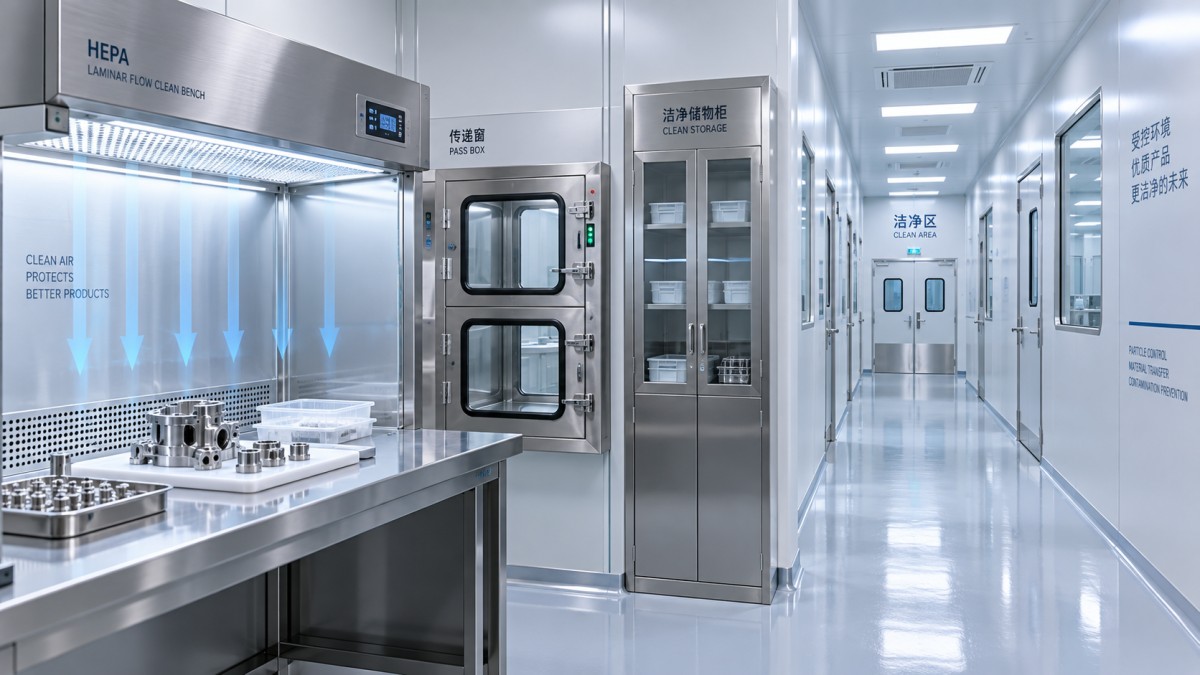
Airflow must protect the product, not merely circulate air
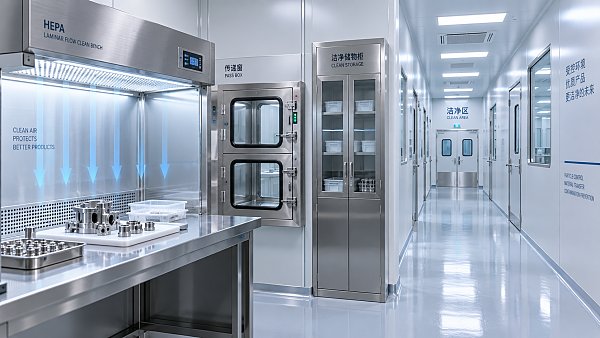
Airflow is central to contamination control because it determines where particles travel after they are released. The useful question is not simply whether air is moving, but whether clean air reaches the exposed surface before it passes over people, packaging, or dirt-generating equipment.
At a clean workbench, the operator should avoid placing hands, labels, tools, or containers upstream of the critical item. In other words, do not create a situation in which air passes over a sleeve or carton and then across an exposed sealing face or precision component. This mistake is common because the workstation may look clean while the airflow path is compromised by normal work habits.
Equipment layout should also prevent return air, exhaust, or turbulence from carrying contamination back into the work zone. Tall equipment, open shelving, hanging cables, and boxes stored beneath benches can disturb intended airflow patterns. When a process involves heat, moving mechanisms, spray, or frequent door opening, the airflow arrangement needs closer scrutiny because these conditions can create local currents that a basic room layout does not account for.
Do not use localized clean-air equipment as a drying rack, general storage surface, or packaging station unless that use was included in the workflow design. Every additional item placed inside the protected zone becomes a possible particle source and a possible obstruction.
Materials and surfaces can quietly undermine a cleanroom
Equipment construction matters because surfaces either support routine cleaning or make contamination persistent. Smooth, non-shedding, accessible surfaces are easier to inspect and wipe down. Crevices, exposed insulation, damaged coatings, difficult-to-reach fasteners, and worn wheels tend to retain dust, oil, and cleaning residue.
Material compatibility needs equal attention when the operation involves coolants, lubricants, solvents, cleaning agents, adhesives, or process fluids. A cleaning method that leaves residue, attacks a seal, embrittles a plastic part, or corrodes a metal surface can create a recurring contamination problem. This is especially relevant when moving components from machining or fluid-control production into a controlled assembly or inspection area. The part may appear clean while trace oil, lint from wipes, or residue from an unsuitable cleaner remains on the surface.
Select work surfaces, trays, bins, garments, and carts as part of the same control system. Reusable containers are only appropriate when their cleaning and inspection cycle is defined. Disposable packaging may reduce handling contamination in some flows, but it can introduce fibers or particles when opened in the wrong place. The better choice depends on where unpacking occurs, how long components wait, and whether containers return from less controlled areas.
Build the room around material movement
People tend to focus on the main room, yet contamination often enters through transitions. Incoming components may arrive with external packaging, cutting-fluid residue, dust from storage, or handling contamination. Once that material crosses into a clean zone without a defined transfer sequence, the cleanroom becomes responsible for contamination that should have been removed earlier.
A practical flow separates receiving, initial cleaning, controlled transfer, protected work, and clean storage. These functions do not always require separate rooms, but they need visible boundaries and a sequence that workers can follow without improvisation. Clean items should not travel back through an area used for unpacking or wiping down incoming materials.
For precision-manufacturing environments, a useful review is to follow one component from arrival to final packing. Note each time it is touched, unwrapped, placed on a cart, inspected, reworked, or temporarily stored. The points where ownership changes between teams are often the least controlled. A contamination-control plan is stronger when those handoffs specify container condition, cleaning status, labeling, and the permitted route.
Pressure relationships require operational discipline
Where adjacent areas are designed to have different cleanliness levels, airflow direction should support the intended separation. Doors held open, simultaneous opening of transfer doors, and improvised access routes can defeat that arrangement. Equipment features such as interlocks or status indicators are helpful, but they do not replace a workflow that allows staff to move materials efficiently without bypassing the controls.
When chemical vapors, hazardous dusts, or process emissions are present, protection requirements may point in a different direction from product-cleanliness requirements. A room designed only to push clean air outward may not be appropriate for a process that needs containment. In these cases, safety containment, local extraction, and product protection must be designed together rather than added one at a time.
Maintenance is a contamination-control activity
Cleanroom equipment can appear operational while its protective performance has declined. Filters load gradually, seals wear, airflow paths become blocked, and sensors drift. The absence of a visible problem is not proof that the room is still performing as intended.
Maintenance plans should cover more than scheduled filter replacement. They should include inspection of door seals, panel joints, fan operation, workbench screens, casters, drains where present, and surfaces that accumulate residue. After maintenance work, the area should be cleaned and returned to service through a controlled release process. Tools, replacement parts, packaging, and personnel can introduce contamination during the maintenance activity itself.
Routine checks should be easy for operators to perform and meaningful for quality teams to review. Examples include verifying that access doors close properly, checking that status indicators show normal operation, inspecting work surfaces before a sensitive run, and recording unusual noise, vibration, odor, or visible residue. These observations do not replace formal performance verification, but they identify changes early enough to prevent routine deviation from becoming product risk.
Cleaning procedures must remove contamination without creating more
“Clean more often” is not a complete control strategy. The method matters. A wiping process can redistribute particles if the wipe, liquid, or sequence is unsuitable. An overly wet method may leave residue or create moisture concerns; an aggressive method may damage labels, seals, coatings, or static-sensitive surfaces.
Define what is cleaned, when it is cleaned, which materials are permitted, and what condition is acceptable after cleaning. High-touch points such as handles, controls, carts, and transfer surfaces need attention, but product-contact or product-adjacent surfaces deserve a separate standard. Cleaning tools should not move from a less controlled area into a critical work zone without appropriate replacement or processing.
For recurring defects, avoid assuming that the solution is a stronger cleaner. Review whether the source is actually airborne particulate, oil carryover, degraded packaging, operator handling, equipment abrasion, or process residue. Different sources need different corrective actions.
A practical equipment review before approval
Before approving new cleanroom equipment or changing an existing layout, use a short cross-functional review. It should connect quality, safety, maintenance, and operations rather than treating the purchase as a facilities decision alone.
- Define the sensitive product surface or operation and the contamination that would cause failure.
- Map the likely sources and movement routes, including incoming materials and temporary storage.
- Decide whether protection is needed for the full room, a local task, a transfer point, or a hazardous process.
- Check airflow direction against the real work position, equipment arrangement, and operator movement.
- Confirm that surfaces, seals, containers, and cleaning materials are compatible with process fluids and cleaning methods.
- Assign ownership for daily checks, cleaning, maintenance release, and response to abnormal conditions.
This sequence is more reliable than starting with a preferred equipment model. It also helps prevent over-specification. A complex system with unclear operational ownership can perform worse than a simpler arrangement with a disciplined material flow and well-maintained local protection.
Where technical procurement support adds value
Cleanroom decisions often sit between facilities engineering, production quality, and equipment procurement. In high-precision manufacturing, that boundary is especially important because machining capability, sealing performance, fluid systems, molds, and functional chemicals can all influence contamination risk upstream of the clean area. Technical intelligence resources such as G-PME can be useful when teams need to compare equipment materials, process interfaces, maintenance implications, and supplier documentation against the actual production requirement rather than treating cleanroom equipment as an isolated purchase.
The final decision should be based on a simple question: does the proposed equipment reduce the contamination pathway that matters for this process, and can the site operate and maintain it consistently? When the answer is clear, the cleanroom becomes a controlled production tool rather than a space that only appears clean.
Recommended News
 When a horizontal boring machine improves accuracy in large metal partsDiscover when a horizontal boring machine for metalworking improves accuracy in large parts, protecting critical bore alignment, stable datums, and assembly-ready results.
 What to verify before choosing a fluid control supplier for critical flowChoose a fluid control supplier with confidence: verify pressure cycling, material compatibility, flow validation, traceability, sealing, and long-term support for critical applications.
 Cleanroom equipment application guidance to reduce contamination riskIndustrial application guidance for cleanroom equipment: reduce contamination risk with practical airflow, material flow, maintenance, and process protection strategies.
 When should wind turbine parts be replaced instead of repaired?Wind turbine parts: learn when replacement is safer than repair, how to reduce repeat failures, protect uptime, and make smarter maintenance decisions.
 What to verify before choosing a coolant flow rate and pressure supplierCoolant flow rate and pressure supplier selection guide: verify duty points, pump curves, filtration, controls and service support for reliable machining performance.
 How mold design choices affect cooling time in injection moldingDiscover how mold design affects injection molding cooling time, part stability, cycle efficiency, and long-term production quality with practical engineering insights.
 Machine tool standards alerts that require 5-axis safety procedure updatesMachine tool standards alerts can trigger critical 5-axis safety procedure updates. Learn which changes demand action to protect operators, equipment, and production uptime.
 Does manufacturing standards compliance for semiconductors affect EDM tool approval?Manufacturing standards compliance for semiconductors shapes EDM tool approval through traceability, validation, contamination control, and inspection. Learn what proves reliable capability.
 Which medical grade materials withstand repeated sterilization in pumps?Medical grade materials for sterilizable pumps: compare 316L, PEEK, PPSU, PTFE, silicone, and EPDM for steam, radiation, and chemical resistance.
 What G-code compatibility issues arise when moving to 5-axis centers?G code compatibility issues in 5-axis centers can affect TCP, rotary limits, feeds, and safety. Learn how to validate programs before production.
 Can custom mailer boxes reduce damage costs in subscription shipping?Custommailerboxes can lower subscription shipping damage costs through right-sizing, protective inserts, stronger materials, and efficient pack-out. Discover how to reduce claims and improve delivery performance.
 How to assess a lubricants manufacturer's batch traceabilityLubricants manufacturer batch traceability: learn how to audit records, controls, CoAs, packaging, and recall readiness to reduce supply risk and protect uptime.
 When solar inverters should be replaced instead of repairedSolar inverters: learn when recurring faults, obsolete parts, safety damage, and rising lifecycle costs make replacement smarter than repair.
 What to verify before choosing a first aid kits distributorFirst aid kits distributor checklist: verify compliance, traceability, expiry control, replenishment, and multi-site delivery before choosing a reliable supplier.
 How mold engineering design reduces warpage in thin-wall partsMold engineering design reduces thin-wall part warpage through balanced gating, cooling, packing, and ejection for stable, production-ready precision.
 What to audit at a CNC machine tools factory before approving a supplierCNC machine tools factory audit guide: verify machining accuracy, metrology, traceability, workforce skills, and capacity resilience before approving a precision supplier.
 When does a horizontal boring machine with ATC justify its cost?Discover when a horizontal boring machine with ATC delivers ROI through faster setups, higher uptime, lower labor costs, and reliable capacity growth.
 How office acoustics affect speech privacy in open-plan workspacesOffice acoustics shape speech privacy in open-plan workspaces. Discover practical strategies for reducing distractions, protecting sensitive conversations, and improving focus.
 Can AI in precision engineering for aerospace applications improve defect detection?AI in precision engineering for aerospace applications improves defect detection through smarter inspection, traceable workflows, and early process-drift alerts. Explore proven deployment strategies.
 Using a supplier capability evaluation framework to screen CNC suppliersSupplier capability evaluation framework for screening CNC suppliers: verify quality, traceability, capacity, and resilience to select reliable partners.
 When supplier capability evaluation services reduce tooling project riskSupplier capability evaluation services help reduce tooling project risk by verifying technical fit, quality controls, capacity, and delivery readiness before costly delays occur.




Search News
Popular Tags