
When supplier capability evaluation services reduce tooling project risk
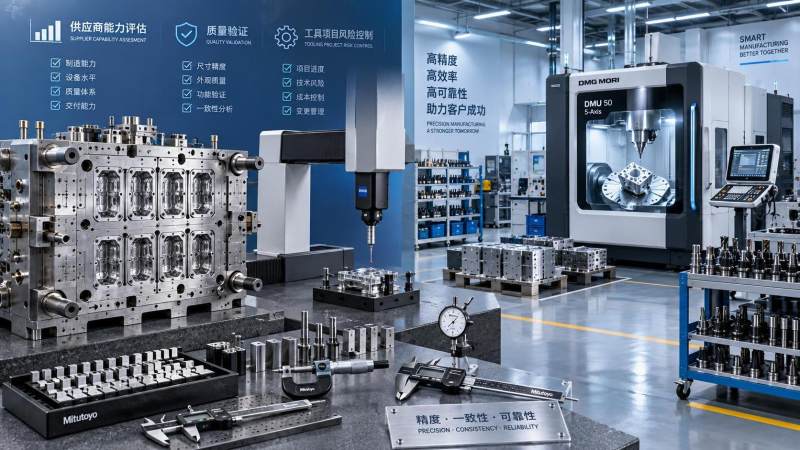
A tooling project can appear stable right up to the moment it is not. The CAD model is released, the purchase order is placed, and the supplier’s quotation looks commercially acceptable. Then the first trial exposes uneven cavity filling, an insert arrives late, a critical tolerance is interpreted differently, or a “full-capacity” shop reveals that its best machines are already committed elsewhere.
For project managers, these are rarely isolated supplier problems. They become schedule problems, launch problems, cash-flow problems, and sometimes customer-relationship problems. This is where supplier capability evaluation services can materially reduce tooling project risk: not by making every supplier identical, but by establishing whether a supplier’s actual operating capability matches the technical and commercial demands of the project before commitments become expensive to unwind.
In precision machining, die and mold engineering, casting, industrial fluid systems, and other production-critical fields, supplier selection is often treated as a sourcing event. It should be treated as an engineering risk decision. Price matters, but the cost of a low initial quote can be quickly eclipsed by rework, expedited logistics, corrective machining, delayed validation, and prolonged production trials.
Tooling risk usually begins before steel is cut
Most tooling failures do not start with a dramatic machine breakdown. They begin earlier, in assumptions that no one has tested carefully enough. A supplier may have impressive equipment on its website but lack the measurement discipline for tight-tolerance inserts. Another may build competent tools for stable, high-volume products but struggle with frequent engineering changes, complex shut-offs, or demanding surface requirements. A third may be technically capable, yet unable to protect the project schedule because planning, subcontractor control, and material traceability are weak.
These distinctions matter because tooling is not a catalog purchase. It is a sequence of linked decisions involving design-for-manufacture review, steel selection, machining strategy, heat treatment, electrode management, finishing, assembly, sampling, dimensional verification, and revision control. A weakness at one stage can travel through every stage that follows.
Consider a multi-cavity mold with close part-to-part consistency requirements. The supplier may be able to machine the core and cavity blocks to nominal dimensions, but can it manage thermal distortion after heat treatment? Can it document EDM settings and electrode offsets? Does it have in-house CMM capability, calibrated gauges, and a meaningful first-off inspection process? Does the team understand how venting, gate geometry, cooling channels, and material shrinkage interact during trial runs? Those questions determine whether the quoted lead time is realistic.
Supplier capability evaluation services bring those questions forward. Instead of discovering limitations during tool tryout, a project team can identify them during sourcing, when alternative routes still exist.
What should be evaluated beyond a supplier’s machine list?
A machine list is useful evidence, but it is only one layer of the picture. A five-axis machining center, wire EDM machine, vacuum hardening furnace, or high-speed milling platform does not automatically prove repeatable performance. The practical issue is how equipment, people, process control, and capacity planning work together under project pressure.
A meaningful evaluation normally examines several connected areas.
- Technical fit for the tool: Can the supplier handle the required tool size, geometry, materials, tolerances, surface finishes, and expected production environment? A supplier experienced in simple blanking tools may not be the right fit for precision molds with intricate cooling circuits or high-wear inserts.
- Manufacturing process maturity: Are machining, EDM, grinding, heat treatment, polishing, assembly, and inspection controlled through defined procedures? Where are the critical processes performed—in-house or through subcontractors—and how are outsourced steps managed?
- Quality assurance and metrology: Is there a clear route from drawing revision to inspection plan to measurement record? Project teams should look for calibration control, nonconformance handling, traceable inspection reports, and the ability to measure the features that matter rather than only convenient dimensions.
- Material and component control: Tool steel certificates, heat-treatment records, purchased standard components, coatings, and weld-repair history can all affect tool life and downstream performance. Material substitution without formal approval is a serious warning sign.
- Capacity and delivery discipline: Capacity is not simply the number of machines on the shop floor. It includes qualified operators, programming availability, maintenance condition, work-in-process visibility, bottleneck management, and the supplier’s ability to absorb engineering changes.
- Program management capability: The project needs one reliable version of the truth. Assess whether milestones, open issues, design revisions, trial results, and recovery actions are tracked in a way the buyer can review and challenge.
The strongest evaluations do not merely collect “yes” answers. They test how a supplier would respond to the specific risks embedded in the project. If a cooling channel is difficult to access, if a tolerance stack is unusually tight, if a customer approval gate is immovable, or if a tool must transfer between sites, the evaluation should make those conditions visible.

Capability assessment is most valuable at the decision gates
Project leaders do not need to audit every supplier with the same intensity. The smarter approach is to align the depth of evaluation with the consequence of failure. A low-complexity fixture with a short replacement lead time requires a different level of scrutiny from a high-cavitation mold, aerospace machining fixture, die-casting tool, or custom component that anchors an entire production launch.
There are four moments when supplier capability evaluation services are especially useful.
Before RFQ release
Early screening prevents the team from inviting suppliers who are structurally mismatched to the work. At this point, an evaluator can review the proposed manufacturing route, tolerance requirements, tool materials, expected annual volume, validation needs, and likely revision frequency. The goal is not to narrow the field based on reputation alone; it is to build a qualified bidder list that reflects the project’s real technical demands.
This step can also improve the RFQ itself. Vague requests invite vague quotations. When the buyer clarifies acceptance criteria, reporting requirements, critical dimensions, trial expectations, spare insert strategy, and ownership of design files, suppliers can price and plan more accurately. Better definition may raise an initial quote in some cases, but it often reduces costly ambiguity later.
During supplier selection
Once quotations arrive, the lowest number can be difficult to ignore. Yet a comparison based only on purchase price is misleading when suppliers are making different assumptions about steel grade, mold base specification, inspection scope, sampling responsibility, or the number of included revisions.
A structured evaluation normalizes those differences. It asks what each quote actually includes, which activities are outsourced, how lead time has been calculated, what capacity is reserved, and what technical exclusions may become change orders. The resulting decision is more defensible because it combines commercial cost with delivery confidence and quality exposure.
Before design freeze and steel release
This is one of the most important control points. A supplier should demonstrate that its design review has considered manufacturability, maintainability, wear areas, part ejection, cooling efficiency, tolerance chains, and inspection access. For machining tooling, the team should verify datum strategy, clamping approach, tool reach, cutting-force implications, and repeatability after tool changes.
Not every concern must be resolved before steel release, but every open point should have an owner, target date, and defined impact. “We will adjust it during tryout” is sometimes practical; it is not a substitute for understanding the cost and schedule risk of that adjustment.
After first-off trials, before production acceptance
A successful sample is not automatically a production-ready tool. The first acceptable part may have been achieved through unusually careful operator intervention, temporary parameter adjustments, or a level of attention that cannot be sustained in routine production. The evaluation should therefore examine repeatability, cycle consistency, dimensional stability, tool maintenance needs, and the completeness of technical documentation.
For critical applications, acceptance should include a clear handover package: approved drawings, inspection results, material and heat-treatment records where relevant, spare-parts lists, recommended maintenance intervals, and a defined process for future modifications. This protects the buyer long after the original project team has moved on.
How to distinguish a capable supplier from a persuasive one
Many suppliers can describe their strengths. Fewer can show evidence that withstands technical review. Project managers should be alert to the difference between a polished presentation and operational proof.
For example, a supplier may state that it works to ISO-based quality systems. The useful follow-up question is not simply whether a certificate exists, but how a drawing revision reaches the operator, how a rejected part is segregated, how gauge calibration is controlled, and how recurring defects are analyzed. Likewise, a claim of “full in-house capability” should prompt a practical map of which operations are internal, which are external, and where responsibility sits if an outside process fails.
Evidence can take many forms: anonymized inspection reports, sample project schedules, preventive maintenance records, capacity-planning snapshots, traceability procedures, corrective-action examples, and guided walkthroughs of active work. The purpose is not to burden suppliers with unnecessary paperwork. It is to verify that the controls needed for the project are alive in daily operations.
One useful question is deceptively simple: What would prevent this tool from being delivered on the promised date? A mature supplier will usually answer with specifics—material lead time, EDM queue constraints, design approval turnaround, coating lead time, trial-machine availability—and explain the mitigations. An evasive answer is itself useful information.
The cost conversation should include risk-adjusted cost
Procurement teams are under pressure to control tooling expenditure, and that pressure is legitimate. However, the relevant number is rarely the tool price alone. A more complete view includes the likely cost of schedule delay, engineering rework, extra trials, air freight, production disruption, and field correction. It also includes the internal time consumed when engineers must repeatedly intervene to stabilize a supplier’s process.
This does not mean the most expensive supplier is automatically the safest choice. A smaller specialist may offer excellent technical control and faster decision-making. A larger supplier may provide deeper capacity but introduce slower communication or more layers of approval. The aim of supplier capability evaluation services is to make these trade-offs explicit, so the team can select the best total-value route for the project rather than relying on instinct.
Where the risk is high, buyers may consider a phased commercial structure: design review approval before steel release, milestone payments tied to verifiable progress, defined acceptance criteria for trials, and documented ownership of tool data. These mechanisms are not adversarial when used well. They create shared clarity about what “complete” means.
Red flags that deserve attention before award
Some warning signs are easy to rationalize when a supplier has an attractive quote or an urgent delivery promise. They should still be investigated. Repeatedly changing lead-time explanations, unclear subcontractor arrangements, missing material traceability, reluctance to share inspection methods, inconsistent answers from sales and engineering, and a lack of visible work-order control all warrant further review.
Another common issue is overloaded capability. A shop can look busy and successful while being unable to give a new project the necessary attention. Ask how priorities are set when multiple urgent jobs collide, whether key machines have backup options, and how preventive maintenance is scheduled. The answer may determine whether a minor disruption becomes a missed launch date.
Equally important, avoid confusing a single supplier audit with permanent assurance. Capacity, ownership, key personnel, subcontractors, and quality performance change over time. For strategic tooling partners, capability should be reviewed at intervals and whenever the project profile changes significantly.
A practical role for independent technical intelligence
Independent evaluation can be particularly valuable when internal teams are stretched, the supplier base crosses multiple regions, or the project combines several disciplines such as CNC machining, mold engineering, die-casting, sealing, and fluid-control components. In these situations, a consistent technical framework helps procurement, engineering, and program management discuss the same facts.
G-PME approaches this need through a data-driven view of manufacturing capability: connecting equipment and process evidence with international standards, material considerations, production constraints, and supply-chain conditions. For a project manager, the value is not another generic supplier scorecard. It is a clearer understanding of where a tooling plan is robust, where it is exposed, and which questions should be resolved before the project reaches an irreversible stage.
The best time to evaluate a supplier is when the findings can still change the outcome. By the time a tool is late, a cavity requires major rework, or production has begun to wait for corrective action, the project is no longer buying capability—it is paying for its absence. A disciplined evaluation process turns supplier selection into an early form of risk engineering, giving teams a more realistic basis for protecting cost, timing, and tool performance.
Recommended News
 Can AI in precision engineering for aerospace applications improve defect detection?AI in precision engineering for aerospace applications improves defect detection through smarter inspection, traceable workflows, and early process-drift alerts. Explore proven deployment strategies.
 Using a supplier capability evaluation framework to screen CNC suppliersSupplier capability evaluation framework for screening CNC suppliers: verify quality, traceability, capacity, and resilience to select reliable partners.
 When supplier capability evaluation services reduce tooling project riskSupplier capability evaluation services help reduce tooling project risk by verifying technical fit, quality controls, capacity, and delivery readiness before costly delays occur.
 How can a trade network help distributors enter new regional markets?Trade network strategies help distributors enter regional markets with verified partners, local insights, technical fit, and reliable logistics for faster, lower-risk growth.
 Does private label manufacturing contract assembly reduce launch risk?Private label manufacturing contract assembly can reduce launch risk with proven quality systems, traceability, supplier validation, and scalable production control.
 When do e-readers make sense for a distraction-free work library?E-readers for focused work libraries: discover when they improve deep reading, technical document review, security, and distraction-free research workflows.
 How a precision milling center factory controls part-to-part consistencyDiscover how a precision milling center factory achieves reliable part-to-part consistency through controlled tooling, workholding, traceability, and in-process inspection.
 Which CNC manufacturing investment drivers matter before capacity expansionCNC manufacturing investment drivers: evaluate demand, automation, workforce readiness, and lifecycle ROI before expanding capacity. Build resilient, profitable growth.
 When CNC turning is the right fit for precision machining servicesPrecision machining services: discover when CNC turning delivers superior concentricity, surface finish, and cost control for critical rotational parts.
 When ozone generators are suitable for odor control in commercial spacesOzone generators for commercial odor control: learn when controlled treatment is appropriate, how to protect people and materials, and why source removal comes first.
 How to select mechanical seals for mixers handling abrasive slurriesMechanical seals for mixers: learn how to select durable seal arrangements, face materials, and support systems for abrasive slurry service.
 How supply chain analysis supports risk management before disruptions occurSupply chain analysis risk management helps businesses detect hidden dependencies, assess recovery time, and act early to protect operations before disruptions occur.
 How to evaluate a smart switchable glass OEM before project approvalSmart switchable glass OEM evaluation guide: verify panel buildability, visual performance, controls integration, quality evidence, and delivery support before project approval.
 When should an interior design distributor expand into commercial projects?Interior design distributor guide: discover the key readiness signals, risks, and practical steps for expanding confidently into profitable commercial projects.
 Where to find industrial application guidance resources for process upgradesIndustrial application guidance resources help technical evaluators validate process upgrades with standards, supplier data, trials, and lifecycle insights.
 How to verify a chip conveyor is CE certified before purchaseChip conveyor CE certified? Learn how to verify declarations, safety documentation, integration duties, and supplier evidence before purchase.
 When smart machine tool integration reduces unplanned downtimeSmart machine tool integration helps manufacturers cut unplanned downtime by turning machine data into actionable maintenance, scheduling, and quality decisions.
 How to size portable solar generators for reliable jobsite powerPortable solar generators sized right deliver reliable jobsite power. Learn to match inverter output, battery capacity, surge demand, and solar recharge for every shift.
 When do synthetic gear lubricants justify their higher upfront cost?Synthetic gear lubricants can lower lifecycle costs in high-load, hot, or hard-to-service gearboxes. Learn when premium performance delivers real ROI.
 Which file setup errors most often delay offset printing services?Offsetprintingservices: discover the file setup errors that delay production, from bleed and color issues to fonts and overprint. Use this practical guide to submit press-ready PDFs faster.
 How accurate are fitness trackers for measuring calories burned?Fitness trackers can reveal useful activity trends, but how accurate are their calorie-burn estimates? Discover what affects results and how to use the data smarter.

















Search News
Popular Tags