
Is Private Label Manufacturing Suitable for Industrial Components?
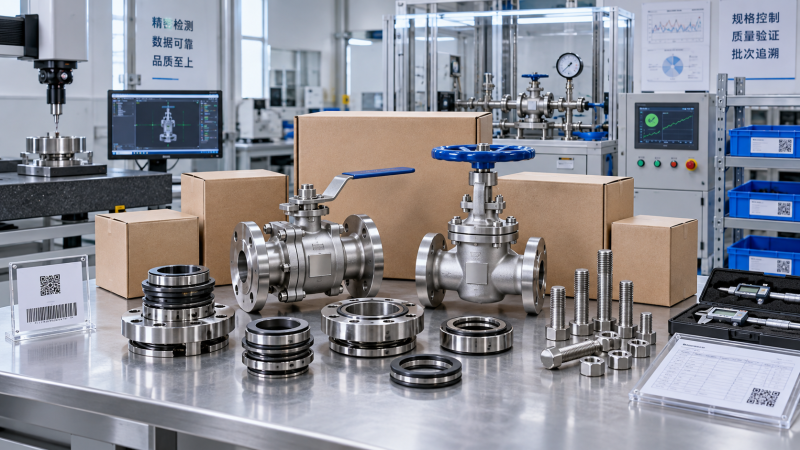
Private label manufacturing can be suitable for industrial components, but only when the buyer treats it as a controlled engineering and supply-chain program rather than a packaging exercise. It works best for parts with stable specifications, repeatable production methods, clear acceptance criteria, and manageable product-liability exposure. It is far less suitable when a component’s performance depends on proprietary design knowledge, highly variable field conditions, safety-critical certification, or tightly controlled process validation.
The central question is not whether a supplier can place a customer’s name, label, or part number on a component. The question is whether the private-label owner can establish and maintain responsibility for specification control, traceability, conformity, warranty exposure, and change management throughout the product life cycle.
What does private label manufacturing mean for industrial components?
In industrial supply chains, private label manufacturing generally means that one company sells a component under its own brand while another company manufactures all or part of it. The arrangement may range from a catalog item with custom packaging to a fully engineered component made from buyer-owned drawings, approved materials, defined inspection plans, and controlled manufacturing processes.
These models carry very different levels of risk. Rebranding a standard hand tool, a non-critical fastener assortment, or a general-purpose fitting may require limited technical intervention. Private labeling a mechanical seal, pressure-containing valve, aerospace-machined part, metering pump component, or high-performance lubricant creates a much deeper obligation. The label owner is effectively making a performance claim to the market, even when it does not operate the factory.
A useful distinction is between commercial ownership and technical ownership. Commercial ownership concerns branding, sales channels, pricing, and customer relationships. Technical ownership covers drawings, material definitions, validation evidence, inspection methods, design changes, nonconformance decisions, and product records. A private-label program becomes robust only when these two forms of ownership are aligned.
Where private labeling is a sound fit
Private label manufacturing is generally more defensible where the component is mature, standardized, and readily verified at incoming inspection or through routine qualification. Examples may include selected standard fasteners, brackets, machined adapters, basic seals, tooling accessories, non-proprietary castings, and established maintenance consumables. This does not mean such products are risk-free. It means that performance requirements can usually be expressed in measurable terms and confirmed through established controls.
The model is particularly practical when the buyer can define the product without relying on undocumented know-how held by a single factory. Drawings should specify dimensions, tolerances, threads, surface finish, material grade, heat treatment where applicable, coating, marking, packaging, and inspection requirements. For chemical products, the controlled definition may include formulation boundaries, physical-property limits, contamination controls, shelf-life requirements, safety documentation, and batch-release testing.
Repeat demand also matters. A private label creates administrative work: artwork approval, part-number systems, labeling control, packaging validation, inventory segregation, documentation review, and periodic supplier assessment. These activities are easier to justify when they support a continuing product line or a defined aftermarket program rather than occasional purchases.
It can also provide commercial value when customers need consolidated sourcing. A distributor or industrial service business may combine compatible components from qualified production partners under a consistent product architecture. That can simplify ordering and inventory management, provided the products are not represented as technically interchangeable when they are not.
When the model becomes difficult or inappropriate
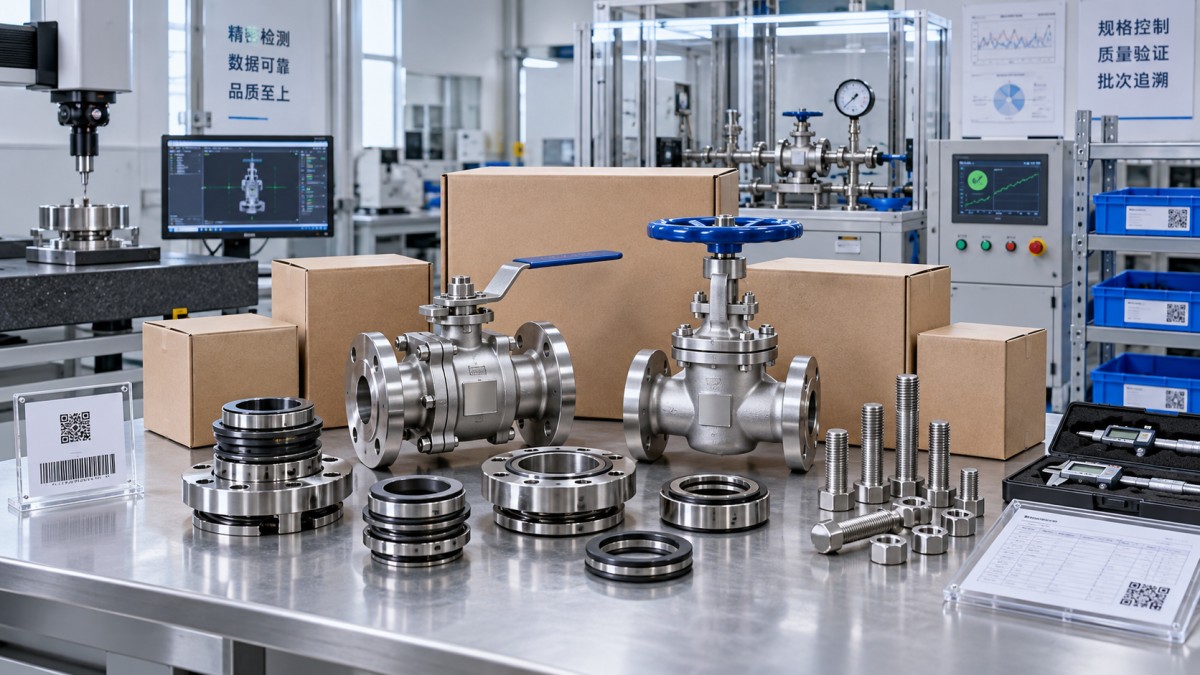
Private labeling should be approached cautiously for components whose failure can create major safety, environmental, regulatory, or uptime consequences. Pressure-retaining equipment, lifting components, electrical protection devices, medical or food-contact process equipment, high-speed rotating parts, and parts used in aviation, rail, energy, or hazardous-area systems may require product-specific approvals, extensive validation, or strict manufacturer control.
The issue is not simply that these products are “high quality.” Their conformity may depend on a controlled combination of design, raw material, process parameters, qualified personnel, calibration, test equipment, and traceable records. A dimensional inspection alone cannot establish whether a critical weld procedure was followed, whether a heat treatment achieved the required structure, whether elastomer compound compatibility has been preserved, or whether a pressure test was conducted under the required protocol.
Private labeling is also a weak fit when the supplier’s design is proprietary and the buyer cannot access enough information to verify equivalence. A factory may offer an apparently identical pump, valve, tooling insert, or lubricant blend, yet the functional details can differ: internal clearances, spring material, seal geometry, additive chemistry, machining sequence, balancing method, or coating preparation. A label change does not transfer design authority.
In these cases, the safer route may be authorized distribution, co-branding, an OEM agreement with transparent technical responsibilities, or a buyer-controlled engineering project with formal design transfer. The right model depends on who can prove that the component will perform in the intended duty cycle.
Does private labeling reduce cost?
It can reduce unit cost, but the apparent saving should not be confused with total cost. Removing an established brand premium may improve purchase economics. Higher order volumes, simplified packaging, rationalized product ranges, and direct factory sourcing can also change the cost structure. Yet industrial components introduce costs that are often invisible in initial quotations.
These include first-article inspection, sample testing, tooling, gauges, laboratory work, third-party audits, quality engineering, packaging redesign, translation and regulatory review, inventory buffers, batch segregation, warranty reserves, and the cost of handling a field failure. If a failed component stops a production line or requires emergency replacement across multiple sites, the consequence can outweigh a modest unit-price advantage.
The relevant comparison is therefore not “branded price versus private-label price.” It is the lifecycle cost of supplying a conforming product at the required level of availability and support. A lower-cost private-label part may be economically rational in a stable, non-critical application. It may be a poor decision where failure diagnosis is difficult, replacement access is costly, or the customer expects immediate technical accountability.
How should specifications be controlled?
A purchase order stating “equivalent to sample” is rarely adequate for an industrial private-label program. Samples are useful references, but they do not define every characteristic needed for repeatable production. The buyer should establish a controlled technical package proportionate to the component’s risk and complexity.
For a precision-machined component, this normally includes the latest drawing revision, tolerances, geometric dimensioning requirements where applicable, material specification, hardness or heat-treatment requirements, surface treatment, cleanliness condition, critical characteristics, inspection frequency, and required records. Where a part interfaces with another assembly, mating conditions and functional tests may be more meaningful than isolated dimensions.
For cast or forged items, the package may need to address alloy chemistry, mechanical properties, porosity limits, non-destructive testing requirements, machining allowances, and lot identification. For seals and polymer components, material identity is essential; a generic statement such as “NBR” or “PTFE” may not adequately control compound formulation, filler content, curing condition, or compatibility with the media and temperature range. For lubricants and functional chemicals, product identity should be linked to defined performance properties and batch testing, not merely color, viscosity, or a marketing description.
Every technical requirement should be traceable to a real function, service condition, contractual requirement, or applicable standard. Over-specification raises cost and can narrow the supplier base without improving performance. Under-specification leaves the factory to make decisions that may later be interpreted as defects.
Which standards and certifications matter?
There is no universal certificate that makes a private-label industrial component acceptable. ISO 9001 certification can provide evidence that a manufacturer operates a quality management system, but it does not certify that a particular product meets a particular application requirement. The same principle applies to many management-system certifications: they may be relevant to supplier evaluation, but they do not replace product qualification.
Applicable product standards depend on the component, end use, and destination market. Specifications may refer to ISO, EN, DIN, ASTM, ASME, JIS, IEC, or other recognized standards. The important task is to identify the exact edition, scope, testing method, and acceptance criteria that apply. A standard number alone can be misleading if it covers several product classes or leaves key options open.
Regulatory obligations also cannot be delegated entirely to the manufacturing partner. Depending on the market and product category, the private-label owner may need to consider chemical restrictions, safety documentation, labeling obligations, material declarations, product marking, importer responsibilities, and records supporting claims of conformity. A supplier’s declaration should be reviewed against the actual product and market route; it should not be accepted as a substitute for determining the applicable legal framework.
Why traceability is often the decisive issue
Traceability determines whether a quality problem can be contained. If a batch of bolts has incorrect coating thickness, a seal compound is found to be incompatible with a process fluid, or a machined housing has material substitution, the label owner needs to know where affected parts were produced, which material lot was used, which customers received them, and whether stock remains in warehouses or field inventory.
The needed depth of traceability should reflect risk. A low-consequence accessory may only require production-date and lot identification. A critical component may require traceability from finished serial number to material certificate, process record, inspection result, and shipping destination. Requiring full traceability without maintaining records that can actually be retrieved is not a control system; it is a contractual phrase with little operational value.
Lot control must also extend beyond the factory. Mixing production lots at a distributor warehouse, removing original labels during repacking, or failing to link internal stock codes to supplier batch numbers can break the chain precisely when a recall or technical investigation is needed.
Can the supplier change materials or processes after approval?
This is one of the most common private-label failure points. A supplier may regard a material substitution, tooling revision, subcontractor change, plating adjustment, or production-site transfer as a normal operational decision. The label owner may regard the same change as a product alteration requiring requalification. Unless the agreement defines this boundary, disagreements emerge only after performance problems occur.
A change-control clause should identify which changes require written approval before implementation. At minimum, it should address raw material sources and grades, critical sub-suppliers, manufacturing location, tooling affecting critical features, heat treatment, coating or surface preparation, formulation, inspection methods, packaging that affects product protection, and changes to controlled drawings or specifications.
The approval process should not be purely administrative. It should state what evidence is required: revised first-article results, dimensional capability evidence, material certificates, functional testing, compatibility testing, or new samples. The correct evidence depends on the risk created by the change.
What should be verified before launch?
Before releasing a private-label industrial component, the buyer should be able to answer several practical questions without relying on verbal assurances:
- Is the product definition complete enough for another qualified facility to understand the required result?
- Are critical features measurable, and is there an agreed inspection method?
- Has the supplier demonstrated capability at production conditions rather than only through hand-made samples?
- Can material, process, and finished-product records be linked to each delivered lot?
- Are customer operating conditions—load, pressure, temperature, media, duty cycle, corrosion exposure, and maintenance practice—within the validated use case?
- Who owns the drawing, tooling, test data, packaging artwork, and product name if the supply relationship ends?
- Is there a defined route for complaints, containment, root-cause investigation, corrective action, and field communication?
These questions reveal whether the proposal is a genuine controlled-manufacturing arrangement or simply a resale transaction with custom labels.
The practical decision
Private label manufacturing is suitable for industrial components when the buyer can control what matters: product definition, supplier capability, verification, traceability, changes, and accountability after delivery. It is most compelling for stable products where conformity can be demonstrated repeatedly and where the commercial benefits exceed the cost of maintaining that control.
It is not a shortcut around engineering responsibility. The more a component influences safety, compliance, process continuity, or equipment reliability, the less acceptable it is to rely on branding, samples, and supplier assurances alone. In those applications, a private-label strategy should be supported by documented technical governance—or replaced with a sourcing model that preserves clearer responsibility for product performance.
Recommended News
 How to verify CE certification for industrial pumps before installationIndustrial pumps CE certified? Learn how to verify declarations, documentation, hazardous-area suitability, and installation compliance before commissioning.
 How to compare a plasma cutting machine supplier before placing an orderCompare a plasma cutting machine supplier with confidence—evaluate cut quality, total cost, consumables, and after-sales support before you order.
 Which factory upgrade projects benefit most from industrial technology solutions?Industrial technology solutions factory upgrade projects deliver the most value when they remove bottlenecks, cut downtime, improve quality, and strengthen resilience. Explore high-impact priorities.
 When a high precision CNC grinding machine justifies its costDiscover when a high precision CNC grinding machine delivers real ROI through repeatable quality, lower scrap, faster verification, and controlled production.
 When do industrial lubricants for compressors need oil analysis?Industrial lubricants for compressors need oil analysis at baseline, under harsh operating conditions, and after warning signs. Learn how testing prevents downtime and protects equipment.
 How CNC controller processing speed affects cycle times in EuropeCNC controller processing speed Europe: discover how look-ahead, interpolation and CAM optimisation can cut cycle times while protecting precision and surface quality.
 What to verify before using supplier sourcing solutions in EuropeSupplier sourcing solutions Europe: verify capabilities, compliance, traceability, total cost, and supply resilience before choosing reliable industrial partners.
 When smart fabrics are reliable enough for industrial wearablesSmart fabrics for industrial wearables: learn how to validate durability, signal quality, cleaning resilience, and safe failure performance before deployment.
 How supply chain management for exporters reduces customs delaysSupply chain management for exporters helps prevent customs delays with accurate data, origin checks, importer readiness, and proactive shipment controls. Explore practical strategies now.
 What to verify before approving an OEM electronics supplierOEM electronics supplier approval checklist: verify BOM control, traceability, testing, sourcing risk, capacity, and commercial terms before committing to volume production.
 When do CNC-machined precision components require five-axis milling?Precision components CNC machined with five-axis milling deliver better access, tighter datum control, and lower setup risk. Learn when five-axis machining is the smart choice.
 What should a restaurant POS system handle during a lunch rush?restaurantPOSsystems keep lunch rushes moving with fast ordering, smart kitchen routing, flexible payments, live inventory, and reliable service controls.
 How CNC controller cycle time speed affects machining throughputCNC controller cycle time speed can raise machining throughput by sustaining feed rates on complex toolpaths. Learn how to optimize CAM, look-ahead, and machine dynamics.
 When a 4 axis vertical machining center is the better fit than 3-axisDiscover when a 4 axis vertical machining center outperforms 3-axis machining—reduce setups, improve datum control, and boost efficiency for complex multi-face parts.
 When industrial fasteners bolts need traceable material certificationIndustrial fasteners bolts need traceable material certification for critical applications. Learn what QA teams should verify to reduce risk and ensure compliance.
 How to size pump systems for cooling circuits for stable flow ratesPump systems for cooling circuits: learn how to match flow, total dynamic head, NPSH, and controls for reliable, energy-efficient cooling performance.
 When does software as a service reduce CNC data management costs?Software as a service can lower CNC data management costs by reducing IT overhead, manual reporting, and disconnected records. Discover when SaaS delivers measurable savings.
 CNC investment trends 2026: are automation upgrades taking priority?CNC investment trends 2026 reveal why automation upgrades are reshaping capacity plans. Compare robots, pallet systems, and new machines for smarter CNC growth.
 How to size high pressure pumps for stable chemical injection ratesHigh pressure pumps sizing guide for stable chemical injection rates—learn how to balance flow range, pressure, suction conditions, materials, and controls for reliable dosing.
 When organic chemicals are suitable feedstocks for synthetic lubricantsOrganic chemicals can unlock high-performance synthetic lubricants. Learn how purity, stability, compatibility, and supply control shape reliable industrial formulations.
 What machine tool market size reveals about capital spending cyclesMachine tool market size reveals capital spending cycles through order mix, automation, replacement demand, and capacity signals. Discover what drives smarter investment decisions.















Search News
Popular Tags