
How a machine tool spindle factory affects uptime
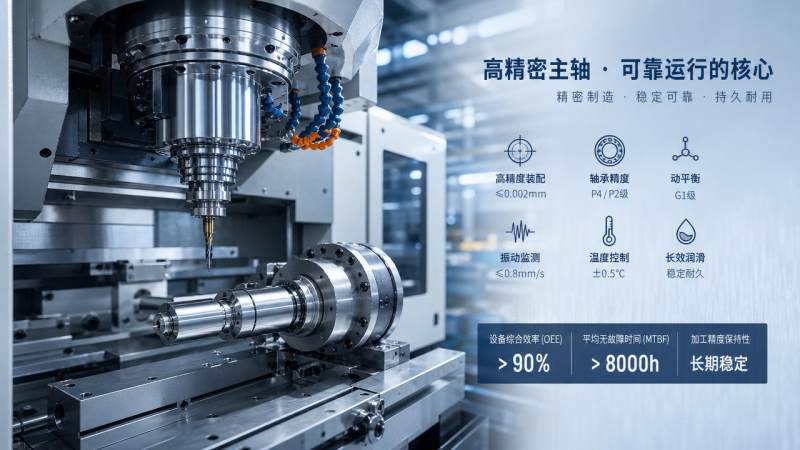
For after-sales maintenance teams, uptime often depends on component reliability long before a machine reaches the shop floor.
A machine tool spindle factory shapes service intervals, thermal stability, vibration behavior, and replacement consistency across the equipment lifecycle.
As industrial lines demand tighter tolerances and fewer stoppages, factory-level spindle quality has become a strategic uptime variable, not just a sourcing detail.
This shift matters across the broader industrial landscape covered by G-PME, where engineering integrity, standardization, and verifiable performance define long-term productivity.
Why the machine tool spindle factory is now part of uptime strategy
A machine tool spindle factory no longer influences only initial machine performance.
It now affects maintenance planning, spare interchangeability, root-cause analysis, and overall line availability.
Recent production trends explain this change.
Machines run at higher speeds, handle mixed materials, and operate under tighter thermal windows than before.
At the same time, many facilities have reduced maintenance buffers and shorter shutdown opportunities.
Under these conditions, even small factory deviations in spindle build quality can create major downstream downtime.
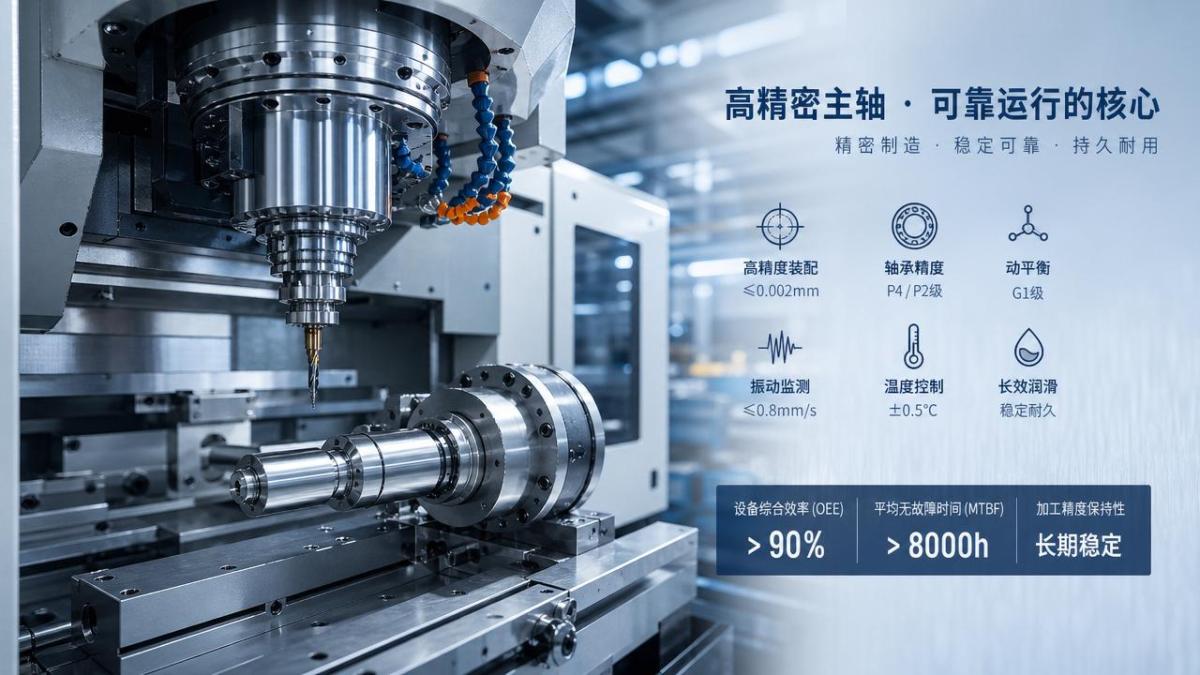
A capable machine tool spindle factory controls preload, balance, bearing selection, shaft geometry, and assembly cleanliness with measurable discipline.
Those controls directly influence heat generation, noise signatures, runout, and fatigue life during real production use.
When those controls are inconsistent, maintenance teams face unstable failure patterns and difficult diagnostics.
The strongest trend signals are coming from service data, not marketing claims
In many industrial settings, the clearest evidence comes after installation.
Repeated alarms, rising vibration, thermal drift, and uneven tool finish often trace back to spindle manufacturing quality.
The machine tool spindle factory affects these field outcomes through process discipline established months earlier.
This is especially visible in high-cycle machining, aerospace component finishing, mold work, and precision metal removal.
In those environments, uptime losses rarely begin with catastrophic failure.
They often begin with small instability signals that expand into scrap, poor surface quality, and emergency maintenance.
Common early signals linked to spindle factory quality
- Gradual temperature increase during similar duty cycles
- Vibration peaks appearing after tool changes or speed transitions
- Inconsistent runout after replacement spindles are installed
- Premature bearing fatigue under otherwise acceptable loading
- Noise changes that complicate predictive maintenance interpretation
What is driving the growing importance of the machine tool spindle factory
Several forces are increasing dependence on spindle factory capability across the comprehensive industrial sector.
These forces are technical, operational, and supply-chain related.
A machine tool spindle factory with traceable quality systems supports these pressures better than one focused only on output volume.
How factory-level decisions change field performance over time
The impact of a machine tool spindle factory unfolds across the full service cycle.
It begins with materials, continues through machining and assembly, and appears later in maintenance records.
Critical factory decisions with direct uptime consequences
- Bearing grade selection affects fatigue life and thermal behavior.
- Shaft grinding accuracy affects runout, load distribution, and chatter resistance.
- Balancing procedures affect vibration under high-speed operating ranges.
- Assembly cleanliness affects lubrication integrity and contamination risk.
- Inspection repeatability affects replacement consistency across batches.
- Thermal testing validates real operating stability, not just static dimensions.
These are not abstract quality topics.
They determine whether a spindle survives a demanding duty cycle without creating false alarms or unplanned outages.
For service teams, a reliable machine tool spindle factory makes troubleshooting faster because baseline performance is more predictable.
The operational impact reaches multiple business and maintenance links
The influence of the machine tool spindle factory extends beyond the machine itself.
It affects maintenance scheduling, spare strategy, production planning, and quality assurance across connected operations.
Where the effects are most visible
- Maintenance execution: predictable spindle quality reduces repeated inspections and uncertain repairs.
- Production continuity: stable thermal and vibration behavior protects cycle time consistency.
- Part quality: lower runout helps maintain finish, geometry, and dimensional repeatability.
- Spare management: standardized replacement performance reduces emergency inventory exposure.
- Data analytics: cleaner operating signatures improve predictive maintenance confidence.
In integrated industrial systems, one unstable spindle can trigger costs far beyond the repair event.
It can affect tooling life, process capability, operator intervention frequency, and downstream delivery commitments.
What should be examined before trusting a machine tool spindle factory
The current trend is clear.
Evaluation should move beyond catalog speed ratings and nominal dimensions.
A machine tool spindle factory should be assessed through measurable process evidence.
- Check traceability for bearings, shafts, housings, and balancing records.
- Review thermal growth testing under realistic load and speed conditions.
- Confirm runout inspection methods and batch-to-batch consistency controls.
- Ask about rebuild repeatability and replacement interchangeability standards.
- Verify compliance with relevant ISO, DIN, ASME, or JIS-linked practices where applicable.
- Assess contamination control during assembly and lubrication filling.
- Look for field failure feedback loops between service data and factory process updates.
These checkpoints align with the broader G-PME approach of combining technical verification, standards awareness, and operational resilience.
Practical response steps for reducing downtime risk
The best response is not reactive replacement alone.
It is structured cooperation between service observations and spindle factory validation.
This approach turns the machine tool spindle factory into a visible part of uptime planning rather than a hidden source of uncertainty.
The next move is to connect factory evidence with maintenance decisions
Uptime is increasingly determined by upstream manufacturing quality.
A machine tool spindle factory influences reliability long before a spindle enters operation and long after it requires service.
The most effective next step is to align service data, acceptance criteria, and replacement standards around measurable spindle performance.
When thermal control, balance quality, inspection traceability, and rebuild consistency are verified, downtime risk falls sharply.
In a market shaped by precision, resilience, and engineering accountability, the right machine tool spindle factory becomes a practical lever for sustained uptime.
Recommended News
 What to verify before using supplier sourcing solutions in EuropeSupplier sourcing solutions Europe: verify capabilities, compliance, traceability, total cost, and supply resilience before choosing reliable industrial partners.
 When smart fabrics are reliable enough for industrial wearablesSmart fabrics for industrial wearables: learn how to validate durability, signal quality, cleaning resilience, and safe failure performance before deployment.
 How supply chain management for exporters reduces customs delaysSupply chain management for exporters helps prevent customs delays with accurate data, origin checks, importer readiness, and proactive shipment controls. Explore practical strategies now.
 What to verify before approving an OEM electronics supplierOEM electronics supplier approval checklist: verify BOM control, traceability, testing, sourcing risk, capacity, and commercial terms before committing to volume production.
 When do CNC-machined precision components require five-axis milling?Precision components CNC machined with five-axis milling deliver better access, tighter datum control, and lower setup risk. Learn when five-axis machining is the smart choice.
 What should a restaurant POS system handle during a lunch rush?restaurantPOSsystems keep lunch rushes moving with fast ordering, smart kitchen routing, flexible payments, live inventory, and reliable service controls.
 How CNC controller cycle time speed affects machining throughputCNC controller cycle time speed can raise machining throughput by sustaining feed rates on complex toolpaths. Learn how to optimize CAM, look-ahead, and machine dynamics.
 When a 4 axis vertical machining center is the better fit than 3-axisDiscover when a 4 axis vertical machining center outperforms 3-axis machining—reduce setups, improve datum control, and boost efficiency for complex multi-face parts.
 When industrial fasteners bolts need traceable material certificationIndustrial fasteners bolts need traceable material certification for critical applications. Learn what QA teams should verify to reduce risk and ensure compliance.
 How to size pump systems for cooling circuits for stable flow ratesPump systems for cooling circuits: learn how to match flow, total dynamic head, NPSH, and controls for reliable, energy-efficient cooling performance.
 When does software as a service reduce CNC data management costs?Software as a service can lower CNC data management costs by reducing IT overhead, manual reporting, and disconnected records. Discover when SaaS delivers measurable savings.
 CNC investment trends 2026: are automation upgrades taking priority?CNC investment trends 2026 reveal why automation upgrades are reshaping capacity plans. Compare robots, pallet systems, and new machines for smarter CNC growth.
 How to size high pressure pumps for stable chemical injection ratesHigh pressure pumps sizing guide for stable chemical injection rates—learn how to balance flow range, pressure, suction conditions, materials, and controls for reliable dosing.
 When organic chemicals are suitable feedstocks for synthetic lubricantsOrganic chemicals can unlock high-performance synthetic lubricants. Learn how purity, stability, compatibility, and supply control shape reliable industrial formulations.
 What machine tool market size reveals about capital spending cyclesMachine tool market size reveals capital spending cycles through order mix, automation, replacement demand, and capacity signals. Discover what drives smarter investment decisions.
 What causes solar inverters to trip repeatedly after installationSolar inverters tripping repeatedly? Discover key causes, from grid voltage and DC faults to wiring, settings, heat, and practical troubleshooting steps.
 How a tool life calculation chart improves cutting parameter decisionsTool life calculation chart insights help optimize cutting speed, feed, and depth for predictable tool changes, better part quality, and lower machining costs.
 What to check before choosing an industrial lubricating oils factoryIndustrial lubricating oils factory selection guide: compare quality control, formulation fit, traceability, technical support, and total cost to reduce downtime risks.
 Where machine shop digital transformation delivers the fastest paybackMachine shop digital transformation delivers faster payback by reducing downtime, setup delays, quality risks, and capacity constraints with focused, measurable workflows.
 When a semiconductor manufacturing solutions provider can shorten process ramp-upA semiconductor manufacturing solutions provider can shorten ramp-up through validated hardware, change control, field support, and resilient supply chains.
 How to evaluate CNC tooling suppliers in Europe for repeatable precisionCNC tooling Europe: learn how to evaluate suppliers for repeatable precision, stable tool life, application support, traceability, and resilient delivery.













Search News
Popular Tags