
What Certifications Should an Industrial Fastener Supplier Provide?
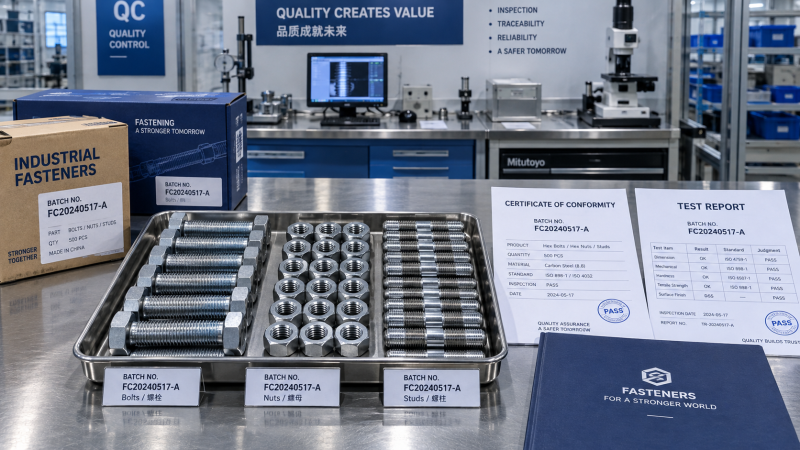
What certifications should an industrial fastener supplier provide? For procurement teams sourcing bolts, nuts, studs, and engineered fastening systems, the answer depends on application risk, industry requirements, and traceability—not simply the length of a supplier’s certificate list. ISO 9001 can demonstrate a structured quality management system, while sector-specific credentials, material inspection documents, and batch-linked test reports provide different kinds of assurance.
The distinction matters when a shipment reaches the receiving dock. A supplier may hold a valid quality certificate yet deliver fasteners without evidence of the specified strength, coating, or material grade. Conversely, a detailed test report is of limited value if nobody can connect it to the boxes being delivered. Reliable qualification requires both organizational controls and evidence tied to the actual product.
What certifications should an industrial fastener supplier provide as a minimum?
For many general industrial purchases, a sensible starting point is a current ISO 9001 certificate covering the supplier’s relevant activities and locations, a certificate of conformity for the shipment, and traceability to the manufacturing batch. Material and mechanical test documentation should be added according to the fastener specification and consequences of failure.
This is a procurement baseline, not a universal legal requirement. A standard machine-cover screw does not warrant the same documentation package as a pressure-boundary stud or a structural bolting assembly.
Is ISO 9001 enough to approve a fastener supplier?
No. ISO 9001 addresses how an organization manages quality; it does not certify that every bolt meets a particular mechanical property class, dimensional standard, or corrosion requirement.
During qualification, inspect the certificate’s scope. A distributor certified for purchasing, warehousing, and sales is not necessarily certified for manufacturing or heat treatment. That does not make the distributor unsuitable, but it changes the questions you should ask about its upstream controls.
Check the legal entity, site address, certificate number, issuing certification body, and current status. For accredited certification, confirm the certification body’s relevant accreditation. Where possible, verify status through the issuer’s directory or another recognized certification database rather than relying solely on a PDF.
ISO 14001 and ISO 45001 may also be relevant to environmental and occupational health and safety policies. They can support responsible supplier selection, but neither substitutes for fastener performance evidence.
Which additional certifications matter in aerospace and automotive purchasing?
Aerospace: distinguish manufacturing from distribution
AS9100 is commonly requested for aerospace manufacturers, while AS9120 addresses aerospace stockist and distributor activities. The appropriate credential depends on the supplier’s role and customer requirements.
A certificate alone is not permission to supply every aerospace part. Buyers may also need approved-source status, conformity to the specified part standard, tightly controlled traceability, and documented oversight of special processes. Nadcap accreditation may be required for particular processes, such as heat treatment or chemical processing, where the customer or contract specifies it. Its scope must match the actual process and facility involved.
Automotive: certification does not replace part approval
IATF 16949 is relevant to eligible automotive production manufacturing sites, subject to its certification rules and customer requirements. A trading-only distributor should not be assessed as though it were automatically eligible for the same manufacturing-site certification.
Automotive buyers may require a Production Part Approval Process package, including material results, dimensional checks, process documentation, and an approved Part Submission Warrant. PPAP is an approval process for a particular part and production arrangement—not a general supplier certificate. Clarify submission level and customer-specific requirements before production starts.
What is the difference between a certificate of conformity and a material test certificate?
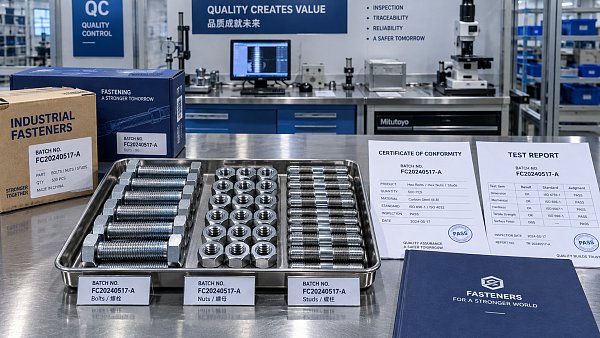
A certificate of conformity, often called a CoC, is a declaration that the supplied goods comply with identified requirements. It should reference the purchase order, part description, applicable specification, quantity, and relevant lot identifiers. Unless the contract says otherwise, it may contain no measured test results.
A material test certificate or inspection certificate provides a different layer of evidence. Procurement specifications frequently use EN 10204 document types, but the requested type must be appropriate to the product and contractual requirements:
- Type 2.1: a declaration of compliance with the order, without test results.
- Type 2.2: a declaration of compliance with results from non-specific inspection; those results are not necessarily from the delivered lot.
- Type 3.1: a declaration of compliance with specific inspection results, validated by the manufacturer’s authorized inspection representative independent of the manufacturing department.
- Type 3.2: specific inspection documentation validated by the manufacturer’s independent authorized inspection representative and either the purchaser’s authorized representative or an inspector designated by official regulations.
Do not assume “3.1” means independent third-party testing. Equally, do not assume a steel mill’s certificate proves the properties of a finished bolt. Cold forming, heat treatment, and subsequent processing can affect the finished fastener; final-product test evidence may still be necessary.
Which test reports should accompany industrial fasteners?
Request reports that address the specified failure risks. Depending on the product standard, these may include tensile strength, proof load, hardness, wedge tensile testing, nut proof load, chemical composition, dimensional inspection, or coating thickness. Not every test applies to every fastener geometry or material.
For carbon and alloy steel fasteners, ISO 898-1 and ISO 898-2 are common references for relevant bolt and nut mechanical properties. Stainless steel fasteners may be specified under the applicable parts of ISO 3506. ASTM specifications such as A193/A193M and A194/A194M are frequently encountered in pressure and high-temperature bolting. Always state the applicable grade, edition, and supplementary requirements rather than accepting a vague reference to “ASTM quality.”
For plated high-strength fasteners, ask how hydrogen embrittlement risk is controlled. A coating certificate or a record of baking alone does not establish that the risk has been eliminated. Relevant process controls, test requirements, and acceptance criteria should come from the applicable specification and engineering assessment.
Likewise, a salt-spray result is useful only in context. It does not directly predict service life in a coastal plant, chemical facility, or outdoor structure. The coating system, installation damage, exposure conditions, and compatibility with mating materials all matter.
When are CE marking, RoHS, or REACH documents needed?
These requirements should be evaluated separately, not bundled into a generic demand for “international certification.”
CE marking is not a universal quality mark for industrial fasteners. Certain structural bolting assemblies placed on the relevant European market fall within construction-product requirements associated with standards such as EN 15048 or EN 14399. Buyers should verify the applicable conformity route, Declaration of Performance, marking, and any required factory production control certification. A CE-marked assembly does not make every separately sourced bolt or nut interchangeable.
RoHS concerns restricted substances in electrical and electronic equipment within its scope. Fastener material or coating declarations may be needed to support compliance of the finished equipment, but there is no universal government-issued “RoHS certificate” for every fastener.
REACH can create substance restrictions and information duties for articles supplied in the EU. Request declarations relevant to the material, coating, current Candidate List, and applicable restrictions. A broad “REACH compliant” statement without product identification or a date is weak evidence.
How should buyers verify traceability before accepting a shipment?
The essential question is simple: can the supplier connect the delivered fasteners to the documents without guesswork?
A useful traceability chain links the purchase order and part number to the package identification, finished manufacturing lot, relevant material heat, processing records, and inspection results. The exact chain varies by specification; one material heat can feed multiple production lots, and one shipment may contain several lots.
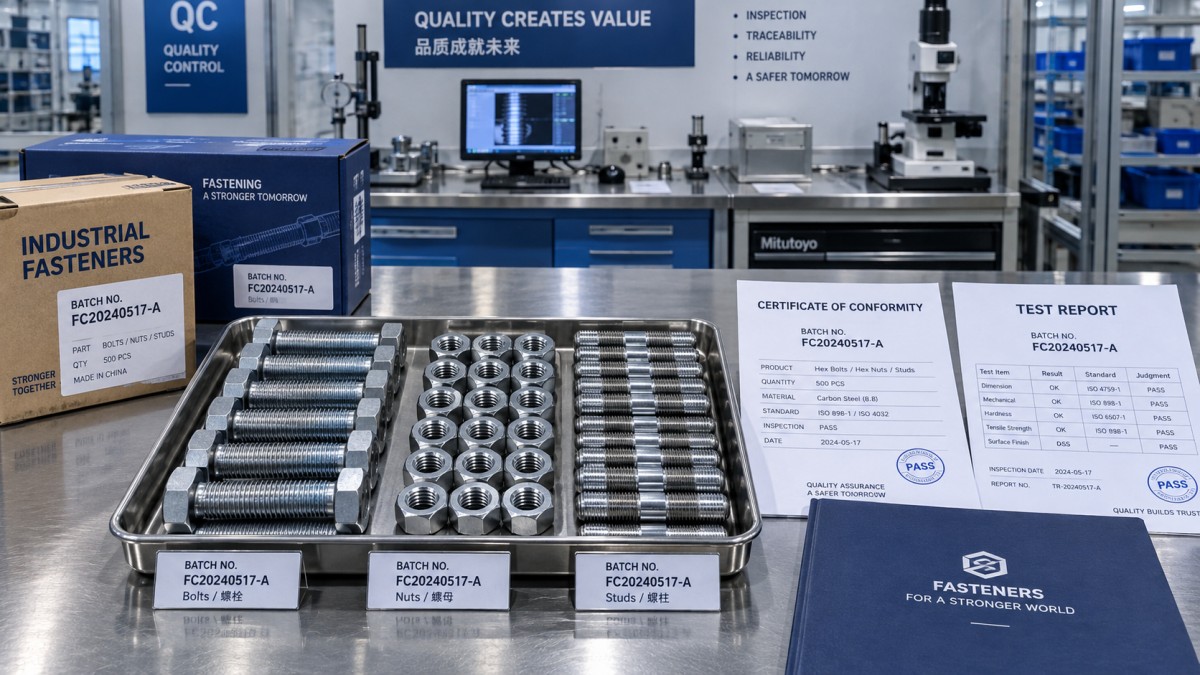
Review a sample documentation package before awarding a critical order. Compare package labels with report identifiers, then check grade, dimensions, coating, specification revision, and acceptance results. Where head markings are required, confirm them against the product standard. Markings help identify a fastener, but they do not replace documentary traceability.
For distributors, ask how lots remain segregated during storage, repacking, and partial shipments. If packaging changes, the traceability information must survive. A perfect manufacturer’s report becomes practically useless when repacked cartons lose their lot identity.
What warning signs suggest the documents are inadequate?
- Scope mismatch: the certificate covers a different entity, site, or activity.
- Generic reports: results have no defensible connection to the delivered batch.
- Missing processing evidence: the documents address raw steel but omit required finished-product verification.
- Unclear acceptance criteria: a report says “pass” without identifying the requirement or test basis.
- Unexplained inconsistencies: grades, dates, quantities, or lot numbers conflict across documents.
- Unsupported claims: statements such as “aerospace approved” name no approving customer, scope, or specification.
An ISO/IEC 17025-accredited laboratory can strengthen confidence in testing, particularly for independent verification. However, accreditation is scope-specific: confirm that the relevant test method is covered. It is laboratory competence evidence, not product certification.
How can procurement teams specify the right package without overbuying paperwork?
Separate supplier qualification documents from shipment deliverables. Review management-system credentials during onboarding and renewal; require product-linked evidence with each shipment where appropriate. This keeps incoming inspection focused on the goods rather than repeatedly collecting unrelated certificates.
A practical purchase-order clause should identify the fastener standard and grade, required inspection document type, mandatory tests, traceability level, permitted sources or subcontractors, and any approval needed before substitutions. Specify when documents must arrive—preferably before dispatch for critical items—and how discrepancies will be resolved.
At G-PME, the useful engineering perspective is to distinguish recognized credentials from verifiable product evidence. That approach applies whether the fastener secures a CNC machine fixture, a pump casing, or a structural connection: qualification should follow the application, not the supplier’s marketing language.
The best supplier is not necessarily the one offering the most certificates. It is the one that can explain what each document proves, identify its limitations, and maintain an unbroken connection between the ordered specification and the delivered fasteners.
Recommended News
 Will wireless alarm systems still work during a power outage?Will wirelessalarmsystems work during a power outage? Discover which features stay active, why cellular backup matters, and what to check before choosing your alarm.
 What affects lead times when buying carbide inserts in Europe?Buying carbide inserts Europe-wide? Discover how stock, specifications, factory schedules and shipping affect lead times, and learn what to confirm to keep production running.
 Which window treatments provide privacy without blocking daylight?Discover window treatments that balance privacy and daylight. Compare cellular shades, sheers, and layered options to find the right fit—and avoid nighttime privacy surprises.
 How to verify a 5-axis CNC machine supplier's MTTF claimsVerify MTTF for CNC machine tools supplier claims with expert checks on failure records, operating hours, and confidence bounds. Make a smarter 5-axis CNC investment.
 How to choose STEM education kits for small-group classroom workChoose STEM education kits that keep every student engaged. Discover how to assess group participation, lesson fit, safety, and long-term costs to make smarter classroom purchases.
 How to read an EDM surface finish Ra chart in µm and µinRead an EDM surface finish Ra chart with confidence. Learn µm-to-µin conversions, avoid costly unit errors, and choose finish targets backed by reliable inspection.
 How to use data analytics to reduce scrap in injection moldingUse data analytics to reduce injection molding scrap. Learn which production data to track, how to uncover defect causes, and how to verify improvements that cut waste and protect quality.
 What affects the cost of axis calibration on a 5-axis machine?Understand axis calibration cost for 5-axis machines, from rotary-axis condition to downtime. Learn how to compare quotes, avoid hidden fees, and secure verified accuracy.
 How to verify a supplier's chip removal rate measurement accuracyReview chip removal metrics supplier teams provide. Learn how to verify removal rates, calibration, timing, and uncertainty for smarter, more confident purchasing decisions.
 How cryogenic service requirements affect fluid control system pricesExplore fluid control systems price drivers for cryogenic service, from materials and testing to insulation. Learn how to compare quotes, avoid hidden costs, and buy with confidence.
 When is die-cast aluminum suitable for lightweight vehicle housings?Light-weighting vehicle materials: Discover when die-cast aluminum suits vehicle housings, balancing weight savings, tooling costs, sealing, and durability for smarter design decisions.
 How to specify CNC machining tolerances for press-fit assembliesSpecify CNC machining tolerance for reliable press-fit assemblies. Learn to calculate interference, control thermal effects, and verify supplier capability to prevent costly fit failures.
 How to assess five-axis machine tool thermal stability data in Latin AmericaReview machine tool thermal stability data Latin America suppliers provide. Discover how to assess five-axis drift, ISO 230-3 tests, and site conditions for smarter purchasing decisions.
 How thick should fiberglass acoustic insulation be for wall cavities?Fiberglass acoustic insulation: how thick should it be? Explore 3.5- and 5.5-inch wall cavity options, tested STC requirements, and installation tips to avoid costly mistakes.
 How bending radius affects the service life of high-voltage cablesProtect highvoltagecables from bending damage. Discover how bend radius affects service life, which installation limits matter, and practical checks for lasting reliability.
 What Certifications Should an Industrial Fastener Supplier Provide?What certifications should an industrial fastener supplier provide? Discover essential ISO credentials, test reports, and traceability checks to qualify suppliers and reduce sourcing risks.
 How Can You Prevent Fasteners from Loosening During Operation?How can I prevent fasteners from loosening during operation? Discover preload, tightening, and locking strategies to reduce downtime and improve equipment reliability.
 Which Fastener Grade Is Suitable for Vibration-Prone Equipment?Which industrial fastener grade is suitable for vibration-prone equipment? Compare classes 8.8, 10.9, and 12.9, preload, and locking methods to make a reliable choice.
 How Do You Select a Mechanical Seal for Chemical Service?How do I select a mechanical seal for chemical service? Explore material compatibility, single vs. dual seals, and support systems to reduce leakage risks and choose with confidence.
 Why Do Mechanical Seals Fail Prematurely?Why do mechanical seals fail prematurely? Discover how dry running, poor flushing, and misalignment cause leaks—and learn practical checks to prevent repeat failures and reduce downtime.
 Metal Cleaner Production Plant Cost: Equipment, Utilities, and ComplianceExplore metal cleaner production plant cost, from equipment and utilities to compliance and hidden expenses. Build a reliable budget, compare supplier quotes, and avoid costly startup surprises.




Search News
Popular Tags