
How adaptive control is changing next-generation EDM machining
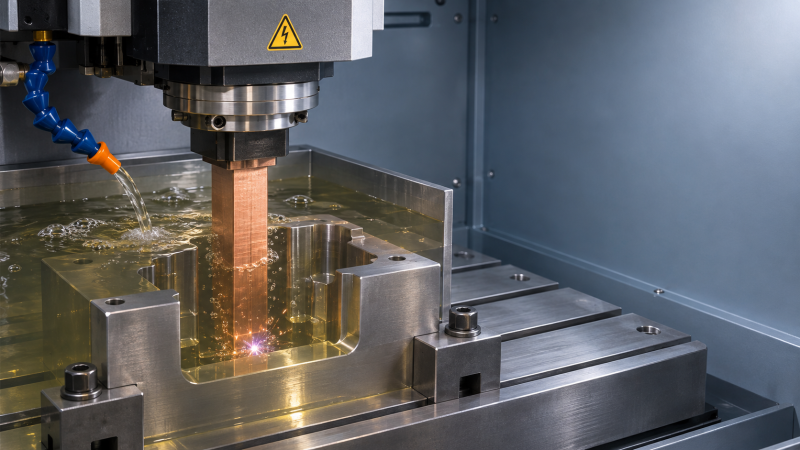
Adaptive control can make electrical discharge machining more stable when conditions inside the cutting gap change faster than an operator or a fixed parameter program can respond. Its value is most apparent in difficult, variable cuts: deep cavities, interrupted geometries, changing flushing conditions, and wire paths where the risk of a break varies along the part.
For technical evaluators, the decision is less about whether a machine has an “adaptive” label and more about what it senses, what it can change, and how those changes affect the finished surface. A controller that reduces unstable discharges may protect the electrode or wire, yet its benefits still have to be measured against cycle time, dimensional accuracy, and the integrity requirements of the component.
What adaptive control changes in the EDM process
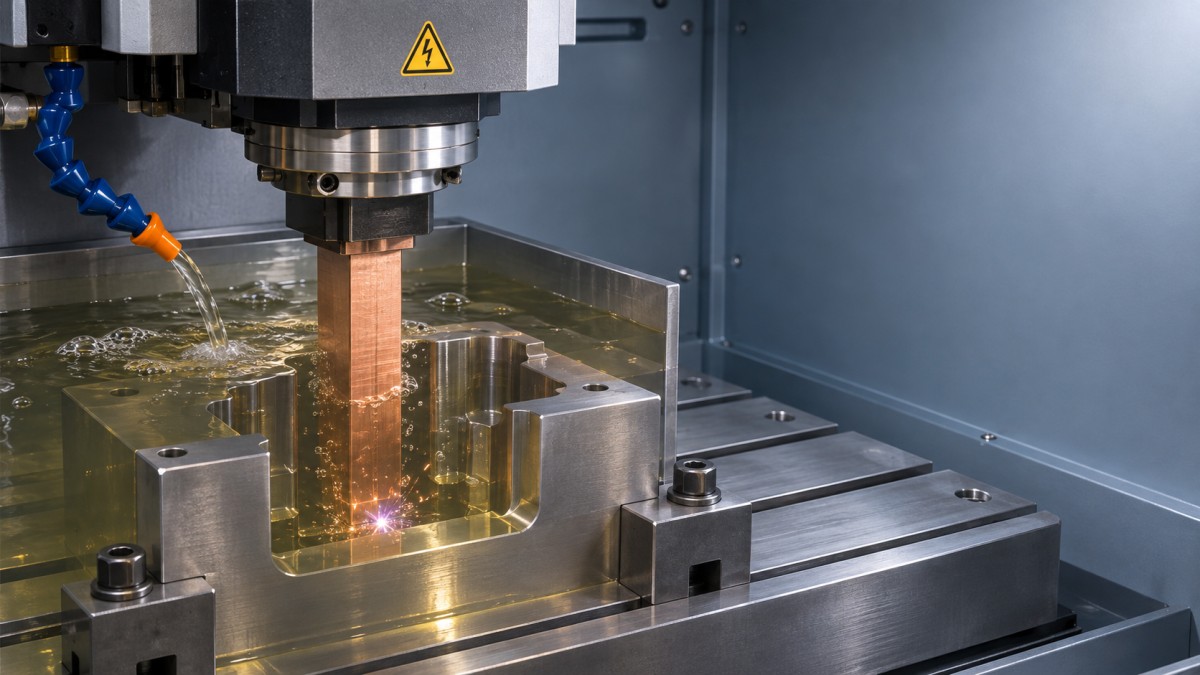
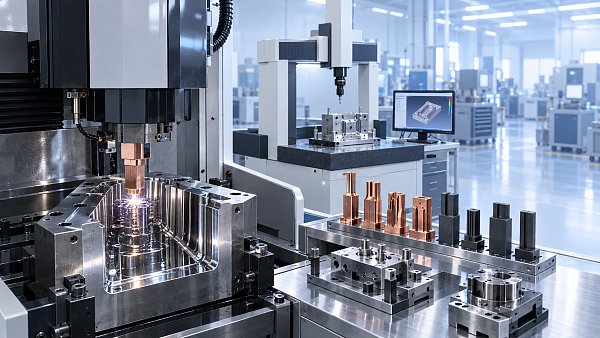
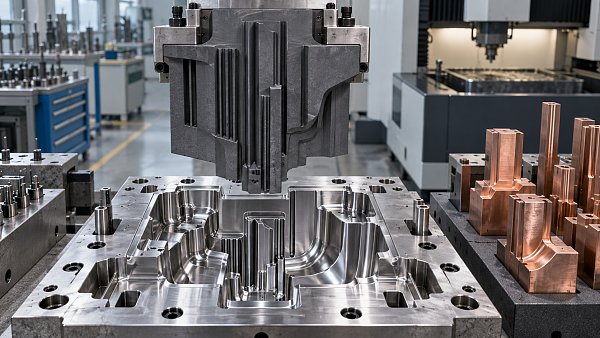
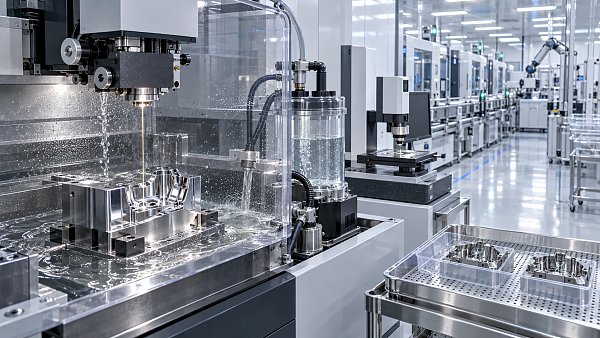
EDM removes material through electrical discharges between an electrode and a conductive workpiece, separated by a dielectric fluid. In sinker EDM, a shaped electrode produces a cavity; in wire EDM, a moving wire cuts a programmed contour. Neither process involves conventional cutting forces at the tool edge, but both depend on maintaining suitable conditions in a narrow, debris-filled gap.
Those conditions do not stay constant. As a cavity deepens, debris removal may become more difficult. A wire may encounter a change in section thickness or pass through a region where flushing is restricted. Electrode wear, local geometry, and dielectric condition can also change the behavior of the discharge. Parameters that worked well at the start of a cut may become less effective later.
A conventional machine already uses servo control to maintain the working gap. Adaptive control adds another layer of decision-making: it evaluates process signals and adjusts selected settings in response to observed conditions. Depending on the machine and strategy, those adjustments may involve feed, discharge energy, pulse timing, flushing-related actions, or recovery movements.
Consider a sinker EDM operation in a deep cavity. As debris accumulates, the controller may detect a rise in undesirable discharge behavior and reduce the rate of advance or initiate a retraction. If the gap recovers, it can resume machining under conditions intended to sustain productive discharges. In wire EDM, a controller may alter feed or electrical settings when a changing workpiece section makes the cut more unstable.
These examples describe possible control strategies, not a universal feature set. Two machines described as adaptive may monitor different signals, act on different parameters, and give the operator very different visibility into their decisions.
What the controller can see—and what it cannot
Many adaptive strategies use electrical information from the gap, such as voltage and current behavior, to classify discharge conditions. A control may use these observations to distinguish productive sparking from states associated with arcing, short circuits, or ineffective pulses. Machine motion and other available signals can provide additional context, depending on the equipment.
The distinction matters because the controller generally observes process behavior indirectly. It does not necessarily measure debris concentration, local surface damage, or the condition of every point on the workpiece in real time. It infers a condition from the signals available and applies a response designed for that condition.
A useful evaluation therefore starts with the control loop itself:
- Signals: Which process variables are measured, and are they available to the user as meaningful trends or alarms?
- Decisions: What conditions trigger an adjustment, and can the operator understand the reason for a slowdown, retraction, or interruption?
- Actions: Which parameters can the control change automatically, and within what limits?
- Recovery: How does the machine resume normal operation after a disturbance, and what happens if the disturbance persists?
A system may react quickly to unstable electrical behavior but have little authority over the underlying cause. If a cavity cannot be flushed effectively, reducing feed may preserve stability while extending the cycle. Similarly, a wire-break prevention function can only work within the capabilities of the wire, guides, power supply, flushing arrangement, and programmed path.
Some controls incorporate models or data-driven methods; others rely on predefined rules and parameter tables. The label alone does not establish which will perform better. The relevant question is whether the control responds reliably to the disturbances that occur on the intended parts, without creating an unacceptable trade-off elsewhere.
Where performance gains are plausible
Adaptive control has a strong case where the machining process encounters changing conditions within the same operation. In deep or narrow sinker EDM cavities, debris evacuation can become a limiting factor as the electrode advances. A controller that recognizes deteriorating gap conditions and manages recovery may reduce the time spent in sustained instability. The result depends on electrode design, flushing paths, material pairing, and the finishing requirements.
Wire EDM presents a different set of problems. A part with varying thickness or an interrupted contour can expose the wire to changing thermal and electrical conditions. Automatic feed and power adjustments may help maintain a stable cut through these transitions. The practical benefit is not only the possibility of a shorter cycle; avoiding a wire break can also prevent rethreading, recovery work, and disruption to unattended operation.
The comparison becomes less compelling when a part is already predictable and the process has been carefully tuned. A stable cut in a uniform section may offer little room for an adaptive strategy to improve on a well-established parameter set. Additional sensing, software, or integration capability should be assessed against the production problem it is meant to solve.
For mixed production, repeatability can be as important as peak removal rate. If a control handles routine variation without frequent operator intervention, it may make scheduling and unattended running more dependable. That conclusion still requires evidence across representative jobs: one successful cut does not establish how the machine behaves with different geometries, electrode conditions, or maintenance states.
Faster machining is only one outcome to measure
EDM performance is often discussed in terms of removal rate or cutting speed, but an adaptive controller changes the process history of the surface as well. Adjustments to pulse conditions, feed, and recovery behavior can affect electrode wear, geometry, and the thermal influence on the workpiece. A faster roughing cycle is valuable only if the subsequent finishing operation can still produce the required part.
For sinker EDM, examine electrode wear alongside cavity dimensions and cycle time. An adjustment that stabilizes the gap may alter wear behavior, and wear can affect corners, depth, or features that are difficult to finish. For wire EDM, assess wire consumption and break frequency together with contour accuracy, taper, and surface finish. A reduction in breaks that comes from consistently conservative feed settings may still be worthwhile, but it should be visible in the full cost and time comparison.
Surface integrity deserves separate attention on parts where fatigue performance, cracking, or subsequent processing is sensitive to the machined layer. Surface roughness measurements alone do not describe every relevant thermal or metallurgical effect. The drawing, material, service conditions, and qualification plan should determine whether additional inspection of the affected surface layer is required.
Adaptive operation also does not remove the need to qualify finishing settings. A control may use different behavior in roughing and finishing, and a strategy optimized for throughput may not be the one used to produce the final surface. Evaluators should establish which part of the process is adaptive and which settings remain fixed.
How to compare systems on a representative part
The most informative assessment is a controlled comparison on a feature that reflects the intended production difficulty. Select a part or test piece with a relevant material, thickness or cavity depth, geometry, and surface requirement. If flushing access is the expected constraint, preserve that constraint in the trial; an easy-to-flush demonstration may reveal little about the proposed application.
Where the machine permits it, compare the adaptive strategy with a suitable established process under documented conditions. If a direct on/off comparison is not available, ask for a clear description of the baseline and the parameter changes used for each run. Keep material condition, electrode or wire specification, dielectric condition, consumables, and finishing requirements as consistent as practical.
Record more than the displayed machining time. A useful comparison includes total time to an acceptable part, interruptions and recovery actions, consumable use, dimensional results, surface measurements, and any required inspection of surface integrity. Note whether operator intervention was needed and whether the control’s adjustments can be reviewed afterward. Repeated trials or a range of representative features provide stronger evidence of consistency than a single best result.
The trial should also expose the limits of the automation. Can operators set bounds on automatic changes? Can they identify why the control slowed down? Are alarms and process records accessible in a form that supports troubleshooting? If production data must enter an existing manufacturing system, evaluate the available interfaces, data fields, and responsibilities for maintaining the connection.
For regulated or tightly controlled work, establish how the adaptive function fits the approved process. A machine’s ability to vary parameters automatically may require the qualification procedure to define permitted operating ranges, retained records, and the circumstances that trigger requalification. The applicable requirements come from the part specification and governing quality system; an adaptive feature by itself does not establish compliance.
Reading the next wave of EDM claims
In next-gen EDM technology news, claims about intelligent control often combine several capabilities: automatic parameter selection before a cut, real-time adjustment during machining, fault detection, and production data analysis afterward. Each can be useful, but they solve different problems. Ask whether a claimed improvement occurs during the discharge process, between machining stages, or only after a human reviews the data.
Also distinguish a machine’s ability to collect data from its ability to act on it. A dashboard can make recurring interruptions easier to diagnose without changing the cut automatically. Conversely, a closed-loop adjustment may improve stability while exposing little information to the user. For a technical evaluation, the strongest evidence links a specific observed condition to a defined response and then to measurable part or production outcomes.
The direction to watch is better coordination between gap control, motion, flushing, and process records. Whether that coordination pays for itself will depend on the parts being made and the freedom the production process allows. A machine that can explain and contain its responses to difficult cuts offers an evaluator a firmer basis for qualification than a headline promise of autonomous machining.
Facing technical bottlenecks in manufacturing or looking for more efficient industrial solutions? Leave your details below and let the engineering experts at G-PME solve them for you.
We respect your privacy. Your information is strictly confidential.
Recommended News
 How adaptive control is changing next-generation EDM machiningExplore next-gen EDM technology news and discover how adaptive control improves machining stability, plus what to assess before investing.
 How to read an EDM surface finish Ra chart in µm and µinRead an EDM surface finish Ra chart with confidence. Learn µm-to-µin conversions, avoid costly unit errors, and choose finish targets backed by reliable inspection.
 What to verify before selecting a sinker EDM machine supplierChoose a reliable sinker EDM machine supplier with confidence. Verify machining trials, electrode compatibility, automation, service support, and total ownership risk.
 How tooling cost calculation changes with EDM electrode complexityTooling cost calculation for EDM electrodes: learn how geometry, electrode count, tolerances, wear, and inspection drive accurate mold cost estimates.
 Does manufacturing standards compliance for semiconductors affect EDM tool approval?Manufacturing standards compliance for semiconductors shapes EDM tool approval through traceability, validation, contamination control, and inspection. Learn what proves reliable capability.
 Industrial Machining Turning vs Milling: Which Process Fits Part Geometry and Cost Targets?Industrial machining turning vs milling: learn how to match part geometry, tolerance, material, and volume to the right process for lower cost, better quality, and smarter sourcing.
 Precision Machining Services in Latin America: How to Compare Lead Time, Tolerance, and CostPrecision machining services Latin America compared: learn how to evaluate lead time reliability, true tolerance capability, and total cost to choose a supplier with confidence.
 Metal Fabrication Processes Explained: Cutting, Bending, Welding, and When to Use EachMetal fabrication explained clearly: learn when cutting, bending, or welding is the right choice for better quality, lower cost, and smarter project decisions.
 When is an EDM machine OEM supplier the safer choiceedm machine oem supplier advantages become clear when accuracy, uptime, and traceability matter. Learn when OEM support is the safer choice for lower risk and faster response.
 What to ask an EDM machine OEM supplier before signingEDM machine OEM supplier due diligence starts with the right questions. Learn what to ask about precision, service, lead times, spares, software, and risk before signing.
 What to check before choosing an EDM machine OEM supplierEDM machine OEM supplier selection starts with accuracy, traceability, service, and lifecycle cost. Discover what to check before buying to reduce risk and improve production fit.
 How to vet an EDM machine OEM supplier before orderingedm machine oem supplier selection starts with a smart vetting process. Learn how to assess quality, customization, delivery, and support before ordering.
 Is an EDM machine OEM supplier worth the lead timeedm machine oem supplier lead time can be worth it when precision, uptime, and long-term support matter. Learn when OEM sourcing reduces risk and improves ROI.
 How to vet an EDM machine OEM supplier with less riskedm machine oem supplier selection starts with the right checks. Learn how to vet quality, compliance, delivery, and service risk before you buy with confidence.
 What to check before choosing an EDM machine OEM supplieredm machine oem supplier selection starts with proof of accuracy, quality systems, customization, and service support. Learn the key checks to reduce risk and choose with confidence.
 How to vet an EDM machine OEM supplier with less riskEDM machine OEM supplier vetting starts with the right risk checks. Learn how to verify quality, export readiness, delivery, and service support before you buy.
 How to vet an edm machine OEM supplier before orderingedm machine OEM supplier selection starts with proof, not promises. Learn how to verify quality, service, uptime support, and risk before ordering.
 Is an EDM machine OEM supplier better for custom workedm machine oem supplier advantages for custom work: learn how to compare precision, process flexibility, service support, and total cost before choosing the right partner.
 When is an EDM machine OEM supplier the better choiceEDM machine OEM supplier selection matters when precision, customization, automation, and lifecycle support drive results. Learn when OEM sourcing delivers lower risk and stronger long-term value.
 Is an EDM machine OEM supplier better for custom jobsedm machine oem supplier options are often best for custom jobs when precision, integration, and long-term support matter. Learn how to compare OEMs, reduce risk, and choose with confidence.
 How to vet an EDM machine OEM supplier with less riskEDM machine OEM supplier selection starts with risk control. Learn how to verify technical capability, service readiness, compliance, and lifecycle cost before you buy.



Search News
Popular Tags