
How idle CNC machines affect energy-efficient manufacturing
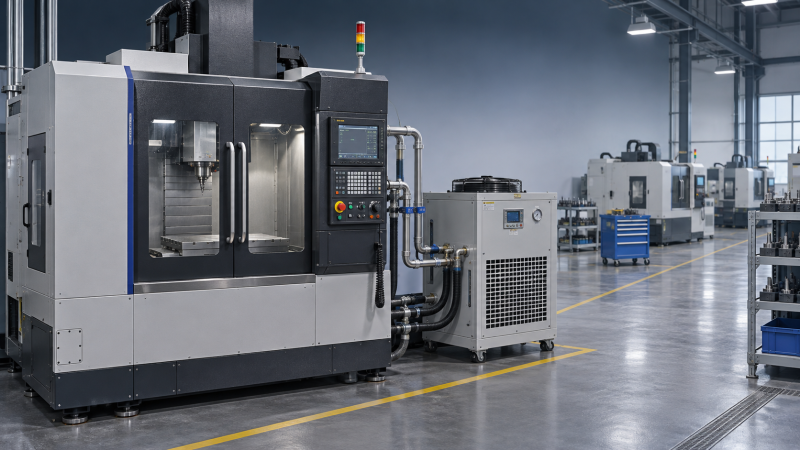
An idle CNC machine can draw substantial electrical power while producing no parts. Controls, hydraulic units, cooling equipment and other auxiliaries may remain active between cycles, during changeovers or after a shift ends. The effect on energy-efficient manufacturing depends on both the power drawn in each idle state and the time spent there—not simply on whether the spindle is turning.
The practical response is to measure machine states separately, identify avoidable waiting periods and compare the energy saved by a lower-power state with the time and energy needed to return to production. A machine that must hold temperature or remain ready for an imminent cycle may need a different strategy from one waiting through an unstaffed weekend.
Idle is not a single operating state
A CNC machine can appear inactive from the outside while its internal systems are doing very different work. A control screen may be on, the axes stationary and the spindle stopped, yet pumps or cooling circuits may still be operating. Conversely, a machine in a programmed energy-saving mode may have disabled some auxiliaries while retaining the control functions needed for a controlled restart.
Distinguish at least the following conditions when reviewing power data:
- Ready but not cutting: The control and selected auxiliaries are available for the next cycle. Servo drives may be energized, and a hydraulic system may maintain pressure.
- Cycle interruption or short wait: Equipment remains in its normal operating configuration while an operator loads parts, changes a tool or resolves a process issue.
- Standby or sleep: The machine has entered a defined lower-power mode. Which loads are disabled depends on the machine and its settings.
- Off or isolated: Power is removed to the extent specified by the shutdown procedure. Upstream services or separate peripherals may still consume energy.
These labels are useful only if their boundaries are documented. One machine’s standby mode may leave a chiller running; another may stop it. A production monitoring system that records only “cycle active” and “cycle inactive” cannot, by itself, reveal those differences.
Where the electricity goes while the spindle is stopped
The CNC control, display, drives and cabinet cooling establish part of the baseline. Depending on the machine, additional loads may include hydraulic power packs, lubrication systems, coolant pumps, chip conveyors, mist extraction and temperature-control units. Some run continuously; others cycle according to pressure or temperature. A brief power reading can therefore miss a significant part of their consumption.
Not every load connected with a machine is supplied through its main electrical input. A central chiller, extraction system or compressed-air plant may be shared across several machines. Measuring only the machine input is useful for comparing its own states, but it does not capture all facility energy associated with keeping that machine ready. Conversely, assigning the entire shared-system load to one machine would overstate its impact.
Compressed air needs particular care. A machine may use air for sealing, tool changing or cleaning even when it is not cutting, and leaks can continue during idle periods. An electrical meter on the CNC machine will not directly capture the compressor electricity caused by that demand. Treat air use as a separate assessment, using appropriate flow measurement or a documented allocation method where individual measurement is unavailable.
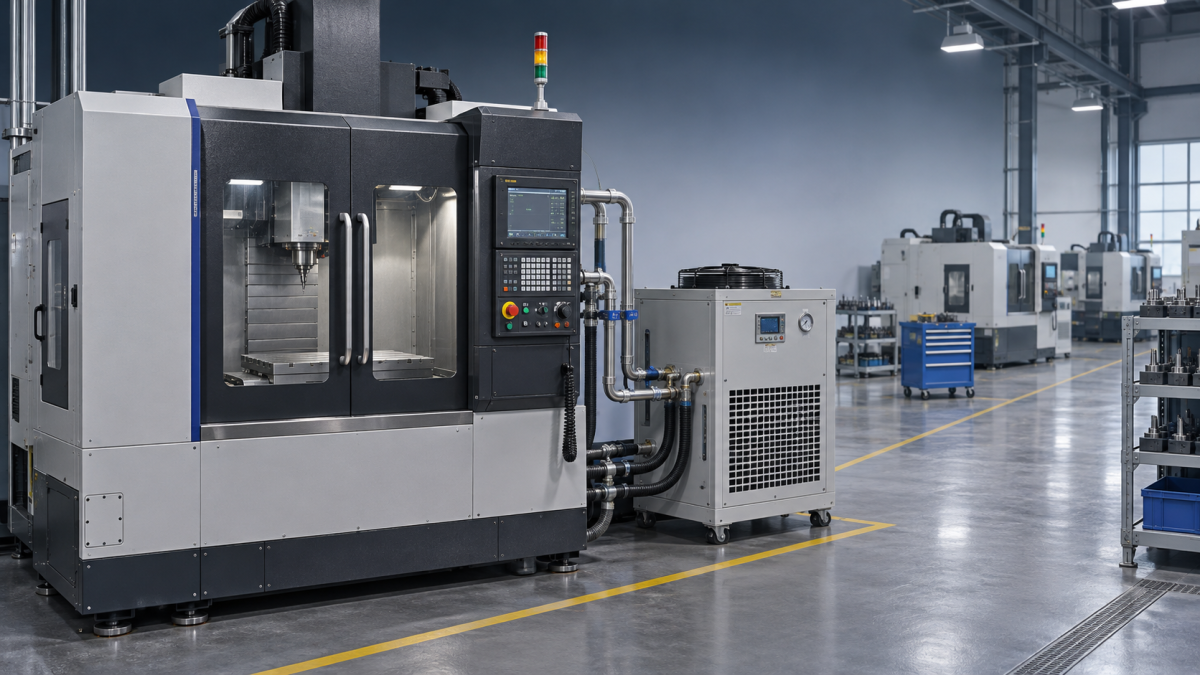
Measure energy by state, not by an instantaneous reading
Start with a defined boundary: the machine input alone, the machine plus dedicated peripherals, or a wider cell that includes shared services. Record the boundary alongside every result. Use a suitable electrical power meter installed by qualified personnel, with measurement capability appropriate for the supply and the expected load. For a three-phase machine, measure real power and energy rather than estimating consumption from one phase or from nameplate ratings.
Log power over enough time to capture a representative sequence of production, waiting and any scheduled shutdown. Include complete cycles of intermittent auxiliaries, such as a hydraulic pump that periodically restores pressure. The interval should be short enough to distinguish relevant transitions but long-term energy totals should also be retained. Synchronize meter timestamps with machine-state, shift and production records so that a low-power interval is not mistakenly classified as ordinary standby when the machine was actually off.
- Record the machine configuration, enabled peripherals, operating mode and measurement boundary.
- Mark transitions between cutting, non-cutting motion, ready idle, standby and shutdown. Note interruptions that explain unusual loads.
- Calculate the energy for each state from the meter’s energy readings or from time-integrated real power, rather than multiplying a single peak reading by the full interval.
- Check that the sum of state-level energy is consistent with the total measured over the same period. Investigate gaps, overlapping labels and clock differences.
- Repeat the observation when schedules, products or operating conditions differ materially from the baseline.
Average idle power can be calculated as idle-state energy divided by idle-state hours. Multiplying that average by comparable idle hours gives an estimate for that specific configuration and period. It should not be applied blindly to a different season, machine setting or peripheral arrangement: temperature control and pump cycling can change the result.
Separate the machine from the production schedule
Two machines with similar idle power can have very different annual effects because their waiting patterns differ. A short pause between closely spaced cycles may offer little opportunity to shut down. A machine left ready throughout breaks, overnight or between batches may have much longer intervals in which a lower-power state is practical.
Review the timestamps around idle periods before changing equipment settings. The useful question is not merely “How many hours was the machine inactive?” but “How many of those hours were long and predictable enough to permit a transition without disrupting the next operation?” Include the time needed for an operator to act, where shutdown is not automatic.
Compare shutdown savings with the cost of restarting
A lower-power state is worthwhile only when the avoided energy and operational impact justify entering and leaving it. A simple screening calculation is:
Estimated net energy saving = (average ready-idle power − average lower-state power) × time in the lower state − additional transition energy.
Use consistent units: power in kilowatts, time in hours and energy in kilowatt-hours. Measure transition energy over the relevant entry and restart periods, including any warm-up, and compare it with the energy the machine would have used by remaining ready during those same periods. Avoid subtracting the ready-state baseline twice.
The associated break-even duration is the additional transition energy divided by the difference between ready-idle and lower-state power. This is an energy threshold, not an automatic operating rule. A restart that is favorable in energy terms can still be unsuitable if it delays a scheduled operation, requires an unavailable operator or compromises process conditions. Likewise, if the lower-state power is not actually lower at the chosen boundary, the calculation offers no energy benefit.
For example, a temperature-controlled machine processing tight-tolerance parts may require stabilization after a long shutdown. The relevant comparison should include warm-up movements or spindle routines specified by the manufacturer and any verification required by the process. Do not assume that the first part after restart will meet the same conditions as a part produced after thermal stabilization; follow the established inspection and process-control plan.
Choose an intervention that matches the waiting period
For short and uncertain pauses
Begin with functions designed for automatic idle reduction rather than a full power-off. A machine may support timed reduction of servo, hydraulic, lighting or peripheral loads, subject to its configuration. Confirm which functions are actually affected and whether the machine returns to the required ready state without an unsafe or disruptive sequence.
Unnecessary non-cutting activity is another target. A coolant pump or chip conveyor may be left running outside the period in which the process requires it. Change control logic or operating settings only after confirming the consequences for lubrication, coolant delivery, chip accumulation and restart. A component that appears idle can still be protecting tooling, seals or the machine.
For predictable long gaps
Scheduled standby or shutdown may be more useful between shifts or during extended production gaps. Document who initiates it, the minimum expected gap, the restart sequence and the point at which the machine must be ready. Where several machines share a chiller or extraction system, coordinate their schedules: turning off one machine may not allow the shared equipment to stop, while stopping the shared equipment prematurely can affect machines still in use.
Do not use the emergency stop as an energy-management control or bypass safety interlocks. Emergency stopping, isolation and routine shutdown serve different purposes. Follow the machine manufacturer’s instructions and site safety procedures, particularly when working on electrical, hydraulic or pneumatic equipment.
Use comparable metrics without rewarding the wrong behavior
Idle energy is most actionable when reported alongside the time and production conditions that generated it. Useful measures include energy in each defined idle state, average power in that state, idle duration by shift and the proportion of measured machine energy consumed outside productive cycles. Energy per accepted part can provide a wider production view, but it varies with part complexity, cycle time, scrap, batch size and process route. It should not be used alone to rank unrelated machines or jobs.
Higher utilization is not automatically an efficiency improvement. Running unnecessary parts, delaying maintenance or eliminating checks to keep a spindle turning can increase total energy and undermine quality. Similarly, a drop in machine-input energy may simply shift consumption to an external chiller or compressor. Keep the measurement boundary and the count of accepted output visible when comparing before and after results.
For technical comparisons, ISO 14955 addresses environmental evaluation of machine tools, including energy-related assessment. ISO 50001 concerns energy management systems at the organizational level; it is not a substitute for a machine-level measurement plan. When using a standard in a specification or evaluation, identify the applicable part and edition, define the test conditions and verify that the proposed method fits the intended comparison. A generic claim of conformity does not establish the idle power of a particular machine configuration.
Verify that a change survives normal production
After changing an idle setting or shutdown schedule, measure the same states with the same boundary and a comparable production mix. Check restart time, alarms, thermal stabilization, first-part acceptance and any change in auxiliary cycling as well as electrical energy. A saving observed on the CNC meter is not enough if a separate peripheral runs longer or if restart creates additional scrap.
Keep the state definitions and control settings with the results. If operators routinely override a sleep timer because it interrupts loading or setup, the measured setting may not represent sustained operation. Adjust the threshold to fit the actual workflow, then remeasure. The strongest decision is one supported by state-level energy data and a restart procedure that production can reliably use.
Facing technical bottlenecks in manufacturing or looking for more efficient industrial solutions? Leave your details below and let the engineering experts at G-PME solve them for you.
We respect your privacy. Your information is strictly confidential.
Recommended News
 How idle CNC machines affect energy-efficient manufacturingImprove energy-efficient manufacturing by uncovering hidden CNC idle power. Learn how to measure machine states, reduce waste and optimize restarts.
 When are 5-axis CNC machine tools worth the investment?When are 5 axis CNC machine tools worth the investment? Compare setup savings, part complexity, costs and alternatives to make a confident decision.
 Belotti Examines 5-Axis CNC Machining in Shipbuilding5-axis CNC machining in shipbuilding: discover how Belotti connects digital design to complex hull production and explores potential precision and efficiency gains.
 How to compare ATC cycle time data across machining centersCompare ATC cycle time data with confidence. Learn how timing boundaries, tool loads and machine conditions affect real-world machining performance.
 How to reduce cybersecurity risks in connected 5-axis machinesReduce cybersecurity risks in connected 5-axis machines with practical steps for network segmentation, secure remote access, data protection and recovery.
 How thermal drift affects accuracy in precision machining centersPrecision machining centers can lose accuracy as temperatures change. Discover how to identify thermal drift, control its causes, and maintain consistent part quality.
 METALEX 2026 Brings More Than 3,000 Brands to BangkokMETALEX 2026 brings over 3,000 brands to Bangkok, November 18–21. Explore metalworking, automation and practical sourcing insights for your next equipment purchase.
 India Unveils Homegrown 2-Micron 5-Axis CNC Machine for Semiconductor PushIndia’s 2-micron, 5-axis CNC machine could support semiconductor localization. Explore its sourcing potential and what buyers should verify.
 How much accuracy do precision machining centers retain over time?Precision machining centers can stay accurate for years—but how can you tell? Discover the tests and factors that reveal real-world performance.
 How to measure spindle nose runout with a dial indicatorMeasure spindle nose run out with a dial indicator. Learn how to set up safely, calculate TIR, and compare results with the right specification.
 How to evaluate 5-axis machining suppliers in North AmericaEvaluate 5 axis machining North America suppliers with confidence. Compare capabilities, quality controls, lead times, and total costs before you commit.
 How ISO 230-1 addresses machine tool static stiffness testingMachine tool stiffness ISO testing explained: discover how ISO 230-1 guides force-deflection measurements and supports meaningful machine comparisons.
 Japan's Machine Tool Export Controls Accelerate China's Five-Axis SubstitutionJapan's machine tool export controls are accelerating China's five-axis CNC substitution. Explore the implications for buyers and supply chains.
 Shanghai Plan Targets Ultra-Precision Machining and Five-Axis Machine Tool UpgradesShanghai's ultra-precision machining and five-axis machine tool upgrade priorities could shape equipment investment. Explore potential opportunities and what buyers should verify.
 Are CNC spindle suppliers expanding local repair for five-axis machines?Explore cnc spindle supplier trends in local repair for five-axis machines. Learn how to verify repair capacity, compare exchange options, and choose support that reduces downtime.
 Do Complex Electronic Components Need 5-Axis Machining?How much does 5-axis machining cost compared with 3-axis machining? Discover when extra axes pay off for electronic components and compare total costs to choose the right process.
 How Much Does 5-Axis Machining Cost Compared With 3-Axis Machining?What should be included in a CNC machining RFQ? Compare 5-axis vs. 3-axis costs, uncover hidden charges, and learn how to request comparable quotes to find the best value for your parts.
 Which ISO standards apply to five-axis machine accuracy testing?Explore ISO machine accuracy standards for five-axis machining. Learn how ISO 230 and ISO 10791 guide geometry, positioning, and motion tests to define clearer acceptance criteria.
 How bearing prices shape machine tool spindle production cost trendsExplore how bearing prices shape spindle production cost trends, from assembly and testing to supply risks. Uncover hidden costs and make smarter sourcing decisions.
 Carrier Plans $600 Million Advanced Manufacturing Center With 5-Axis CNC EquipmentCarrier plans a $600M+ advanced manufacturing center with 5-axis CNC equipment in Texas. Explore potential opportunities for machining suppliers and commercial chiller buyers.
 Aluminum vs. titanium for lightweight parts with equal stiffnessEngineering materials comparison: lightweight alloys aluminum and titanium face off at equal stiffness. Discover how geometry, loading, and cost guide the best choice for lighter parts.
Search News
Popular Tags