
How cutting fluid concentration affects industrial machining
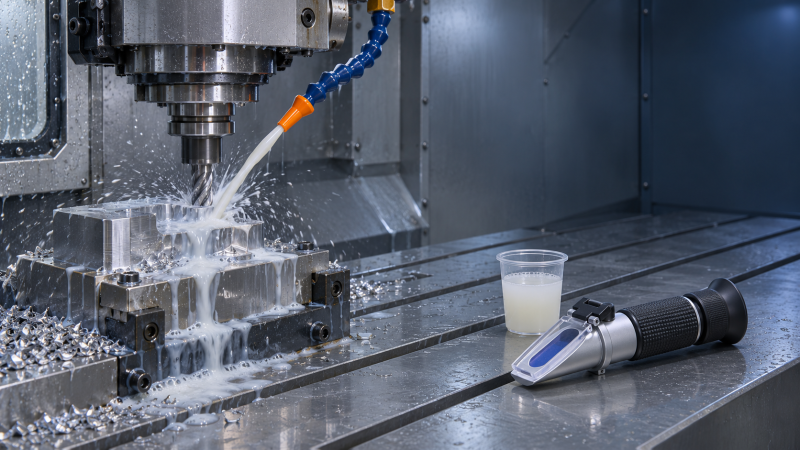
When surface finish deteriorates or tools begin wearing faster during a machining shift, cutting fluid concentration is one of the first conditions worth checking. A mixture below its specified range may provide too little lubrication and corrosion protection; one above the range can leave deposits, increase concentrate consumption, and contribute to skin irritation or foaming.
The correct response is not automatically to add more concentrate. Measure a representative sample, compare the result with the fluid supplier’s operating range for the application, and check whether contamination or another process change could be affecting the reading. In industrial machining, concentration is a controllable variable, but it is not a complete measure of coolant condition.
What changes as concentration moves out of range?
Water-mix cutting fluids depend on a balance between water, which carries heat away, and concentrate, which contains lubricating components, corrosion inhibitors and other additives. Changing that balance affects more than the amount of lubricant delivered to the cut. It can also alter how the fluid behaves in the sump, on machine surfaces and on finished parts.
When the mixture is too weak
Insufficient concentrate can reduce the lubricating film available at the tool–workpiece interface. Depending on the operation, operators may notice a rougher finish, built-up edge, increased cutting forces or faster tool wear. Difficult cuts and materials that tend to adhere to the tool can be particularly sensitive to inadequate lubrication.
A weak mixture may also leave less corrosion inhibitor available to protect ferrous parts, fixtures and the machine. Rust appearing on components between operations is a reason to check concentration, although storage conditions, water quality and contamination can also contribute. An in-range reading does not guarantee that a part will remain rust-free under every condition.
When the mixture is too strong
Higher concentration can improve lubrication within the range intended for the product, but more is not always better. Excess concentrate may reduce the mixture’s ability to carry heat away compared with a more dilute mixture, while increasing residue on guards, tooling and workpieces. Sticky deposits can interfere with housekeeping and subsequent cleaning.
Overconcentration also consumes more product than necessary and may make some fluids more prone to foam or leave operators exposed to a more irritating mixture. Foam has several possible causes, including air entrainment, soft water and fluid return design, so concentration should be checked alongside those conditions rather than treated as the only cause.
The symptoms overlap with other machining problems. A worn insert, blocked coolant nozzle or change in workpiece material can produce a poor finish even when the mixture is correct. Use concentration as a diagnostic measurement, not a substitute for examining the cut.
Start with the range for the actual operation
There is no single concentration that fits every water-mix cutting fluid. A supplier may specify different operating ranges for general machining, grinding or more demanding cuts. The appropriate setting also depends on the workpiece material, tool, machine and fluid formulation. Use the product’s technical guidance and the site’s approved procedure before changing a sump.
Within an approved range, the operating target can be chosen for the job. A process experiencing boundary-lubrication problems may need a different setting from one where cooling and clean rinsing are the dominant concerns. A higher setting should still remain within the supplier’s permitted range and be evaluated against finish, tool condition, residue and other relevant observations.
Confirm which percentage the supplier specifies and how it is measured. A refractometer reading is not necessarily the actual concentration percentage: many products require a correction factor. Do not transfer a target or factor from one fluid to another merely because both are described as soluble oils or synthetics.
Measure a representative sample
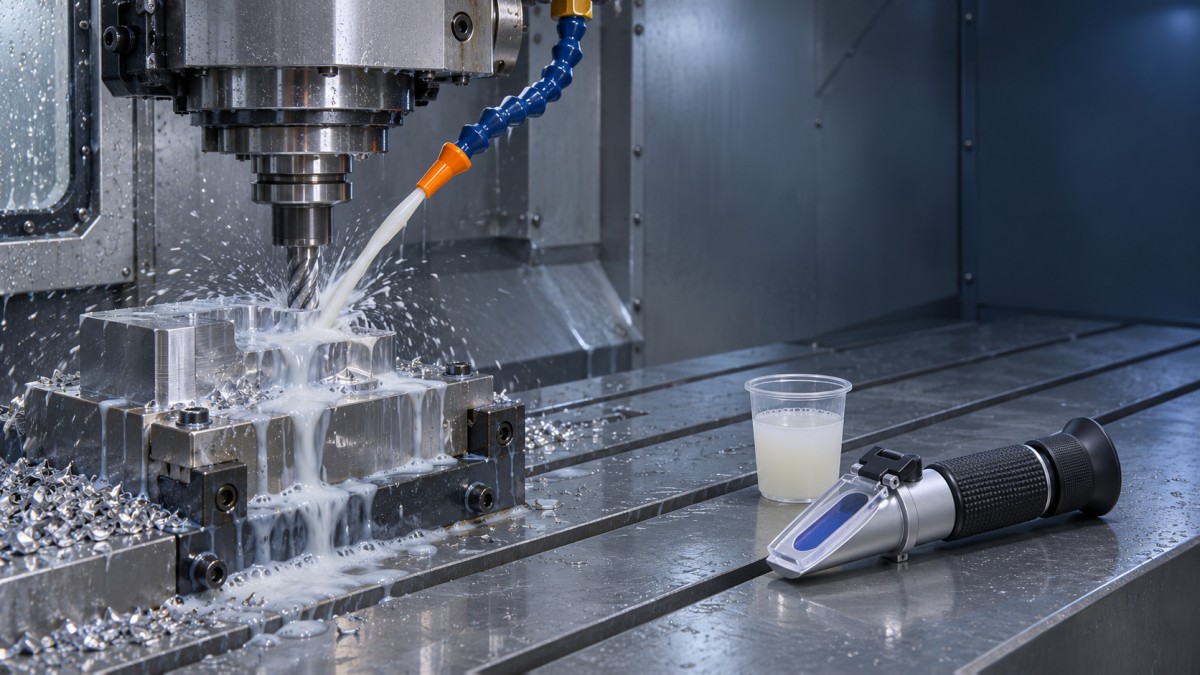
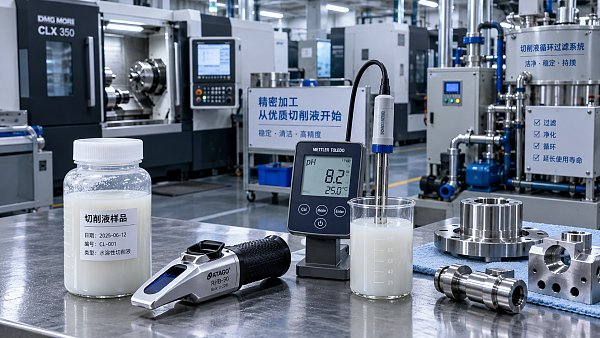
A handheld refractometer is a practical routine tool for many water-mix fluids. Its value depends on the sample, instrument condition and product factor. Check the fluid supplier’s instructions first; some formulations require a different test or additional control method.
- Prepare the instrument. Clean the prism with a soft, non-abrasive material and zero the refractometer using the water specified by the instrument instructions. Check that the scale and correction factor match the coolant in use.
- Collect circulating fluid. Take a sample from a representative point after the system has circulated, following site procedure. Avoid sampling only the oily surface layer, settled sludge or a fresh addition that has not mixed through the sump.
- Read the sample. Place the sample on the prism and take the reading according to the instrument instructions. Temperature, a dirty prism, bubbles or a blurred boundary can affect the result.
- Apply the product factor. Multiply the refractometer reading by the factor supplied for that fluid, unless the supplier specifies another calculation. Compare the resulting concentration with the approved operating range.
- Record the result and action. Note the machine, date, reading, calculated concentration and any addition made. A trend is more useful than an isolated number when diagnosing repeated drift.
For example, if a product has a supplier-stated factor of 1.5 and the refractometer reads 4.0, the calculated concentration is 6.0%. This illustrates the calculation only; neither the factor nor the result is a recommended setting. Use the current factor for the specific product and the scale on the instrument.
Tramp oil, dissolved material and degraded fluid can make a refractometer reading less reliable. If the boundary is persistently unclear, the reading conflicts with sump behavior, or repeated adjustments do not give a plausible result, clean and recheck the instrument, resample and use the supplier’s recommended verification method. Do not keep adding concentrate on the strength of an uncertain reading.
Correct a low or high reading without overshooting
Before making an addition, establish the approximate sump volume and allow any recent top-up to circulate. The amount needed depends on both the current concentration and the volume of fluid already in the system. A small correction in a large central system may require a substantial quantity, while the same addition to a small machine sump could cause an overshoot.
When the mixture is low, raise it using concentrate or a stronger premix only as permitted by the fluid supplier and the site’s mixing procedure. Add in controlled stages at the designated point, circulate thoroughly and retest. Do not pour a large amount into an isolated corner of the sump and judge the result immediately: a locally strong sample can conceal an uneven mixture.
When concentration is high, the correction generally involves dilution with suitable water, subject to the supplier’s instructions and available sump capacity. Where the sump is already full, an approved removal and replacement procedure may be necessary. Collect and dispose of removed fluid under site requirements; do not discharge it simply to make room.
For a fresh charge, follow the specified mixing order, equipment and water quality. Many water-mix products are added to water while mixing, rather than the reverse, but the product instructions govern. A proportioning mixer can help produce a consistent premix when it is set up and checked correctly.
After either correction, circulate the system for the period specified by the site or equipment procedure, then sample again from a representative point. Record both the addition and the new result. If the concentration repeatedly returns out of range, investigate the cause rather than treating each reading as an isolated event.
Why concentration drifts during production
Evaporation removes water while leaving most concentrate components behind, tending to raise the measured concentration. In contrast, fluid carried out on chips, parts and machine surfaces removes a mixture; replacing that loss with water alone can lower concentration over time. Actual behavior varies with the fluid, production conditions and losses, so neither mechanism should be assumed without measurement.
Top-up practice is often the controllable difference. A fixed top-up mixture can be useful, but its concentration needs to match the observed trend and supplier guidance. Adding the same mixture every time without recording results can allow drift to continue unnoticed. Automatic mixers also need periodic checks: an incorrect setting, restricted pickup line or unsuitable water supply can produce a different mixture from the one expected.
Changes in water quality deserve attention as well. Excessive hardness can affect emulsion stability or leave deposits; very soft water can contribute to foam with some products. Use water that meets the fluid supplier’s recommendations, and investigate a supply change when fluid behavior changes across several machines.
Separate concentration problems from coolant condition
A refractometer tells the operator something useful about the mixture, but it does not directly measure every additive, microbial condition or contaminant. A sump can show an apparently acceptable concentration and still perform poorly. Conversely, a fluid that looks slightly different from a fresh mix is not automatically out of specification.
Use the safety data sheet and site controls when handling concentrate or used fluid. Avoid unnecessary skin contact, clean spills promptly and report persistent irritation. Do not add unapproved biocides, cleaners or other chemicals to correct odor or deposits; compatibility and safe use need to be established for the specific system.
If concentration is within range but corrosion, unstable readings or machining problems continue, retain the operating records and arrange the fluid checks specified by the supplier or site procedure. That information helps distinguish a mixing error from contamination, fluid degradation or a problem at the machine itself.
Facing technical bottlenecks in manufacturing or looking for more efficient industrial solutions? Leave your details below and let the engineering experts at G-PME solve them for you.
We respect your privacy. Your information is strictly confidential.
Recommended News
 How cutting fluid concentration affects industrial machiningImprove industrial machining performance by learning how cutting fluid concentration affects tool life and surface finish—and how to measure and correct it.
 Karolinska Institute Study Links Petroleum-Based Industrial Fluids to MS RiskPetroleum-based industrial fluids may be linked to MS risk, a Karolinska Institute study suggests. Explore what the findings mean for workplace safety.
 Global Metal-Cutting Semi-Synthetic Coolant Market Forecast to Reach $1.73 Billion by 2030The semi-synthetic metal-cutting coolant market is forecast to reach $1.73 billion by 2030. Explore growth drivers and key considerations for buyers and suppliers.
 Why do pH meters give unstable readings in metalworking coolants?Unstable pHmeters in metalworking coolants? Learn how to identify probe fouling, verify calibration, and improve sampling for reliable readings before costly coolant adjustments.
 11th CIMSS Conference in Wuxi to Focus on Metalworking Fluid Industry UpgradesExplore the 11th CIMSS Conference in Wuxi, October 22–23, 2026, for insights into metalworking fluid innovation, industrial cleaning and cost control to support industry upgrades.
 Can Cutting Fluid Analysis Reduce Replacement Costs Without Hurting Quality?Discover how fluid analysis for cost savings can reduce cutting fluid replacement costs without compromising machining quality. Learn which tests and maintenance decisions deliver real value.
 What raw materials market signals matter for cutting fluid buyersRaw materials market signals help cutting fluid buyers manage cost, supply risk, formulation changes, and machining performance. Learn what to monitor and act on.
 Where manufacturing competitiveness cost reduction starts in cutting fluid useManufacturing competitiveness cost reduction starts with smarter cutting fluid use. Learn how to cut hidden costs in tooling, downtime, cleaning, and waste without risking process stability.
 Where energy-efficient manufacturing cuts costs fastest in metalworkingEnergy-efficient manufacturing cuts metalworking costs fastest through compressed air fixes, thermal optimization, idle-load reduction, and scrap control—discover where payback starts first.
 What Drives Coolant Flow Rate and Pressure Cost in High-Duty MachiningCoolant flow rate and pressure cost affects tooling, downtime, energy use, and machining stability. Learn what drives total cost and how to choose the right system for heavy-duty machining.
 Crop Protection Methods Explained: How to Choose by Pest Type, Crop Stage, and RiskCrop protection explained clearly: learn how to choose the right method by pest type, crop stage, and field risk for smarter decisions, better timing, and more reliable results.
![]() Coolant Pressure for Machining Centers: How to Match PSI to Tooling and Chip LoadCoolant pressure for machining centers affects chip evacuation, heat control, and tool life. Learn how to match PSI to tooling and chip load for more stable machining.
 Industrial procurement mistakes in cutting fluidsIndustrial procurement mistakes in cutting fluids can weaken manufacturing competitiveness, disrupt production line optimization, and hurt precision components. Learn how technical specifications, supply chain analysis, and project tenders affect smarter sourcing.







Search News
Popular Tags