
How to Compare an EDM Machine OEM Supplier Without Missing Lead Time Risks
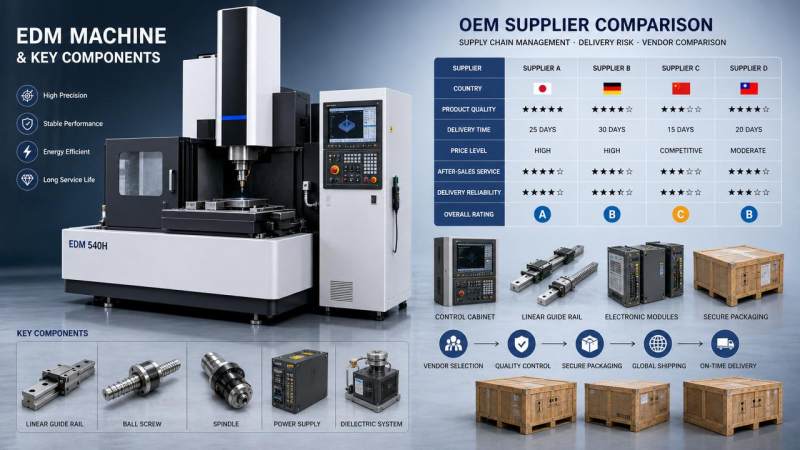
Choosing an edm machine oem supplier is not just about unit price or machining capability—it is a decision that directly affects project schedules, tooling readiness, and delivery reliability. For project managers and engineering leads, a structured comparison must uncover hidden lead time risks early, from component sourcing and production capacity to quality approval cycles and after-sales response.
In precision manufacturing programs, EDM equipment often sits on the critical path. Whether the application involves mold making, toolroom support, aerospace components, medical parts, or high-hardness inserts, a delay of 2 weeks in machine shipment can easily trigger 4 to 8 weeks of downstream impact across fixture validation, operator training, and pilot production.
For buyers working in multinational industrial environments, comparing an edm machine oem supplier requires more than checking quoted delivery dates. A robust evaluation should test lead time assumptions, identify bottleneck components, and verify how the supplier performs when schedules shift, engineering changes arise, or acceptance criteria become more demanding.
Why Lead Time Risk Is the First Filter in OEM Supplier Comparison
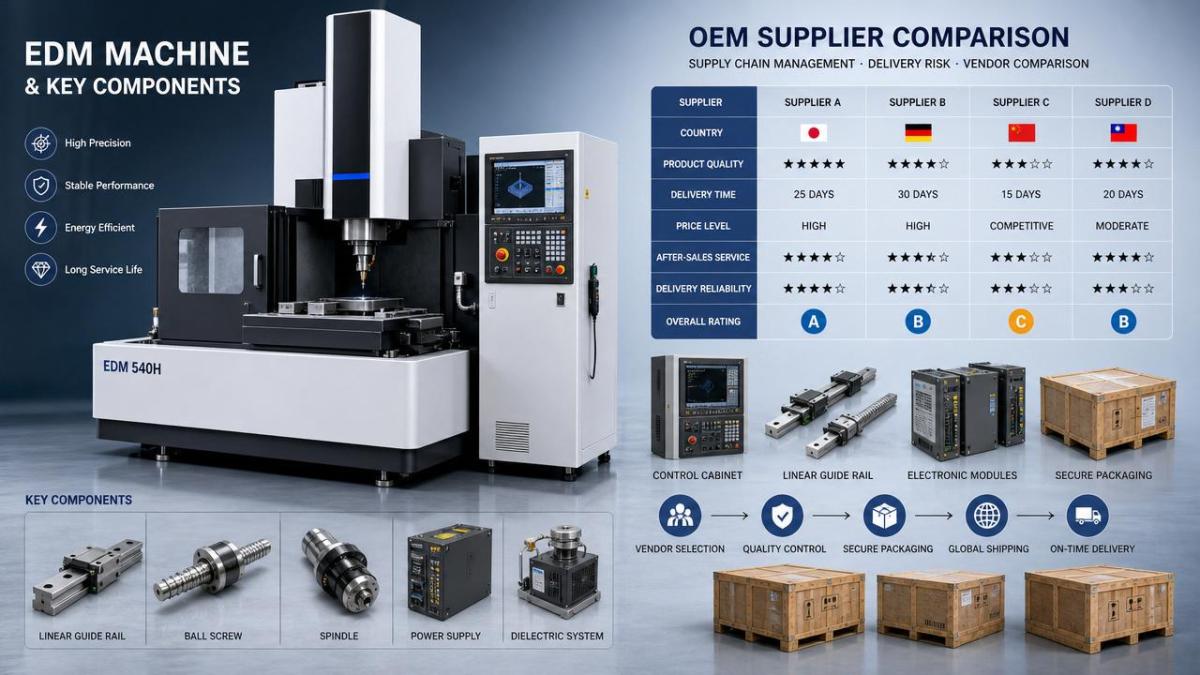
An edm machine oem supplier may present a standard lead time of 8 to 12 weeks, yet that number can hide multiple dependencies. CNC machined frames, linear guides, generators, dielectric systems, control units, imported electronics, and testing fixtures often come from different supply channels. If only 1 of these sub-systems slips by 10 days, final assembly and FAT can move by 2 to 3 weeks.
For project managers, this matters because EDM machines are rarely standalone purchases. They are usually linked to mold launch milestones, spare capacity planning, or replacement programs tied to uptime targets. In a plant environment where installation windows are fixed and utility preparation is scheduled in advance, schedule variance becomes a cost driver rather than a simple inconvenience.
The 4 hidden layers behind quoted lead time
When reviewing proposals, it is useful to separate the total promised delivery cycle into 4 layers: engineering confirmation, component procurement, machine build and test, and shipment plus commissioning. A supplier that only states “delivery in 10 weeks” without splitting these stages gives limited visibility into where risk is concentrated.
- Engineering confirmation: typically 3 to 7 working days for standard models, 2 to 3 weeks for customized tables, power packs, or automation options.
- Component procurement: often 2 to 6 weeks depending on servo systems, imported controllers, pumps, chiller units, and electrical parts.
- Assembly, calibration, and FAT: commonly 2 to 4 weeks for sinker EDM or wire EDM platforms.
- Packaging, export handling, shipping, and commissioning: usually 1 to 5 weeks based on destination and incoterms.
This stage-by-stage view helps procurement teams compare two suppliers that look similar on paper but operate very differently in reality. One may carry safety stock for 70% of core components, while another relies on just-in-time purchasing and therefore shows higher volatility during material shortages.
What delays usually cost beyond the machine price
In many industrial projects, the financial impact of delay exceeds any 3% to 5% savings won in the sourcing phase. Late machine arrival can postpone sample approval, push mold tryout to the next production slot, or force temporary outsourcing of EDM work at a premium rate. It can also reduce available buffer before customer PPAP, line qualification, or seasonal launch windows.
That is why an edm machine oem supplier should be assessed not only for manufacturing capability, but also for schedule resilience, escalation discipline, and quality-release speed under real operating pressure.
How to Compare an EDM Machine OEM Supplier Step by Step
A useful comparison model for project-driven procurement includes technical fit, lead time transparency, operational capacity, and post-delivery support. These 4 dimensions reveal whether the supplier can protect the project timeline from quotation to ramp-up.
1. Check whether the lead time is standard, realistic, or merely commercial
Ask each edm machine oem supplier to define lead time in measurable terms. Does the countdown begin after PO, after down payment, after drawing approval, or after completion of technical clarification? Differences of 5 to 10 working days at this stage can materially affect internal project plans.
You should also verify whether the quoted period reflects actual current loading. A workshop running at 85% to 90% capacity may have far less flexibility than one running at 65% to 75%, especially when urgent retrofit or high-margin export orders arrive.
Key questions to ask during RFQ review
- Which 5 to 8 components have the longest replenishment cycle?
- What percentage of core parts are stocked versus purchased against order?
- How many EDM machines are already in production this month?
- How many days are reserved for FAT, rework, and shipment release?
- What is the average response time if the end user requests an engineering change?
The table below can help buyers compare suppliers using schedule-specific factors rather than broad claims.
A comparison like this quickly exposes whether a short promise is operationally credible. In many cases, a 12-week plan with documented milestones is safer than an 8-week quote built on uncertain procurement assumptions.
2. Review machine configuration risk, not only machine performance
Different EDM configurations carry different supply and validation risks. A standard sinker EDM with a proven generator, fixed work tank, and common controller is usually simpler to deliver than a machine with custom automation, larger X-Y travel, robotic interface, or non-standard dielectric filtration.
This is particularly important when comparing a domestic configuration against a mixed international parts package. Imported drives, PLC modules, and high-spec electronic assemblies may improve performance or user preference, but they can also extend procurement cycles from 2 weeks to 6 weeks or more if stock is limited.
Typical areas where configuration affects delivery
- Table size and load class, such as 500 kg versus 1500 kg workpiece support
- Generator power class and discharge requirements for roughing and finishing
- Automatic tool changer, robot interface, or pallet system integration
- Voltage adaptation, safety standards, and site-specific electrical requirements
- Software language packs, remote diagnostics, and data connectivity features
3. Evaluate FAT, SAT, and acceptance cycle discipline
Many delays happen after the machine is mechanically complete. If the edm machine oem supplier has weak FAT preparation, poor sample planning, or unclear acceptance criteria, the machine can sit in the factory waiting for customer sign-off. A 3-day FAT can become a 2-week delay when electrodes, test blocks, reports, or dimensional standards are not aligned in advance.
Project managers should request a pre-FAT checklist at least 7 to 10 days before inspection. This should include test material grade, electrode type, target surface finish, dimensional tolerance, runoff time, dielectric condition, and report format. For high-precision applications, even a tolerance shift from ±0.01 mm to ±0.005 mm may change both testing time and machine tuning requirements.
Red Flags That Often Signal Future Delivery Problems
Experienced sourcing teams usually detect lead time risk through behavior as much as through documents. If the supplier is vague during RFQ, late with technical clarification, or unable to provide a simple production timeline, those habits may continue after order placement.
Operational warning signs to document early
A practical supplier audit does not need to be overly complex. Even in a remote evaluation, 6 to 8 evidence points can reveal whether the supplier works with disciplined planning or reactive firefighting.
- No documented production schedule linked to the PO
- No named project owner for engineering, assembly, and shipment stages
- Repeated changes in promised delivery week during quotation
- Inability to explain sub-supplier dependency for controls or electrical parts
- No standard FAT template or sample acceptance protocol
- After-sales team separated from manufacturing with slow handover
These issues may not always disqualify an edm machine oem supplier, but they should trigger risk mitigation actions such as milestone-based payment, weekly progress review, or mandatory photo and video reporting at 3 key production stages.
The next table maps common lead time risks to the control actions that project leaders can build into contracts and execution plans.
What stands out is that most delivery problems are preventable when risks are converted into specific control points. Buyers who formalize these controls usually reduce schedule surprises far more effectively than those who negotiate only on machine price.
Commercial terms that influence schedule reliability
Contract structure also matters. If a purchase order leaves technical scope partially open, the supplier may delay procurement until all open points are closed. Likewise, payment terms that postpone component ordering can push back the full project by 1 to 3 weeks. Clear trigger points for design freeze, down payment, FAT notice, and shipment release reduce ambiguity.
For higher-value installations, some project teams use a 3-stage governance model: kickoff within 3 working days of PO, progress review at 30% and 70% completion, and final FAT closure before packing. This cadence improves visibility without creating unnecessary administrative burden.
Building a Practical Supplier Scorecard for Project Managers
To compare an edm machine oem supplier consistently across multiple bids, it helps to use a weighted scorecard. This is especially valuable when technical teams prioritize performance while procurement focuses on commercial terms and project management is accountable for timing.
Suggested 5-part scoring model
- Technical suitability: 25%
- Lead time transparency and schedule control: 30%
- Manufacturing capacity and supply-chain resilience: 20%
- FAT, SAT, and quality documentation readiness: 15%
- After-sales response and spare-part support: 10%
This structure reflects a simple reality: for many industrial programs, a machine that arrives on time and ramps up smoothly creates more enterprise value than a marginally cheaper alternative with poor schedule discipline. The exact weighting can change, but timing-related factors often deserve at least 30% to 40% of the final decision score.
What strong suppliers typically provide before award
A capable edm machine oem supplier usually supports decision-making with practical evidence: preliminary general arrangement drawings, utility requirements, estimated FAT window, standard acceptance samples, installation timeline, and a list of recommended consumables and wear parts for the first 6 to 12 months. This reduces planning uncertainty for site teams and procurement committees.
In the G-PME view of industrial sourcing, supplier comparison works best when technical benchmarking is tied to operational readiness. A machine should not be judged only by spark erosion performance or axis travel, but by how reliably it fits into the plant’s broader production, quality, and maintenance ecosystem.
Common mistake: treating service as post-sales only
For project leaders, service capability starts before delivery. Remote commissioning support, English technical documentation, spare-part identification, software backup procedures, and 24 to 48 hour response commitments can materially influence how fast the machine becomes productive after arrival. If startup slips by 7 days, the project still experiences a lead time problem even if the shipment was on time.
Therefore, the best edm machine oem supplier is often the one that connects production planning, technical clarification, FAT control, and service execution into one coherent workflow rather than treating them as separate departments.
A disciplined comparison process helps project managers avoid the most expensive sourcing mistake: selecting a supplier that looks competitive at quotation stage but introduces invisible delays during execution. By validating component sourcing, capacity loading, acceptance discipline, contract triggers, and startup support, buyers can turn supplier selection into a schedule-protection tool rather than a price-only exercise.
If your team is evaluating an edm machine oem supplier for a mold program, production expansion, or replacement project, G-PME can help you benchmark technical and delivery risk with a more structured lens. Contact us to discuss supplier comparison criteria, request a tailored evaluation framework, or explore broader precision-manufacturing solutions aligned with your project timeline.
Recommended News
 Laminated Safety Glass Bulk Buying Guide: Thickness, Standards, and Supplier ChecksLaminated safety glass bulk buying guide covering thickness selection, key standards, and supplier checks. Learn how to reduce risk, verify compliance, and source with confidence.
 How AR Is Used in Training, Maintenance, and Product Visualization Across IndustriesAR transforms training, maintenance, and product visualization across industries by reducing errors, speeding decisions, and improving technical accuracy. See where it delivers real value.
 Hydraulic Press Specifications Explained: Tonnage, Stroke, Bed Size, and PowerHydraulic press specifications explained clearly: compare tonnage, stroke, bed size, and power to match tooling, improve uptime, and choose the right press with confidence.
 Bedding Sets Price Breakdown: What Affects Cost Across Materials, Sizes, and MOQBedding sets price explained: compare costs by material, size, and MOQ, uncover hidden fees, and make smarter supplier decisions with confidence.
 How to Choose a Stationery Wholesale Supplier for Schools, Offices, and RetailStationery wholesale buying starts with the right supplier. Learn how schools, offices, and retailers can compare quality, cost, delivery, and service to choose a reliable partner.
 How to Evaluate a B2B Network for Supplier Discovery and Partnership QualityB2B network evaluation starts with data depth, risk signals, and partnership quality. Learn how to identify qualified suppliers faster and make smarter procurement decisions.
 Why Thermal Barcode Labels Fail: Smudging, Fading, and Adhesive Issues SolvedThermalbarcodelabels failing from smudging, fading, or peeling? Discover the real causes, proven fixes, and smarter label choices to improve scan reliability and adhesion.
 Gas Detectors for Industrial Safety: Fixed vs Portable and What to CheckGasdetectors for industrial safety: compare fixed vs portable options, key checks for hazards, placement, alarms, and maintenance to improve compliance, uptime, and worker protection.
 Smart Health Devices Explained: Key Features, Data Types, and Use CasesSmart health devices explained: discover key features, data types, and real-world use cases to compare options smarter and choose reliable solutions with confidence.
 How to Choose STEM Education Kits for Different Age Groups and Learning GoalsSTEM education kits made simple: discover how to choose the best options by age, skill level, and learning goals to boost curiosity, confidence, and long-term value.
 Organic Fertilizers Explained: Types, Nutrient Content, and Best Use CasesOrganic fertilizers explained clearly: compare types, nutrient content, release speed, and best use cases for gardens, farms, and landscapes to choose smarter and grow better.
 E-Learning vs Classroom Training: Which Works Better for Employee Upskilling?E-learning vs classroom training: discover which model drives faster employee upskilling, better retention, and stronger business results—and why blended learning often wins.
 Radiators Manufacturer Comparison: Key Specs, Materials, and OEM CapabilitiesRadiators manufacturer comparison guide: evaluate key specs, material quality, pressure performance, and OEM capabilities to choose a reliable supplier with lower lifecycle risk.
 Architectural Low E Glass Wholesale: What Buyers Should Check Before OrderingArchitectural low e glass wholesale buyers should verify U-value, SHGC, coating type, fabrication fit, and compliance before ordering to reduce risk, control cost, and choose with confidence.
 How to Choose Stainless Steel Fasteners for Outdoor and Marine Applicationsstainlesssteelfasteners guide: learn how to choose 304, 316, or duplex fasteners for outdoor and marine use, avoid corrosion risks, and buy smarter for longer service life.
 Why Nursing Pads Leak or Shift: Common Causes and How to Choose Better ProtectionNursingpads leaking or shifting? Discover the most common causes, what features really improve protection, and how to choose comfortable nursing pads that stay in place.
 Kraft Paper Bags vs Plastic Bags: Which Packaging Option Fits Cost, Strength, and Compliance?kraftpaperbags vs plastic bags: compare real cost, load strength, moisture limits, and compliance risks to choose smarter packaging for retail, food, and industrial use.
 How an Industrial Database for Manufacturing Helps Source Suppliers and Compare CapabilitiesIndustrial database for manufacturing helps buyers source qualified suppliers, compare capabilities, reduce risk, and make faster procurement decisions with confidence.
 How to Choose Gear Machinery: Load Capacity, Speed, Precision, and Maintenance FactorsGear machinery selection made simple: learn how to compare load capacity, speed, precision, and maintenance factors to reduce downtime, improve efficiency, and choose the right system with confidence.
 Insulation & Waterproofing Explained: Key Materials, Methods, and Where Each Works BestInsulation & Waterproofing explained clearly: compare key materials, installation methods, failure risks, and where each system works best for durable, efficient projects.
 Automatic Mechanical Watches Explained: How They Work and What Affects Accuracyautomaticmechanicalwatches explained clearly: learn how self-winding movements work, what impacts accuracy, and how to choose a reliable model with confidence.








Search News
Popular Tags