How cybersecurity gaps expose industrial control systems to ransomware
How cybersecurity gaps expose industrial control systems to ransomware
As factories become more connected, ransomware is no longer just an IT problem sitting behind the corporate firewall. In industrial environments, a small cybersecurity gap can move from a forgotten remote-access account to a stalled production line, a locked engineering workstation, or a safety system that no longer talks cleanly to the rest of the plant. That is why industrial control systems are now one of the most sensitive parts of the enterprise attack surface.
The issue is not simply that attackers are more active. It is that many operational technology environments were built for availability and long service life, not for constant threat exposure. When legacy controllers, vendor laptops, flat networks, and inconsistent patching sit beside modern cloud-connected monitoring tools, ransomware operators do not need a dramatic breakthrough. They only need one weak path that was never fully closed.
Where the gap usually starts
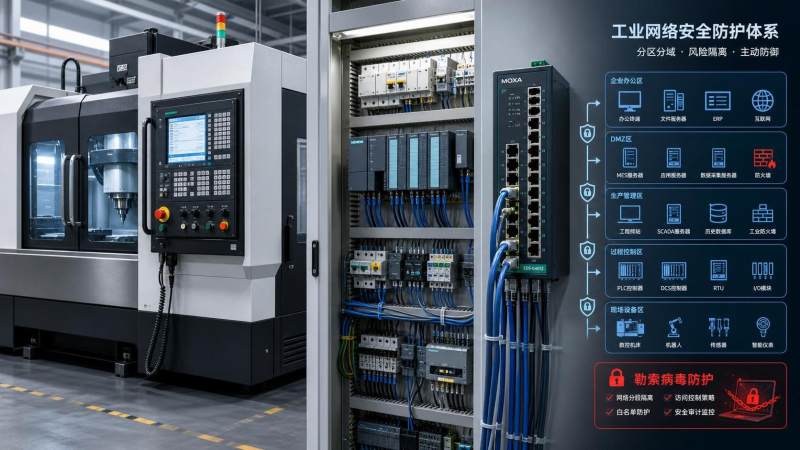
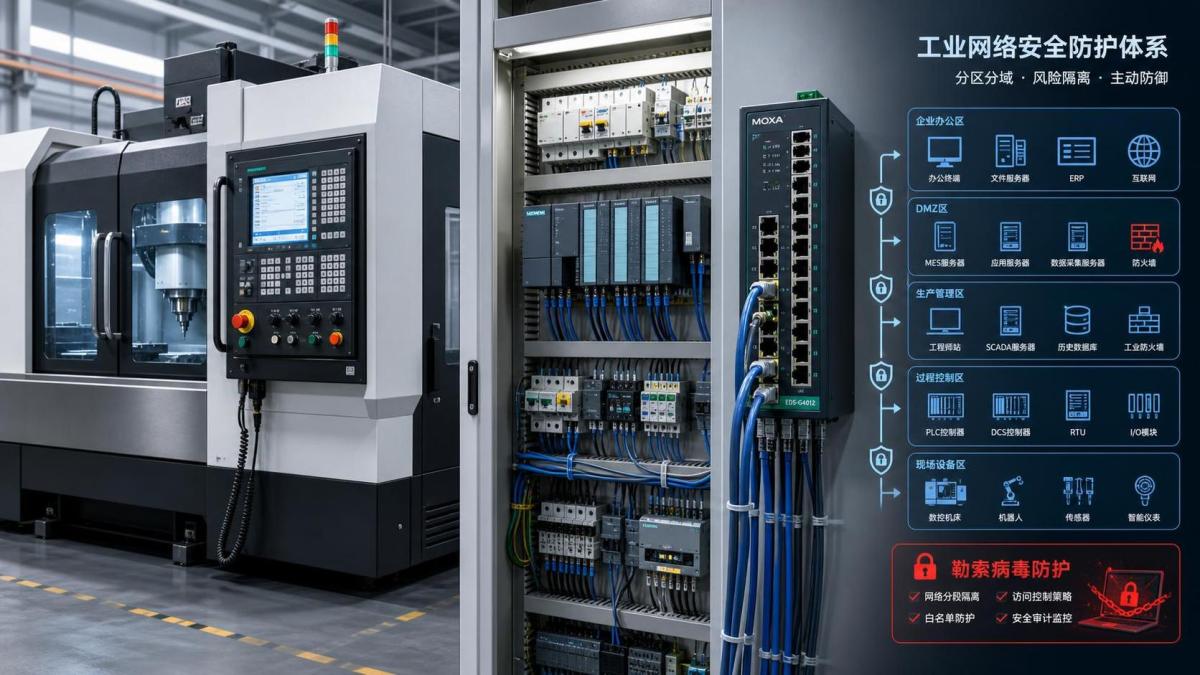
Most industrial ransomware incidents do not begin inside the control room. They often start in ordinary enterprise spaces: phishing on a business email account, stolen VPN credentials, an exposed remote desktop service, or a third-party maintenance connection that was left broader than necessary. Once inside, attackers look for the bridge between business systems and operational systems. In many plants, that bridge exists because people need it to keep production running.
This is where cybersecurity gaps become operational risk. If segmentation is weak, an attacker who compromises an office laptop may eventually reach historians, engineering stations, backup servers, or management interfaces. If asset inventories are incomplete, security teams may not even know which controllers, HMIs, or remote gateways are exposed. If authentication is inconsistent, one shared account can become a site-wide problem. Ransomware then spreads not because the attacker is unusually sophisticated, but because the environment was too easy to move through.
Why industrial control systems are different
Industrial control systems are not just another category of endpoints. They often run on long maintenance cycles, depend on vendor-specific protocols, and support equipment that cannot be paused for routine software changes. In sectors tied to machining, fluid control, sealing systems, die-casting, and specialty chemicals, even short interruptions can have knock-on effects on quality, material waste, or safe process conditions. That is especially relevant for organizations where uptime, tolerances, and traceability matter more than a simple restart.
G-PME’s work across advanced CNC machining, industrial fastening and sealing systems, pump and fluid control equipment, precision die-casting and mold engineering, and lubricants or functional chemicals makes this point very concrete: industrial reliability is never only about hardware. It also depends on the information and control layer around that hardware. A high-precision machine can still become a production liability if its control environment is left vulnerable to ransomware-driven disruption.
The attack path is often broader than people expect
Once ransomware actors reach an industrial environment, they rarely try to “hack the machine” in the cinematic sense. They target the systems that make recovery difficult: domain services, backup repositories, engineering file shares, remote support tools, and accounts with broad privileges. If they can encrypt configuration files, disable backups, or alter visibility into process status, the plant may be forced into manual operation or shutdown even if the controller logic itself is untouched.
This is why many organizations underestimate the blast radius. A gap in cybersecurity does not need to affect the PLC directly to become a plant-level issue. It may be enough to lock the engineering workstation used for recipes, interfere with alarm management, or block access to maintenance documentation that operators rely on during exceptions. In mixed IT/OT environments, that can quickly become a safety and quality problem, not just a data issue.
The weaknesses decision-makers should look for
A practical review usually starts with a few questions that sound simple but expose the real risk. Are remote-access pathways tightly controlled, logged, and time-bound? Are OT and IT networks segmented in a way that limits lateral movement? Are backup systems isolated enough to survive a compromise? Are vendor and contractor accounts reviewed with the same discipline as internal accounts? Are engineering workstations protected like production-critical assets rather than general office computers?
These checks matter because ransomware operators look for convenience. The less friction they face, the more likely they are to move from one weak point to another. In industrial settings, convenience often comes from legacy exceptions: a shared password kept for shift changes, an always-on remote tool for maintenance, or a flat VLAN created years ago to solve a short-term commissioning problem. Each one is understandable on its own. Together, they can create a clear attack route.
What resilience really looks like in practice
A serious ransomware defense for industrial control systems is less about a single product and more about disciplined boundaries. That usually means segmenting networks so that one compromise does not automatically reach the rest of the plant, limiting remote access to approved paths, and using multifactor authentication where feasible. It also means understanding which systems can be patched quickly and which require careful testing because downtime is expensive or process stability is sensitive.
For enterprise leaders, the harder part is often governance. Security teams and operations teams may use different language, but they are managing the same risk. Procurement, engineering, maintenance, and plant management need a shared view of which assets are most critical, which vendors have access, and what recovery would actually require. A ransomware response plan that only exists on paper is not enough if operators do not know which systems must come back first or how long a safe manual workaround can really last.
A useful way to judge maturity
No table can replace site-specific assessment, but this kind of comparison helps decision-makers see where ransomware risk is more about structure than tooling. If the same weak pattern appears in remote access, backup design, and asset visibility, the environment is already telling you where attackers will try first.
The procurement and engineering angle
For procurement directors, R&D leaders, and EPC contractors, cybersecurity should be treated as part of technical due diligence, not a late-stage add-on. That means asking how a system supports authentication, logging, update management, remote service control, and recovery planning before it enters a production line or long-term service contract. In industries where mechanical precision and uptime define value, a cyber weakness can undermine both.
G-PME’s broader approach to benchmarking equipment against ISO, DIN, ASME, and JIS-aligned expectations reflects a similar logic: industrial decisions should be evaluated against performance, reliability, and operating context, not just brochures. The same discipline applies to cybersecurity. If a control architecture cannot be explained clearly, segmented properly, and recovered under pressure, it is not mature enough for a plant that cannot afford extended downtime.
A realistic next step
The most useful next step is not a blanket “more security” instruction. It is a focused review of the paths that connect office systems, remote vendors, and production networks. Start with the assets that would hurt most if encrypted: engineering workstations, backup repositories, identity systems, and the interfaces used to monitor and recover operations. Then compare that map with who can actually reach them today.
If the answer is unclear, the plant already has a cybersecurity gap. And in ransomware scenarios, unclear usually means exposed.
Recommended News
 How to size pump systems for cooling circuits for stable flow ratesPump systems for cooling circuits: learn how to match flow, total dynamic head, NPSH, and controls for reliable, energy-efficient cooling performance.
 When does software as a service reduce CNC data management costs?Software as a service can lower CNC data management costs by reducing IT overhead, manual reporting, and disconnected records. Discover when SaaS delivers measurable savings.
 CNC investment trends 2026: are automation upgrades taking priority?CNC investment trends 2026 reveal why automation upgrades are reshaping capacity plans. Compare robots, pallet systems, and new machines for smarter CNC growth.
 How to size high pressure pumps for stable chemical injection ratesHigh pressure pumps sizing guide for stable chemical injection rates—learn how to balance flow range, pressure, suction conditions, materials, and controls for reliable dosing.
 When organic chemicals are suitable feedstocks for synthetic lubricantsOrganic chemicals can unlock high-performance synthetic lubricants. Learn how purity, stability, compatibility, and supply control shape reliable industrial formulations.
 What machine tool market size reveals about capital spending cyclesMachine tool market size reveals capital spending cycles through order mix, automation, replacement demand, and capacity signals. Discover what drives smarter investment decisions.
 What causes solar inverters to trip repeatedly after installationSolar inverters tripping repeatedly? Discover key causes, from grid voltage and DC faults to wiring, settings, heat, and practical troubleshooting steps.
 How a tool life calculation chart improves cutting parameter decisionsTool life calculation chart insights help optimize cutting speed, feed, and depth for predictable tool changes, better part quality, and lower machining costs.
 What to check before choosing an industrial lubricating oils factoryIndustrial lubricating oils factory selection guide: compare quality control, formulation fit, traceability, technical support, and total cost to reduce downtime risks.
 Where machine shop digital transformation delivers the fastest paybackMachine shop digital transformation delivers faster payback by reducing downtime, setup delays, quality risks, and capacity constraints with focused, measurable workflows.
 When a semiconductor manufacturing solutions provider can shorten process ramp-upA semiconductor manufacturing solutions provider can shorten ramp-up through validated hardware, change control, field support, and resilient supply chains.
 How to evaluate CNC tooling suppliers in Europe for repeatable precisionCNC tooling Europe: learn how to evaluate suppliers for repeatable precision, stable tool life, application support, traceability, and resilient delivery.
 When does manufacturing competitiveness consulting pay off for a plant?Manufacturing competitiveness consulting pays off when plants face costly constraints, capital decisions, quality risks, or supply disruptions. Learn how to build a measurable ROI case.
 How to order acoustic ceiling tiles in bulk without overbuyingAcoustic ceiling tiles bulk buying made simple: calculate accurate quantities, control waste, secure spare stock, and plan phased deliveries to avoid costly overordering.
 Which laboratory microscopes fit routine quality inspection work?Laboratory microscopes for routine quality inspection: compare stereo, digital, compound, and measuring options to improve defect detection, documentation, and throughput.
 Can AI for multi axis machining reduce errors in complex toolpaths?AI for multi axis machining helps reduce complex toolpath errors through smarter collision detection, kinematic analysis, post validation, and machine-data insights. Learn how to improve precision.
 How seamless steel pipes are checked for wall-thickness consistencySeamlesssteelpipes wall-thickness checks explained: learn how ultrasonic scanning, calibration, and tolerance control ensure reliable, pressure-ready pipe quality.
 When a horizontal boring machine for metalworking improves large-part setupHorizontal boring machine for metalworking: learn how stable datums, rotary indexing, and rigid fixturing improve large-part accuracy and setup efficiency.
 What the MTTF standard for CNC means for machine reliabilityMTTF standard for CNC explained: learn how failure definitions, duty cycles, MTTR, and real-world data shape machine reliability and uptime.
 When does company formation offshore reduce cross-border tax risk?Companyformationoffshore can reduce cross-border tax risk when substance, governance, transfer pricing, and supply-chain roles align. Learn the key tests.
 How to read a measuring tape accurately for repeatable cutsMeasuringtape guide for accurate, repeatable cuts: master markings, hook movement, reference edges, kerf control, and stop-block setup.













Search News
Popular Tags